
Heritage Insurance Strengthens Underwriting and Capital Position with Reinsurance in Q2 2026
Heritage Insurance Holdings reports solid Q2 underwriting and maintains robust liquidity, underpinning its catastrophe risk mitigation strategy.
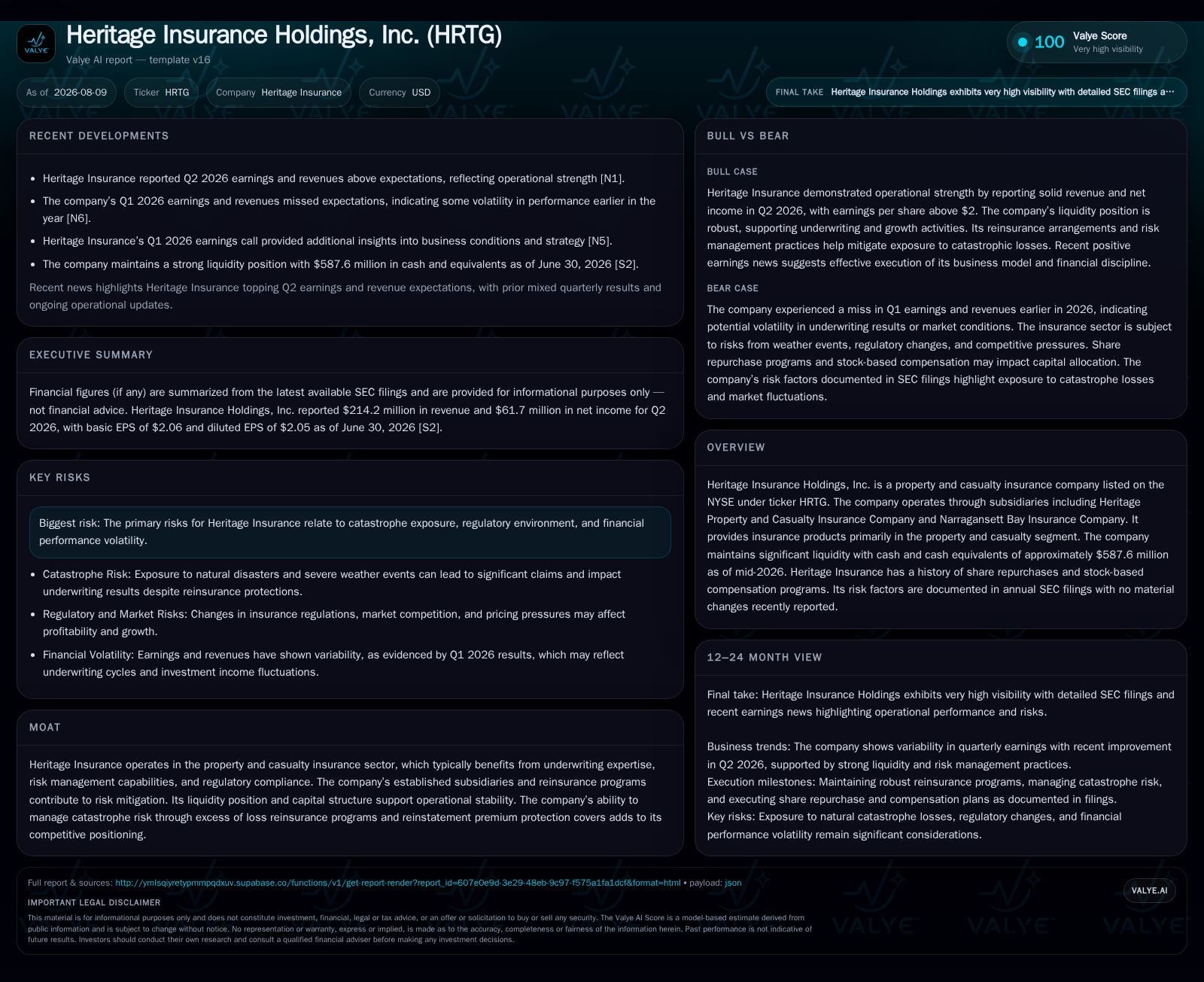
In its latest quarterly filing ending June 30, 2026, Heritage Insurance Holdings demonstrated stable underwriting results complemented by a strong liquidity position. The company’s execution of its 2026-2027 catastrophe excess-of-loss reinsurance program reinforced its risk mitigation capabilities, essential in managing exposure in the property and casualty insurance market. While no material risk factor changes were reported since its 2025 annual filing, Heritage continues to navigate typical industry challenges such as catastrophe volatility and regulatory oversight with disciplined underwriting and capital management.
Recent Operating Update: Q2 2026 Highlights
Heritage Insurance Holdings’ most recent quarterly filing as of August 7, 2026 ([S2]) reflects a continuing focus on underwriting stability and risk management in the property and casualty insurance domain. On August 5, 2026, the company confirmed via an 8-K filing ([S3]) the full placement of its indemnity-based catastrophe excess-of-loss reinsurance program for the 2026-2027 policy year. This program covers key subsidiaries including Heritage Property Casualty Insurance Company, Narragansett Bay Insurance Company, and Zephyr Insurance Company ([S24]). The timely renewal of this reinsurance is a fundamental pillar in protecting the firm from volatility due to natural catastrophes — a material risk for P&C insurers.
This development confirms Heritage’s proactive approach to risk mitigation that helps cap losses from large catastrophic events while supporting capital efficiency. The effectiveness of such programs is critical given the sector’s sensitivity to catastrophe-related losses which can disproportionately affect underwriting profitability if unmanaged.
Business Model: Underwriting and Risk Management Focus
Heritage Insurance operates primarily through its subsidiaries that write property and casualty insurance policies targeted at residential and commercial customers. Revenue arises chiefly from net premiums written — upfront payments from policyholders — which are earned over the life of the policies. The company’s profitability hinges on maintaining favorable combined ratios (claims plus expense costs relative to premiums), underwriting discipline, prudent pricing momentum on renewals, and effective claims management.
A key element of Heritage’s model involves balancing direct underwriting with transferring risks via reinsurance treaties to reinsurers that absorb losses beyond preset attachment points. This reinsures both frequency and severity risks associated with catastrophic events such as hurricanes or floods that are prevalent in their operating geographies ([S1]). Moreover, through investment of the premium float—the pool of premiums collected but not yet paid out in claims—Heritage earns supplemental income contributing to total returns.
Operationally, maintaining strong policy retention rates across renewals enhances revenue stability while new policy issuance drives premium growth. Heritage leverages data analytics for underwriting selection but discloses no explicit recent changes in product strategy or geographic expansion ([S1],[S2]). Its scale is modest compared to larger P&C peers but sufficient to maintain underwriting leverage underpinned by a conservative capital base.
Industry Structure and Competitive Position
The property and casualty insurance industry is fragmented yet highly regulated, with competition centered on underwriting expertise, pricing agility, risk selection, regulatory compliance, and claims handling effectiveness. Firms like Travelers, Chubb, and Progressive set benchmarks for expense efficiency, reserve adequacy, and catastrophe reinsurance sophistication.
Heritage distinguishes itself by focusing on tailored regional markets leveraging subsidiaries adept at managing volatile catastrophe exposure through layered reinsurance protection including reinstatement premium covers registered in filings ([S1]). This approach mitigates adverse loss spikes which can erode earnings if unhedged.
While Heritage does not disclose exact market share or comparative combined ratios against top-tier peers ([N1],[S1]), it shows robust liquidity positioning conducive to absorbing loss shocks. Its reliance on excess-of-loss indemnity reinsurance programs aligns with industry best practice for mitigating tail risks appointing a competitive moat rooted in prudent risk transfer.
Growth Drivers
Key growth levers for Heritage lie in premium rate adequacy driven by ongoing underwriting discipline amid rising asset replacement values following inflationary pressures. Market conditions favor disciplined price increases especially in catastrophe-exposed territories where insured values rise biomechanically over time.[S1]
Additionally, technological improvements in underwriting analytics offer potential upside by optimizing pricing accuracy and claims adjudication speed—though specific investments are not detailed recently.
Cross-selling opportunities within subsidiary brands and expanding footprint into complementary specialty lines or adjacent geographies could serve as incremental growth vectors if pursued strategically.
The company’s substantial cash reserves enable flexible capacity deployment for selective growth without immediate capital raising concerns ([F1]).
Risks and Watchpoints
Heritage faces typical P&C insurer risks including:
- Catastrophe Loss Volatility: Despite reinsurance protections, extreme events or multiple correlated catastrophes could stress earnings beyond modeled scenarios ([S1],[S24]).
- Regulatory Environment: Compliance with evolving Florida-centric insurance regulations remains critical; adverse regulatory changes could impact pricing freedom or capital requirements ([S2],[S1]).
- Reserve Adequacy: Incorrect loss reserve estimates pose financial risk; reserve development trends will be an important indicator going forward ([S1]).
- Pricing Competition: Market pressure may constrain renewal price increases limiting margin improvement potential particularly if competitors engage aggressively ([S1]).
- Investment Income Variability: Changes in interest rates or credit quality affect investment yields on float impacting total profitability ([S1]).
- Credit Risk: Dependence on reinsurers’ creditworthiness underpins financial stability; deterioration could expose Heritage to unexpected losses ([S1]).
- Operational Efficiencies: Claims processing delays or inaccuracies might elevate loss ratios or customer attrition risks.
Monitoring these factors through quarterly combined ratios, reserve developments, catastrophe frequency reports, and investment return data will be critical to assessing ongoing business health.
What to Watch Next
Investors and analysts should observe:
- Quarterly updates on combined ratio trends to measure ongoing underwriting profitability relative to premiums earned.
- Announcements regarding any enhancements or changes in the reinsurance program structure ahead of future renewal cycles.
- Reserve development disclosures for signs of adverse claims experience emerging from prior accident years.
- Detailed commentary on premium growth strategies including rate increases or product mix shifts disclosed during quarterly earnings calls or SEC filings.
- Investment yield performance amid dynamic interest rate environments influencing float returns.
- Updates on claims management metrics such as settlement times which impact customer satisfaction and retention rates.
Any material deviations here will signal shifts in the underlying business model resilience or emerging sector headwinds that require reassessment.
Financial Profile Discussion
As of June 30, 2026, Heritage Insurance maintains a strong liquidity position with cash and cash equivalents totaling approximately $587.6 million contrasted against total debt of roughly $73.1 million, yielding a markedly negative net debt balance near -$514.5 million [F1]
The company’s most recently reported operating income was $89.7 million with net income standing at $66.7 million as per year-end December 31, 2025 data [F1]. Though full details from Q2 2026 operating profit are embedded within quarterly filings [S2], the continued profitability alongside reinvested capital signals stable earnings generation capability commensurate with its size.
Disclaimer: This analysis is based solely on publicly available filings as of August 2026 without provision of investment advice or forward-looking guidance. It aims to provide an informed industry perspective rather than definitive forecasts or research views.
Disclaimer: This is research-only, informational analysis and not investment advice. It may include AI-generated interpretation and general industry context. Always verify important details using primary sources.

Comments