
Shutterstock Faces Liquidity and Regulatory Headwinds in Content Licensing Market
Recent quarterly disclosures reveal Shutterstock’s financial strain amid a stalled Getty Images merger and mounting competitive pressures reshaping digital content licensing.
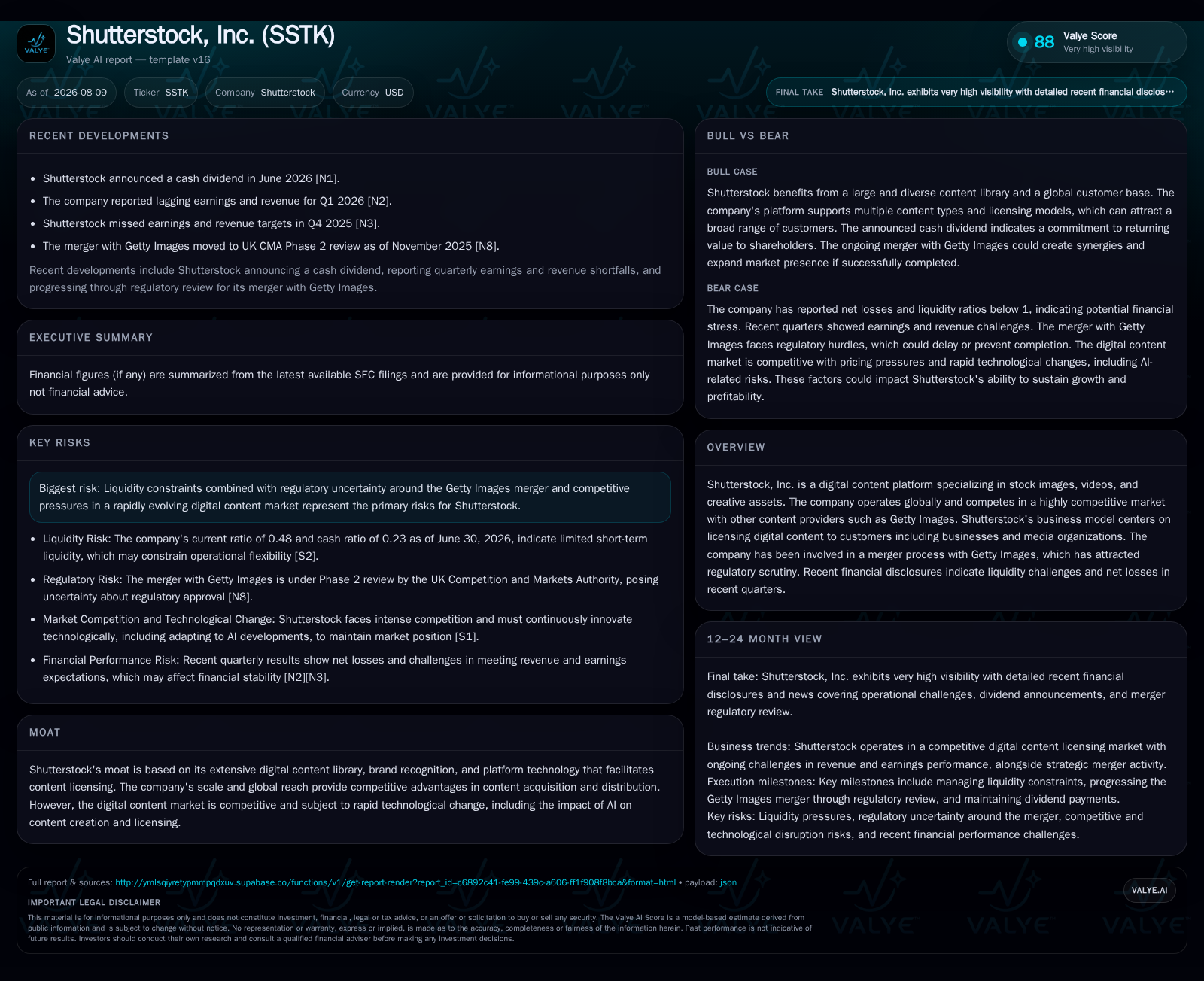
Shutterstock’s Q2 2026 filing highlights intensifying liquidity challenges with a weak current ratio and substantial net debt, alongside ongoing regulatory hurdles delaying its strategic merger with Getty Images. The company’s dual revenue model—balancing subscription and transactional licensing—remains susceptible to pricing pressure amid rising AI-generated content competition. Contributor royalty obligations further compress margins, while the evolving digital content landscape demands innovation in platform technology and customer engagement to sustain growth. Key risk factors include regulatory uncertainty, heavy leverage, and competitive dynamics intensified by rapid AI adoption.
Q2 Highlight: Elevated Liquidity Strains Undermine Growth Flexibility
Shutterstock’s latest quarterly filing covering the period ended June 30, 2026 shows a current ratio of approximately 0.48 at quarter-end, reflecting current liabilities exceeding current assets by a wide margin [F1]. This imbalance is compounded by a net debt position estimated near $140 million after accounting for cash reserves totaling $133 million [F1]. Despite generating cash from operations historically, recent quarters have shown net losses including a substantial $174 million goodwill impairment charge in H1 2026 that weighs on equity [S2]. Such financial stress is critical as it restricts capital allocation options for investing in platform technology improvements or marketing initiatives pivotal for market share defense.
Deferred revenue accounting confirms significant prepayments by customers for content licenses—a positive signal for recurring revenue visibility—but this does not offset the high leverage burden under the amended and restated credit agreement signed in mid-2024 with Bank of America as administrative agent. The credit facilities include a $250 million revolving credit line drawn to $155 million currently and a term loan balance around $118 million maturing in 2029 [S2][F1]. Interest costs remain manageable but persistent operating losses raise questions about free-cash-flow sustainability absent operational turnaround.
Licensing Dynamics: Subscription vs. Pay-Per-Download Revenue Implications
Shutterstock monetizes its extensive digital content library primarily through two licensing mechanisms: subscription plans offering customers ongoing access to downloads at fixed monthly or annual fees, and pay-per-download options catering to ad hoc usage [S1][S2]. This hybrid model allows coverage of diverse customer segments ranging from individual creatives needing sporadic assets to enterprise clients requiring volume licenses for campaigns.
Subscription revenue contributes to more predictable ARR-like streams benefiting margin stability if renewal rates remain robust. However, transactional pay-per-download sales introduce variability tied closely to marketing spend cycles and seasonality of digital content demand. Average revenue per user (ARPU) thus fluctuates with customer mix shifts. Maintaining high subscription renewal rates is crucial for sustained pricing power—an area vulnerable given intensifying competition from peers with larger integrated platforms like Adobe Stock.
The business model also involves upfront recognition of deferred revenue from prepaid subscriptions or license credits redeemable over time, providing visibility on upcoming recognized sales but posing risks if churn accelerates [S2]. Ongoing platform enhancements targeting search efficiency and user experience aim at boosting renewal rates and lifetimes.
Content Contributors and Royalty Pressures Shaping Platform Quality
A critical factor underpinning Shutterstock’s moat is its network of content contributors who supply images, videos, illustrations, and increasingly AI-generated assets [S1][S2]. Contributors are compensated through royalty payments calibrated against download volume; hence, payout ratios become a significant cost component influencing gross margins
Balancing attractive compensation to draw top contributors while controlling royalty expenses is an ongoing tension. High royalty payout ratios can constrain profitability but are essential to preserving content quality and diversity—a key differentiator in an industry where brand recognition partly stems from expansive libraries.
Changes in contributor incentives or shifts towards direct-to-customer models leveraging AI-generated content could disrupt this dynamic. Shutterstock’s ability to innovate royalty frameworks or integrate AI tools into contributor workflows will be pivotal to retain supply-side strength without margin erosion.
Competitive Terrain: Getty Merger Impact Amid AI Innovation Surge
Shutterstock has sought strategic consolidation through its proposed merger with Getty Images—a direct competitor with complementary scale advantages in stock photo distribution [N2][S1]. However, the deal faces ongoing regulatory scrutiny delaying closure and introducing uncertainty regarding realization of projected synergies.
This delay limits near-term potential for national or global market share expansion via combined libraries or cost rationalization. It also complicates capital planning given integration risks remain externalized.
Concurrently, the digital content ecosystem is undergoing rapid transformation driven by AI technologies enabling scalable automated generation of creative assets at low incremental cost—a disruptive force challenging traditional licensing paradigms including Shutterstock’s own platform technology capabilities [N1]. Competitors like Getty have struck deals integrating AI offerings into their portfolios enhancing their competitive positioning.
Shutterstock must accelerate innovation in platform search algorithms, digital rights management encompassing AI-created works, and licensing convenience to counter commoditization risks impacting pricing power.
Growth Catalysts: AI Tools, Enterprise Demand, and Geographic Expansion Potential
Defensive headwinds notwithstanding, Shutterstock operates within secular growth trends fueled by expanding online advertising budgets, proliferation of social media content creation demands, and enterprise adoption of digital asset management (DAM) solutions necessitating scalable creative asset access [S1].
Integration of AI-assisted content creation tools offers new product avenues potentially improving curation efficiency and lowering customer acquisition costs if successfully embedded within the core offering.
Geographic expansion into emerging markets where digital marketing penetration remains nascent also provides runway for adding active customers. Success hinges on boosting KPIs such as average download volume per user and subscription renewal rate—direct levers of ARPU improvements underpinning sustainable recurring revenue growth.
Risks Ahead: Regulatory Hurdles, Debt Burden, and Market Saturation
Three dominant risk vectors threaten Shutterstock’s operating scenario going forward: first is protracted regulatory hurdles surrounding the Getty merger that could scuttle or delay the transaction indefinitely reducing scale benefits; second is elevated indebtedness restricting capital flexibility needed to invest against intensifying competition; third is increasing competition from well-resourced players including Adobe Stock who enjoy integration within broader creative software ecosystems plus emerging pure-play AI-generated content providers lowering barriers for alternative asset sourcing [N1][N2].
The industry faces saturation dynamics especially in mature markets driving price compression which puts upward pressure on marketing spend efficiency requirements. Rapid technological change amplifies intellectual property enforcement complexity increasing litigation risk exposure associated with copyright infringement claims detailed in past filings.
Additional external risks include macroeconomic factors curtailing media budgets which represent end-customer demand drivers.
Catalysts to Monitor: Merger Developments, Customer Metrics, and Revenue Trends
Key indicators for gauging Shutterstock’s near-to-medium term trajectory encompass updates on merger regulatory approval progress signaling consolidation likelihood; changes in number of active customers particularly enterprise penetration metrics; shifts in ARPU reflecting pricing power sustainability; subscription renewal rate fluctuations indicating retention strength; deferred revenue trends revealing evolving predictability of top-line streams; and growth or shrinkage in license/download volume highlighting market demand elasticity under competitive assault [S2][S3]
Tracking operational spending effectiveness in marketing versus incremental customer acquisition cost also offers insight into go-forward unit economics critical given constrained balance sheet capacity.
Financial Profile Discussion: Balance Sheet Stress Points Amid Strategic Investment
At quarter-end June 30, 2026 Shutterstock reported $133 million of unrestricted cash alongside total debt approximating $273 million predominately composed of a $250 million revolver drawdown classified as current liability plus an amortizing term loan maturing in 2029 [S2][F1]. The company maintains compliance with its financial covenants related to consolidated leverage ratios ensuring no immediate risk of technical default but operates with limited cushion given continuing operating losses exacerbated by substantial goodwill impairments recognized earlier this year weakening shareholders’ equity base.
Operating cash flows remain pressured with net loss surpassing $200 million over H1 2026 after non-cash adjustments reflecting impairment charges [S2]. Sustained negative free cash flow would necessitate either deleveraging via asset sales or equity issuance absent meaningful margin improvements or successful merger capture.
Overall, Shutterstock’s financial profile reflects typical mid-cycle capital structure challenges for fast-evolving digital platforms facing headwinds around competitive disruption and regulatory uncertainty requiring focused execution discipline on both growth initiatives and cost control measures.
This analysis incorporates data publicly filed by Shutterstock through August 7, 2026 alongside recent industry developments as context. It aims to provide an evidence-based assessment without commentary on investment decisions.
Disclaimer: This is research-only, informational analysis and not investment advice. It may include AI-generated interpretation and general industry context. Always verify important details using primary sources.

Comments