
American Financial Group Strengthens Specialty P&C Underwriting and Investment Income in Q2 2026
AFG reports solid second-quarter earnings driven by underwriting discipline in specialty lines and effective risk management amid catastrophe exposures.
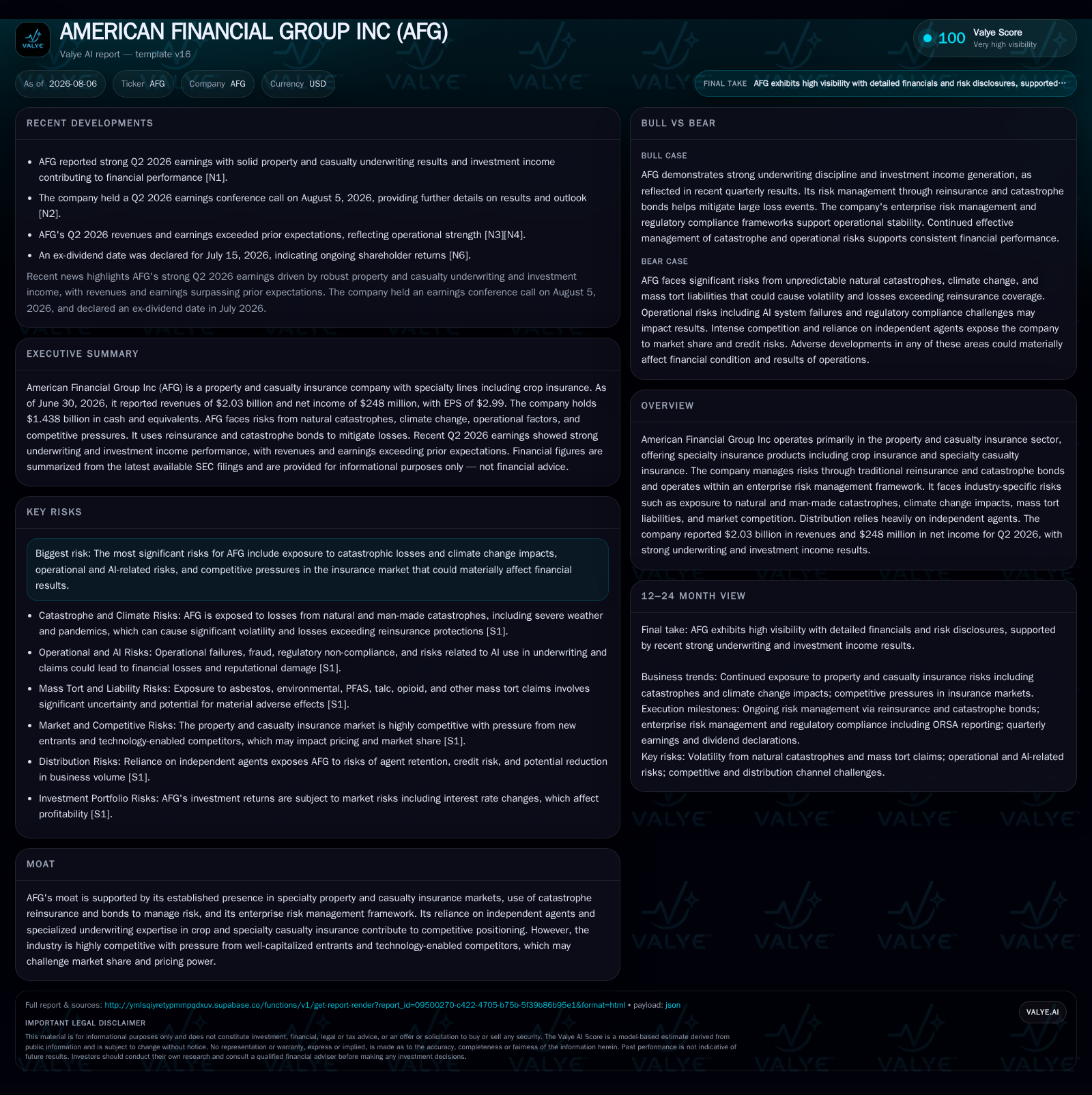
American Financial Group (AFG) delivered robust Q2 2026 results, posting $2.03 billion in revenues and $248 million in net income [S3]. Underwriting profit benefited from disciplined risk selection in its specialty property and casualty insurance segments, including crop and specialty casualty insurance, while investment income contributed steadily despite market volatility [N2]. Enterprise risk management strategies, including the use of traditional reinsurance and catastrophe bonds, remain central to managing exposure to natural and man-made catastrophes. However, exposure to increasingly frequent severe weather events and mass tort liabilities underscore ongoing challenges for underwriting consistency [S1]. Distribution continues to rely primarily on independent agents, reinforcing AFG’s niche positioning relative to broader P&C insurers [S1].
Recent Operating Update
American Financial Group (AFG) reported a strong operating performance for the second quarter ended June 30, 2026, with revenues reaching approximately $2.03 billion and net income of $248 million [S3][N2]. This performance highlights the company’s successful underwriting discipline in its specialty property and casualty (P&C) insurance businesses, which include specialized crop insurance products alongside unique casualty coverages targeting niche markets. Notably, management disclosed that return on equity (ROE) and underwriting profit are key metrics used by its Co-CEOs who serve as Chief Operating Decision Makers (CODMs) for resource allocation decisions within the P&C segment [S2]. The reported underwriting profits indicate effective risk selection and pricing strategies amid an environment challenged by increased catastrophe frequency.
Investment income remained a stable contributor during Q2 despite market volatility, supported partly by AFG's equity interests in limited partnerships which are aggregated into net investment income per the latest filing [S2]. Such revenue streams complement the core underwriting operations that generate premiums and bear claims costs. This diversified income model is important given the potential variability in claims severity related to catastrophic events.
Business Model Overview
Operating primarily within the specialty P&C insurance industry, AFG focuses on niche markets such as crop insurance—a sector highly sensitive to weather variability—and specialty casualty insurance addressing unique liability risks not typically covered by mainstream insurers [S1]. Revenues are generated principally through premiums earned via policy underwriting. Unlike broad-based P&C insurers that cater to mass-market commercial or personal lines, AFG's product mix emphasizes tailored coverage with specialized underwriting expertise. Premiums earned fluctuate based on volume of policies underwritten, price adjustments prompted by risk modeling updates, and renewal rates largely influenced by agent-broker relationships.
Claims management forms a critical part of cost control; AFG maintains claims reserves adequate to cover expected losses but may face volatility from unpredictable catastrophe events. To mitigate severe losses, the company employs traditional reinsurance contracts ceding part of its exposure to external reinsurers. Additionally, AFG has leveraged alternative risk transfer mechanisms such as fully collateralized catastrophe bonds—financial instruments transferring catastrophe risks to capital markets—to augment protection layers against large-loss scenarios [S1]
Distribution relies predominantly on independent agents who market policies directly to insured parties. This channel fosters strong customer relationships which support policy retention—a key driver of stable earned premium growth—and better facilitates pricing adjustments responding to evolving risk environments. The company's enterprise risk management framework integrates underwriting insights with capital deployment decisions ensuring balanced risk/reward outcomes across business segments.
Industry Structure and Competitive Position
The property and casualty insurance sector is inherently exposed to volatility stemming from both natural catastrophes—such as hurricanes, floods, wildfires—and man-made events including terrorism or civil unrest. Increasingly severe weather patterns attributed to climate change have augmented unpredictability complicating traditional actuarial models used for pricing catastrophes. This elevates both frequency and severity risk profiles industry-wide; companies are compelled to enhance their modeling sophistication while expanding capital buffers or ceded reinsurance limits.
Within this challenging landscape, AFG occupies a specialist role relative to broad-based insurers like Travelers or Chubb who operate large-scale commercial portfolios across numerous geographies. AFG’s focus on crop insurance—sensitive to weather-induced yield fluctuations—and tailored specialty casualty products enables it to develop refined pricing models supported by deeper domain expertise than more diversified competitors. However, this specialization also concentrates risk exposures requiring vigilant enterprise risk management.
Competition extends beyond traditional P&C carriers to include reinsurance firms like Arch Capital—which offer structured capacity solutions—and alternative capital providers issuing catastrophe bonds akin to those deployed by AFG. Independent agent networks remain vital distribution conduits across peers although some competitors are progressively experimenting with direct-to-consumer digital platforms reflecting changing customer preferences.
Growth Drivers
AFG’s growth strategy leverages several structural trends favorable for specialty insurers. First is growing recognition among businesses and agricultural producers of climate-related risks driving increased demand for specialized crop protection offerings supported by parametric triggers or enhanced indemnity structures. Expanding agricultural commodity markets globally further enlarges addressable volumes.
Second is growth in specialty casualty lines where emerging liabilities—from cyber exposures to environmental torts—require bespoke coverage solutions often underserved by standard commercial products. AFG’s underwriting skillset positions it well here.
Thirdly, innovation in alternative risk transfer mechanisms such as catastrophe bonds enables more efficient capital deployment mitigating peak loss exposures while optimizing balance sheet utilization.
Finally, strengthening relationships within independent agent channels supports steady policy retention rates while selective geographic expansion—currently about 4% international revenue—offers incremental diversification without diluting core competencies [S2]
Risks and Constraints
Material risks persist around exposure to catastrophic losses which could exceed reinsurance protections especially if climatic events intensify unpredictably or occur concurrently across multiple regions [S1]. Increased frequency of convective storms or wildfire seasons raises claims frequency elevating combined ratio volatility beyond historical norms.
Crop insurance profitability remains susceptible to volatile commodity prices influenced by global supply-demand shifts as well as biotic risks like pests affecting yields—a factor introducing year-over-year earnings variability.
Mass tort liabilities embedded within certain casualty portfolios have potential for sudden inflationary effects on claims reserves posing reserve adequacy challenges.
Competitive pressures arise from technology-enabled entrants deploying data analytics targeting pricing precision potentially eroding incumbent market share or compressing premium rates.
Further risks include regulatory changes mandating expanded coverage scopes or imposing capital requirements increasing operational costs.
Operationally, integrating AI tools within underwriting workflows carries both opportunity and implementation hazards necessitating controlled adoption aligned with compliance standards.
What To Watch Next
Key upcoming milestones involve quarterly updates on combined ratio trends reflecting claims experience post-catastrophe seasons and initial impacts of climate-related loss modeling enhancements. Monitoring changes in gross written premium volumes alongside net earned premium retention rates will signal demand traction within targeted specialty niches.
Watch statements regarding renewal rate adjustments or expansions into new agronomic segments indicating responsiveness to evolving risk landscapes. Developments around issuance or structuring of new catastrophe bonds will highlight evolving capital management strategies mitigating peak event risks.
Management commentary during subsequent earnings calls may reveal shifts in distribution emphasis adapting toward hybrid agent-digital sales models or progress on enhancing underwriting automation leveraging AI tools.
Regulatory developments impacting crop insurance subsidy frameworks or casualty claims administration processes deserve scrutiny given their potential financial ramifications.
Financial Profile Discussion
As of June 30, 2026, American Financial Group reported cash and equivalents totaling approximately $1.44 billion alongside total debt near $1.85 billion resulting in a modest net debt position around $410 million [F1]. This balance sheet reflects prudent leverage enabling flexible capital deployment amidst volatile underwriting cycles. Solid liquidity supports operational resilience against adverse claim episodes while allowing opportunistic investment in product development or distribution enhancements.
The company’s steady net investment income contributions underline effective asset-liability matching strategies paired with selective exposure to limited partnerships generating alternative yield streams [S2]. Maintaining disciplined expense ratios alongside manageable loss ratios will be pivotal for sustaining attractive underwriting margins measured through combined ratio stability—a critical indicator tracked closely by AFG leadership for capital allocation decisions.
Careful stewardship over claims reserves adequacy mitigates reserve run-off volatility which could otherwise obscure underlying earnings power as witnessed across cyclical peers during recent years.
Overall financial metrics reinforce a foundation tailored towards balancing growth investments against maintaining robust solvency buffers necessary under frequent peak peril shocks inherent in specialty P&C insurance operations.
This analysis synthesizes American Financial Group’s latest operating results alongside industry context emphasizing its specialized focus within property and casualty insurance markets vulnerable to environmental uncertainties yet benefiting from targeted underwriting expertise supported by advanced enterprise risk frameworks.
Disclaimer: This is research-only, informational analysis and not investment advice. It may include AI-generated interpretation and general industry context. Always verify important details using primary sources.

Comments