
Exagen Inc. Advances Autoimmune Diagnostics with Strategic Product Expansion and Operational Turnaround
Exagen reports continued revenue growth and margin expansion driven by AVISE® CTD test enhancements and pipeline validation efforts.
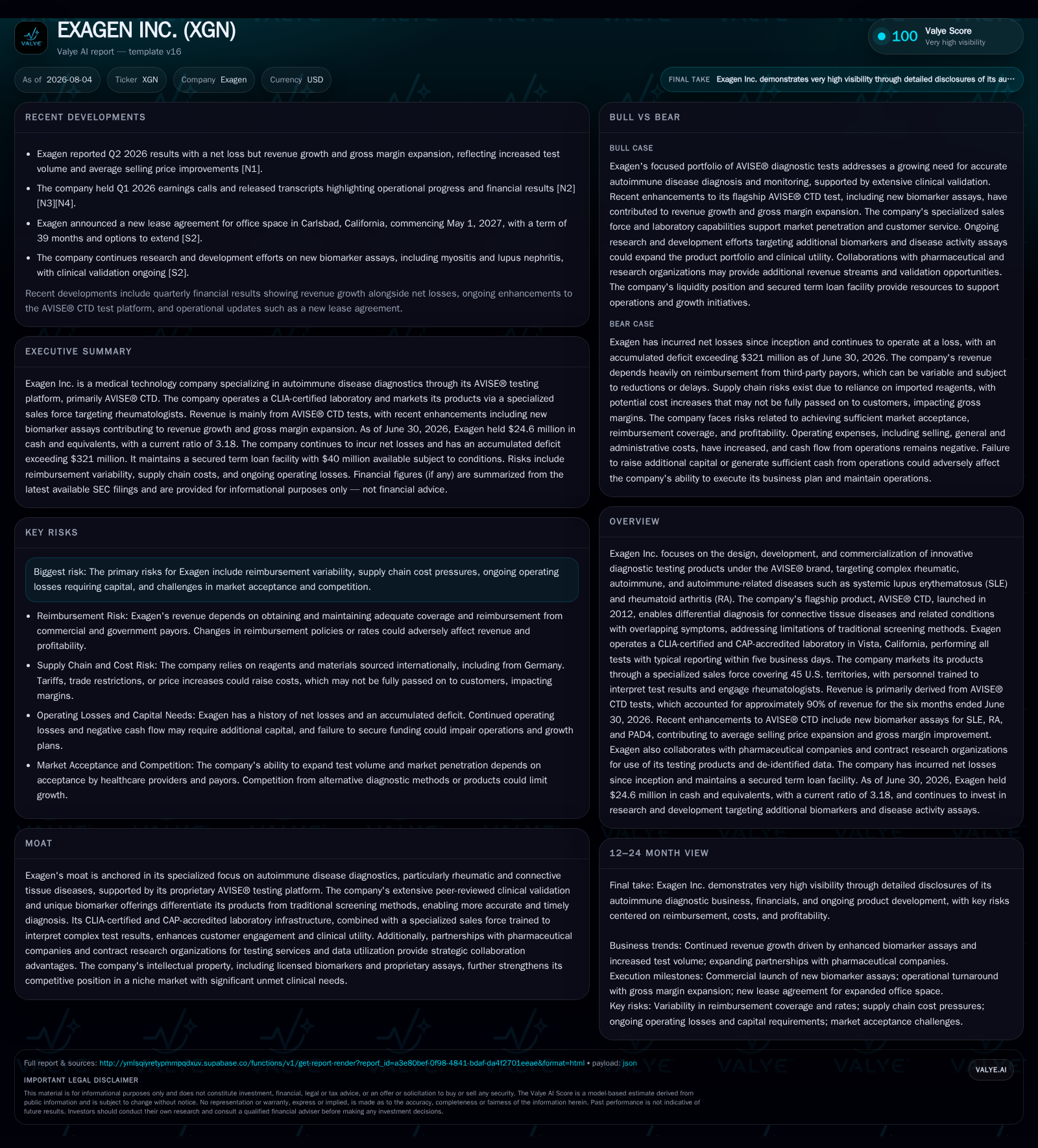
Exagen Inc.’s recent quarterly filing highlights a moderate revenue increase driven by 11% test volume growth and an improved average selling price for its core AVISE® CTD diagnostic product. The company is advancing clinical validation of new SLE and RA disease activity biomarkers, aimed at improving patient management. Exagen operates a CLIA-certified and CAP-accredited lab focused on autoimmune diseases, leveraging a specialized sales force to engage rheumatologists across 45 U.S. territories. Despite ongoing operating losses, Exagen benefits from laboratory infrastructure, proprietary biomarker panels, and strategic pharma partnerships that differentiate it in a reimbursement-challenged diagnostic market.
Recent Operating Update
In parallel, Exagen disclosed progress toward the clinical validation of a novel AI-powered SLE Disease Activity assay. By leveraging longitudinal patient data from multiple systemic lupus erythematosus cohorts, the company's research aims to provide clinicians actionable insights that guide treatment decisions throughout disease progression — a step beyond differential diagnostics toward real-time disease activity monitoring [S2]. Patient recruitment for this candidate assay remains ongoing.
Operating expenses saw an expected increase corresponding with corporate growth initiatives: selling, general and administrative (SG&A) expenses rose by $1.8 million or around 8%, attributed mainly to elevated personnel-related costs including salaries, commissions, stock-based compensation, alongside expanded outside services and facilities expenses needed to support scaling the specialized sales force and administrative infrastructure [S2]. Research and development (R&D) expenditures experienced slight moderation but remain directed at advancing pipeline assays.
Business Model: Specialized Autoimmune Diagnostics
Exagen's business model centers on the development, commercialization, and laboratory execution of proprietary diagnostic assays under the AVISE® brand for complex rheumatic and autoimmune conditions such as systemic lupus erythematosus (SLE) and rheumatoid arthritis (RA). The flagship product AVISE® CTD addresses a critical unmet need in differentiating connective tissue diseases (CTDs) that manifest overlapping clinical symptoms typically confounding traditional screening methods.
Revenue is predominantly derived from performing these high-complexity tests—carried out exclusively within Exagen’s CLIA-certified and College of American Pathologists (CAP)-accredited clinical laboratory in Vista, California. The lab infrastructure supports rigorous quality standards essential for regulatory compliance while delivering results in approximately five business days—a key performance metric important both clinically and commercially [S1], [S2].
Monetization occurs largely via billing third-party payors: commercial insurers, government programs like Medicare/Medicaid, healthcare systems directly contracting for testing services, plus patient out-of-pocket arrangements where applicable. Reimbursement rates vary widely by test complexity and payor policies; hence maintaining coverage levels is central to revenue stability.
Differentiation stems from proprietary multi-biomarker assay configurations combined with peer-reviewed clinical validation demonstrating improved diagnostic accuracy over conventional approaches—thereby encouraging physician adoption among rheumatologists heavily involved in managing autoimmune patients. The company's deployment of a highly specialized sales team trained not only in assay features but also capable of interpreting de-identified test results enhances clinician engagement—a distinct advantage against competitors employing more generic sales approaches [S1]
Complementing direct clinical testing revenues are collaborations with pharmaceutical companies and contract research organizations (CROs), which utilize Exagen’s assays or anonymized test-derived data sets for drug development or observational studies. These relationships add a revenue diversification dimension while elevating Exagen’s position as a partner of choice within medical research ecosystems [S1]
Industry Structure and Competitive Position
Operating within the Diagnostic Laboratory Services sector—specifically addressing autoimmune diagnostics—Exagen distinguishes itself as a specialty lab deeply focused on rheumatic disease areas rather than broad-spectrum testing like major clinical laboratories such as Quest Diagnostics or LabCorp. This narrow product scope allows for concentrated investment in biomarker discovery, assay refinement, and tailored provider education.
Peers include specialty entities like Myriad Genetics engaged in autoimmune genetic testing or molecular diagnostics firms such as Exact Sciences emphasizing proprietary assays for complex indications. Unlike larger labs offering scale advantages through extensive network coverage and broad testing menus potentially benefiting from operational synergies, Exagen’s moat lies in its clinically validated distinct biomarker combinations coupled with its ability to interpret nuanced immunologic results through expert sales force support.
However, challenges arise from reimbursement disparities common across specialty diagnostics where payor policies evolve slowly relative to innovation cycles; failure to secure adequate coverage or pricing can erode profitability despite technical superiority. Moreover, competition from emerging diagnostics innovating with AI-enhanced algorithms or alternate molecular targets can pressure market share if Exagen does not sustain innovation velocity or demonstrate incremental clinical benefit through robust validation studies.
Growth Drivers
Key catalysts shaping Exagen’s growth trajectory include:
- Expanding Autoimmune Disease Incidence Awareness: Rising prevalence of conditions like SLE fuels demand for more precise diagnostic tools capable of early detection or disease differentiation amid symptom overlap.
- Biomarker Portfolio Enhancement: Addition of novel immune cell subprofile biomarkers expands the test’s scope enabling higher ASPs supported by improved clinical utility.
- Clinical Validation Progress: Success in validating disease activity assays such as the AI-based SLE tool could unlock monitoring use cases beyond initial diagnosis enhancing recurring test volumes.
- Sales Force Specialization: Coverage across 45 U.S. territories staffed by personnel specifically trained in rheumatology fosters deeper provider relationships aiding adoption rates.
- Pharma/CRO Partnerships: Continued collaboration interest from biopharma leveraging Exagen’s high-quality testing platform for drug trials supports non-recurring revenue streams and data monetization.
- Regulatory Compliance Maintenance: Sustaining CLIA certification alongside CAP accreditation enables execution flexibility within licensed states critical for scaling volume.
The company’s current ratio stood at approximately 3.18, reflecting solid short-term liquidity given current assets of roughly $42.9 million versus liabilities near $13.5 million [F1], [S2]. Operating cash flow usage narrowed significantly relative to prior year periods: net cash used in operations declined to $6.4 million over six months ended June 2026 from $13.6 million a year earlier, signaling improving efficiency though still reflective of ongoing investment phase expenditures [S12].
Gross margin remained stable just above 60%, benefiting from ASP improvements partially offsetting upward cost pressures primarily material/supply increases due to expanded biomarker test complexity [S18]. SG&A expense increases paralleled investments in scaling commercial capabilities essential to drive higher penetration within rheumatology practices [S18], while R&D spend saw modest fluctuations consistent with pipeline progression status [S16]. Interest expense rose reflecting indebtedness associated with the credit facility established April 2025 designed to fund operational pivots including expansions in testing panels and sales resources [S16]. Overall net losses narrowed slightly but continue evidencing need for capital discipline until self-sustaining profitability thresholds are met.
In sum, Exagen's financial footing permits continued execution on targeted initiatives while balancing prudent cash stewardship critical amid the reimbursement-dependent specialty diagnostics landscape typical of peer-like Myriad Genetics or Exact Sciences before their scale efficiencies matured.
--- *This analysis is based solely on publicly available SEC filings dated through August 4, 2026 along with market news releases cited herein [F1]. Current assets of $42.9 million and current liabilities of $13.5 million imply a current ratio near 3.18x for 2026-06-30
Disclaimer: This is research-only, informational analysis and not investment advice. It may include AI-generated interpretation and general industry context. Always verify important details using primary sources.

Comments