
PAR Technology Updates Operating Review Amid Persistent Customer Concentration and Integration Challenges
PAR Technology's latest quarter reaffirms its integrated omnichannel strength while highlighting financial pressures and risks from key customer dependencies.
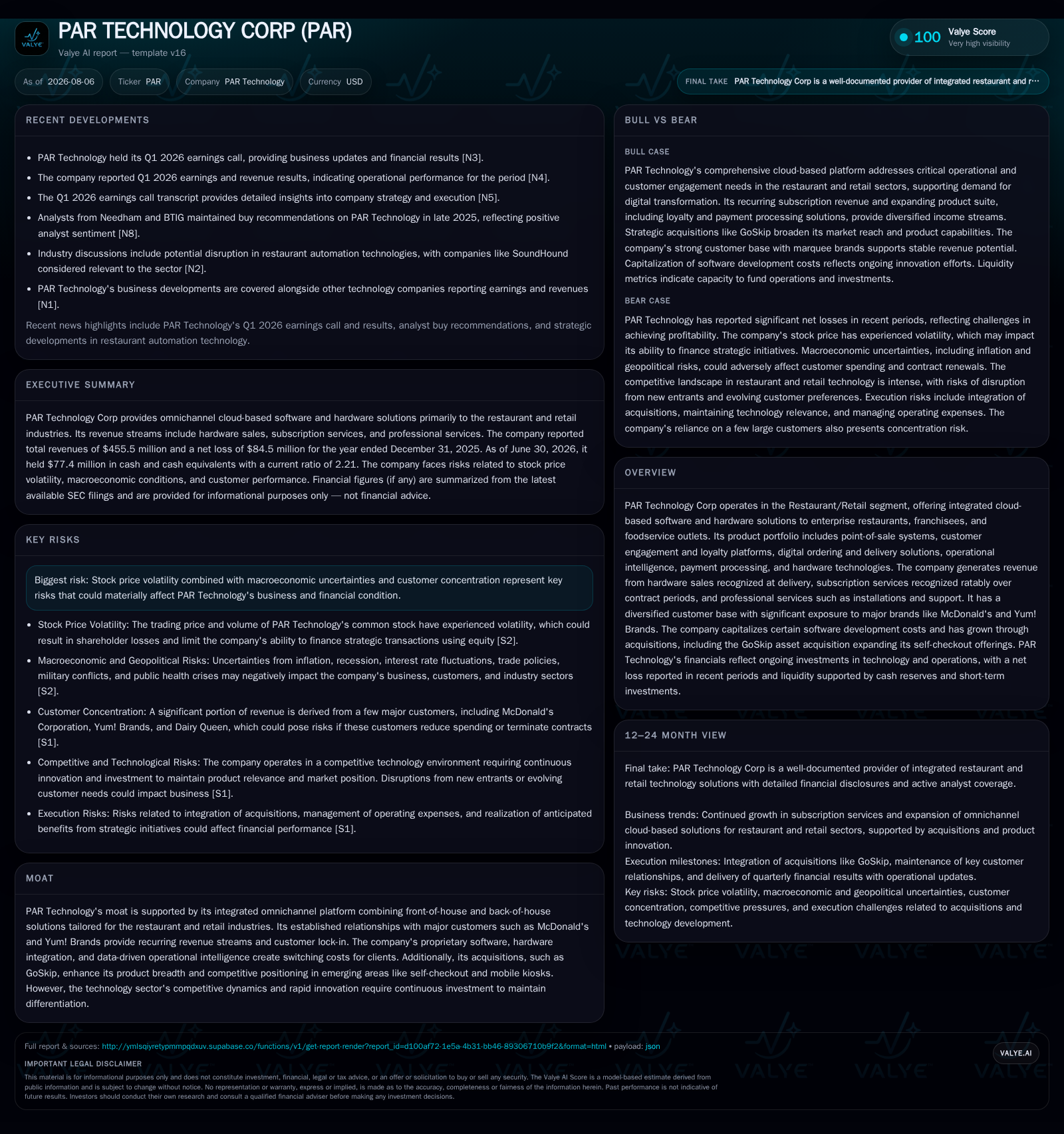
In the quarter ending June 30, 2026, PAR Technology maintained its core focus on providing integrated cloud-based software and hardware solutions tailored to enterprise restaurants and retail foodservice operators. Recurring subscription revenue continues to build from its omnichannel platform, supported by a diverse product suite including point-of-sale systems, digital ordering, and self-checkout kiosks. However, notable risks remain from significant customer concentration and operating losses, with management actively reviewing strategic options amid technology competitive pressures and macroeconomic volatility. Capitalized software development remains a critical accounting element shaping reported earnings. Monitoring ARR growth, subscription retention, and hardware sales trends will be key to assessing PAR’s medium-term trajectory.
Recent Operating Update
PAR Technology Corporation’s second-quarter 2026 filings underscore active management attention towards both operational execution and capital structure considerations. The company disclosed ongoing evaluation of strategic alternatives including acquisitions or divestitures to enhance shareholder value during an operating environment marked by intensifying competition and demand variability [S2]. This signals potential adjustments in capital allocation or portfolio refocusing initiatives responsive to evolving customer needs and technology adoption curves.
The company’s core business continues to revolve around cloud-enabled omnichannel platforms for enterprise restaurant and foodservice operators. These combine front-of-house solutions such as point-of-sale terminals and digital ordering interfaces with back-of-house operational intelligence tools. Revenue drivers are nuanced between upfront hardware shipments—recognized at delivery—and recurring subscription services that smooth top-line recognition over contract durations under ASC Topic 606 guidelines [S1]. Such revenue recognition requires critical assessment of distinct performance obligations within bundled contracts, signaling accounting complexity that can materially influence reported results quarter-to-quarter
Strategically significant is PAR’s client base composition which relies heavily on marquee customers like McDonald’s and Yum! Brands. While these relationships underpin stable recurring revenue streams through embedded loyalty platforms and payment processing integrations, they also introduce concentration risk. Loss or renegotiation away from these large customers could materially affect revenue predictability. Tracking subscription renewal rates and contract tenure within these accounts will remain essential early warning KPIs [S1]. Recent acceleration in self-service kiosk adoption following the acquisition of GoSkip broadens PAR’s product scope into high-growth segments embracing contactless ordering — a clear alignment with restaurant operators’ evolving preferences towards automation and guest convenience enhancement.
Business Model Specifics
PAR monetizes through three main revenue categories: hardware sales (POS terminals, self-checkout kiosks), subscription-based cloud software (loyalty programs, operational analytics), and professional services (installation/support). The hybrid model blends upfront revenue spikes from hardware shipments with steadier deferred revenue streams tied to monthly or annual software subscriptions. Professional services typically relate to initial deployment or system customizations.
Hardware margins tend to be lower due to component commoditization pressures but generate essential ecosystem lock-in via proprietary integrations. Subscription services command higher gross margins given their SaaS-like characteristics paired with recurring billing that boosts financial visibility if churn remains controlled [S1]. Capitalized software development costs reflect PAR’s internal investment in platform enhancements; these are expensed incrementally once projects reach commercialization milestones — making R&D intensity a pivot point for near-term profitability
Customer buying decisions are influenced by system reliability, ease of integration across front- and back-of-house operations, data intelligence capabilities enabling labor optimization or inventory control efficiencies, plus compliance facilitation around payments security standards. The company's ability to bundle services into comprehensive omnichannel solutions creates switching costs that foster retention but require continuous innovation investment.
Industry Structure and Competitive Position
PAR operates within the dynamic restaurant and retail technology solutions industry where integrated POS hardware/software suppliers compete alongside cloud-only SaaS platforms and standalone payment processors. Competitive peers range from established firms like NCR Corporation—with extensive POS footprint—to cloud-native restaurant management providers such as Toast, Inc., each variant emphasizing different points along the value chain.
A distinctive competitive vector for PAR is its broad solution stack coupling physical self-checkout kiosks (expanded by GoSkip) with operational intelligence modules—a combination enabling customers to centralize vendor relationships while benefiting from unified data insights across sales channels. This omni-channel comprehensive approach contrasts with more fragmented offerings by pure-play SaaS vendors lacking tangible hardware components.
Nevertheless, challenges arise due to rapidly evolving technology standards requiring continuous R&D expenditure alongside periodic upgrades in payment security protocols. Supply chain constraints affecting hardware parts can also delay installations impacting professional services schedules. Price competition in commoditized terminal manufacturing exerts margin pressure even as subscription revenues help stabilize earnings volatility.
Growth Drivers
Several thematic drivers underpin PAR’s growth potential: the shift toward cloud-based POS deployments enhances scalability over legacy systems; burgeoning omnichannel ordering encompassing mobile apps, kiosks, and traditional counter interactions fuels demand for integrated solutions; appetite grows among restaurant franchise chains for data-driven operational tools improving margins against labor cost inflation.
Notably, the extension into self-service kiosks through recent acquisitions positions PAR well amid rising consumer preference trends favoring contactless interactions post-pandemic. Increased penetration within existing blue-chip clients combined with expanding digital engagement features (loyalty platforms, personalized marketing analytics) create cross-selling opportunities boosting Annual Recurring Revenue (ARR).
The replacement cycle embedded in the restaurant segment also supports hardware sales volumes periodically while emerging markets offer expansion vectors beyond North American operations should regulatory pathways permit. Finally, increasing subscription mix elevates gross margin profiles over time assuming churn remains restrained.
Risks and Watchpoints
Key risk factors include high customer concentration notably with McDonald’s and Yum! Brands which together represent a material portion of revenues; losing one or facing contract renegotiations could destabilize cash flows substantially [S1]. Moreover, macroeconomic headwinds—such as inflationary pressures or geopolitical uncertainties like trade tariffs—may suppress discretionary technology spend across patrons.
Technology risks center on needing persistent innovation investments to fend off competitors offering newer cloud-native or AI-augmented solutions potentially eroding PAR’s feature parity advantage. Integration complexities arising from acquired product lines can strain operational efficiency temporarily while supply chain disruptions present challenges to timely hardware rollouts.
Volatility in stock price further hampers capacity to raise capital cheaply if needed for strategic initiatives or buffering working capital demands during cyclical downturns [S2]. Increased debt leverage measured against cash flow generation must be closely monitored particularly given ongoing operating losses evidenced at FY 2025 levels [F1], [S1].
What To Watch Next
Upcoming data points worthy of attention include quarterly updates on ARR progression indicating subscription base robustness; churn rate statistics reflecting customer satisfaction; quarterly hardware unit shipment volumes signaling new deployments; professional services backlog as a proxy for installation momentum; plus any announced strategic transactions reshaping the portfolio.
Further insight will come from management commentary during earnings calls outlining capex plans for R&D projects especially those related to AI-driven operational intelligence modules or next-gen kiosk functionalities. Monitoring deferred revenue trends will illuminate contractual renewals status while tracking cost structures clarifies trajectory toward breakeven profitability.
Finally, external factors—such as changes in regulatory frameworks governing payment processing security—or macroeconomic shifts impacting restaurant sector health should be factored into forward-looking analysis.
Financial Profile Discussion
As of June 30, 2026, PAR held approximately $77 million in cash balanced against $433 million in total debt resulting in net debt near $356 million—a leverage level that underscores caution despite a solid current ratio of 2.21 supported by $232 million current assets versus $105 million current liabilities [F1]. Liquidity appears adequate for near-term commitments but sustained operating losses pose refinancing risks if unaddressed.
The company continues capitalizing significant software development expenditures consistent with ASC Topic 350-40 policies initiated post feasibility confirmation but prior to commercial launch stages; this accounting defers expense recognition influencing operating income metrics negatively during heavy R&D phases seen at end-2025 reporting periods [S1], [F1]. Monitoring cash flow conversion relative to capital spend will provide clarity on investment efficiency.
Collectively, the financial profile mirrors the typical restaurant/retail technology provider balancing upfront capital-intensive hardware sales against recurring higher-margin subscription receipts while managing working capital dynamics tied to project cycles for professional services deployments.
This analysis synthesizes publicly available SEC filings dated through August 6, 2026 ([S1],[S2],[S3]) along with company facts data ([F1]) without expressing any investment research views or forecasts. It aims to provide an informed perspective on PAR Technology Corp’s business fundamentals, operating environment, competitive dynamics, growth prospects, risks, and financial health within its industry context.
Disclaimer: This is research-only, informational analysis and not investment advice. It may include AI-generated interpretation and general industry context. Always verify important details using primary sources.

Comments