
First Mid Bancshares Strengthens Capital and Credit Quality Post-Blackhawk Acquisition
Q2 2026 results highlight stable net interest margin, prudent credit risk management, and continued integration benefits from the Blackhawk Bancorp acquisition.
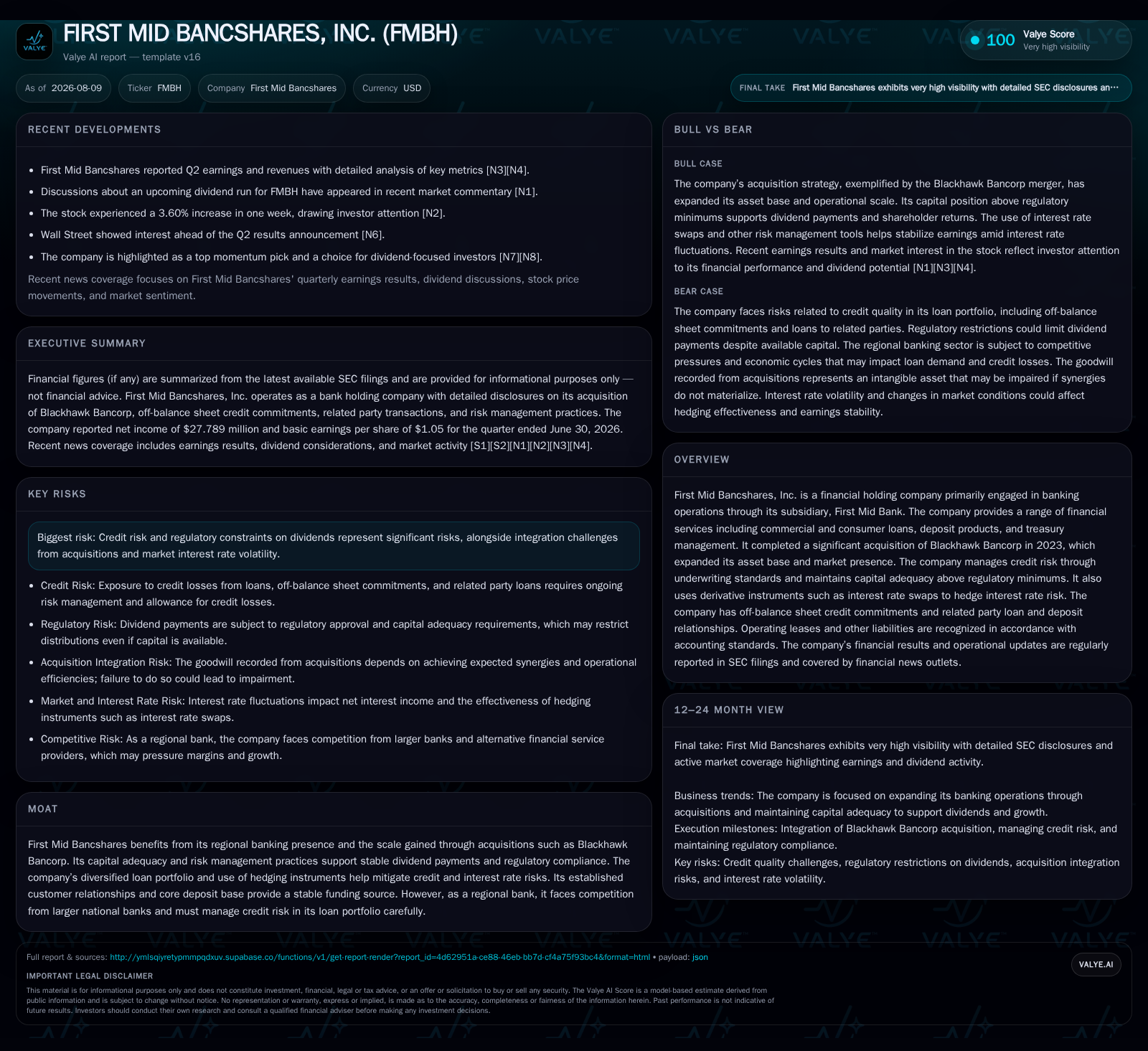
First Mid Bancshares demonstrated operating resilience in Q2 2026 by maintaining net interest margin through effective hedging amid rising interest costs and growing its loan portfolio modestly post-acquisition. Its diversified loan book, strong capital adequacy well above regulatory minima, and disciplined underwriting support stable dividend capacity and competitive positioning in its regional footprint. While integration of the Blackhawk Bancorp acquisition adds scale and market presence, successful synergy realization remains critical. Going forward, deposit base stability, credit quality metrics, and funding costs will be key monitors.
Q2 Operating Performance Highlights Reveal Income and Margin Drivers
First Mid Bancshares' latest quarterly filing (10-Q dated August 7, 2026) shows that net interest margin (NIM) remained resilient despite a rising interest rate environment. Interest expense on repurchase agreements with customers increased modestly to $1.03 million in Q2 compared to $1.22 million previously but was managed effectively through derivative hedges. The held-to-maturity investment portfolio's fair value slightly declined from $2.288 billion at year-end 2025 to $2.265 billion by June 30, 2026 [S2]. This indicates relatively stable investment positioning in the face of broader market rate volatility. Overall, these income stream dynamics underscore how First Mid relies on both asset repricing flexibility and active interest rate risk management to sustain core earnings.
Loan Portfolio Composition Reflects Diversification and Credit Discipline
The company’s loan portfolio continues to be well-diversified across commercial real estate, operating commercial loans, consumer loans including home equity products, agricultural real estate loans, and other secured lending categories [S1][S2]. Post-acquisition integration of Blackhawk Bancorp has expanded the overall loan book scale while maintaining underwriting discipline that limits elevated credit exposures. Commitments for lines of credit stand at $1.38 billion as of December 31, 2025, with commercial operating lines comprising the largest portion [S1]. This diverse mix assists the bank in mitigating sectoral concentration risks characteristic of regional banks focused on specific geographic footprints.
Consistent credit standards contribute to a stable non-performing assets (NPA) ratio without material spikes this quarter [S2]. The company also maintains provisions for loan losses that reflect cautious anticipation of potential future credits downturns without excessive reserve build-up that would impair earnings.
Deposit Base Stability Supports Funding Cost Control Amid Competition
First Mid benefits from a stable core deposit base that provides reliable low-cost funding critical for supporting loan growth without overly relying on volatile wholesale funding sources [S1][S2]. The company’s ability to resist pass-through deposit beta increases remains important given competitive pressures from larger national banks with broader product offerings that can attract deposits through aggressive pricing.
The company’s relatively lower-cost deposits combined with moderate balance-sheet leverage help sustain net interest margin amid fluctuating funding costs. Deposit mix shifts or beta changes are key areas observers will track to assess ongoing margin resilience.
Interest Rate Hedging Limits Volatility Impact on Net Interest Margin
A defining feature of First Mid’s risk management approach is the use of derivative instruments such as interest rate swaps to hedge against adverse movements in interest rates [S1][S2]. These hedges have been instrumental in smoothing earnings volatility arising from inherent mismatches between fixed-rate loans and variable-rate deposits or short-term borrowings.
The effectiveness of this strategy is evident in First Mid's ability to maintain net interest income growth even as total interest expense rose year-over-year due primarily to higher market rates impacting repo agreement costs [S2]. This disciplined hedging complements conservative credit policies by stabilizing core profitability.
Acquisition Scale Enhances Market Presence but Integration Remains Critical
Since completing the acquisition of Blackhawk Bancorp in 2023, First Mid has significantly increased its asset base and broadened regional penetration [S1]. This transaction has allowed access to new customer segments and geographic markets extending beyond existing Illinois-centered operations.
However, integration challenges typical post-acquisition remain relevant. Combining systems, achieving operational efficiencies, harmonizing underwriting standards, and retaining acquired customer relationships are ongoing priorities noted by management. Successful execution here will influence future margin improvement trajectories and scalable growth potential.
Credit Quality Metrics Indicate Conservative Risk Management Practices
Consistent with its regional banking peers prioritizing credit quality preservation amid economic uncertainties, First Mid exhibits controlled levels of non-performing assets and manageable provision expenses [S1][S2]. Off-balance sheet financial instruments including unused lines of credit ($1.38 billion) and standby letters of credit ($17.6 million) involve similar underwriting rigor such that exposure does not materially exceed on-balance sheet credit risk [S1].
The company discloses no significant litigation or contingent liabilities posing undue risks beyond ordinary business course matters [S1]. This prudent governance approach supports confidence in the durability of asset quality metrics.
Growth Opportunities Rooted in Core Lending Expansion and Fee Income Growth
Organic growth drivers rest substantially on expanding commercial lending aligned with economic activity within Midwest regional markets served by First Mid. Agricultural-related loans remain an important segment given local clientele profiles [S1]. Consumer loans including residential mortgages complement the diversification strategy.
Additionally, fee income derived from treasury management services and deposit account maintenance contributes an increasingly relevant source of non-interest revenue as banks seek balanced income streams amid interest rate cycles [S3]. Enhancements in digital customer engagement platforms may further support customer acquisition and retention over time.
Risks: Loan Credit Trends, Regulatory Dividend Constraints, Competitive Pressures
Material risks include cyclical credit deterioration stemming from localized or broader economic slowdowns that could elevate NPAs and increase provisioning needs [S1]. Regulatory capital mandates impose constraints on dividend distributions; although current capital ratios exceed requirements comfortably (discussed below), regulators may still limit payouts if deemed unsafe practice [S1].
Competitive pressures arise especially from larger national banks with scale advantages influencing deposit pricing dynamics potentially increasing funding costs. Community banks focused on local commercial segments present alternative choices for borrowers, intensifying market contestability.
What to Watch: Upcoming Earnings Signals, Deposit Trends, Loan Performance Metrics
Future quarterly disclosures will provide insight into how deposit beta evolves amid continuing competition for core deposits alongside potential rate normalization impacts on liability costs. Loan performance indicators such as delinquencies or classified asset ratios remain early warning signs for credit cycle shifts.
Capital adequacy trends following incremental retained earnings versus dividend payments will also indicate payout sustainability. The success of ongoing hedging programs under variable rate scenarios will clarify earning stability prospects.
Financial Profile Discussion: Capital Adequacy Anchors Dividend Capacity
As per the latest filings, First Mid maintains its regulatory capital well above minimum requirements ensuring ongoing compliance vital for operational flexibility including dividend distributions. The bank’s tangible capital ratios reflect sound leverage positioning supporting long-term stability [S1][F1].
This prudent financial stewardship frames First Mid Bancshares as a disciplined regional bank leveraging strategic acquisition scale gains coupled with vigilant risk control measures to deliver consistent shareholder returns under evolving market conditions.
Disclaimer: This analysis is presented solely for informational purposes based on publicly available filings as of August 2026. It does not constitute investment advice or research views regarding securities transactions.
Disclaimer: This is research-only, informational analysis and not investment advice. It may include AI-generated interpretation and general industry context. Always verify important details using primary sources.

Comments