
QCR Holdings Advances Profitability with Stable Loan Growth and Hedged Interest Rate Exposure
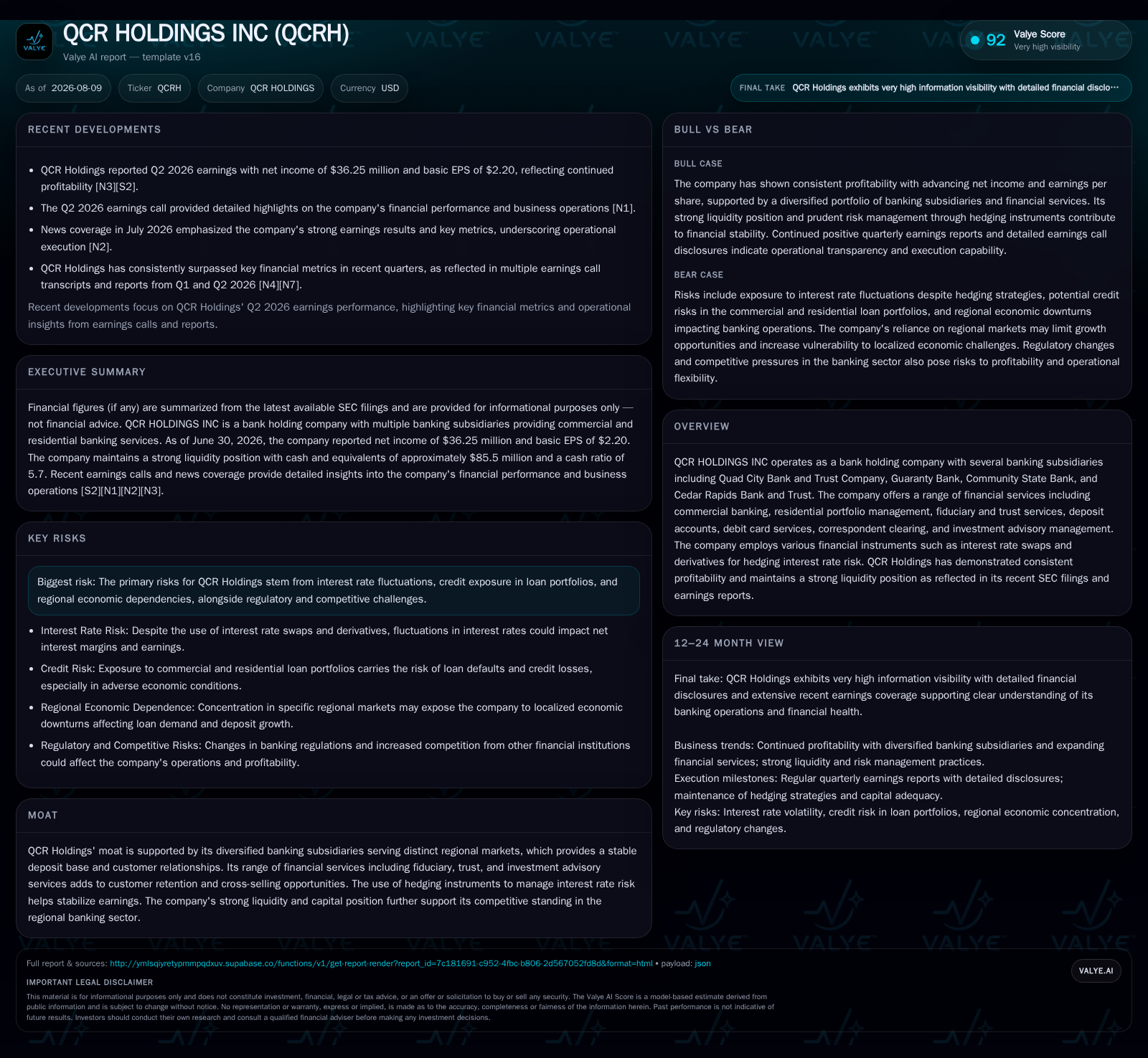
QCR Holdings reported solid Q2 2026 results underpinned by diversified banking subsidiaries, effective interest rate risk management, and steady loan portfolio expansion.
In its latest quarterly filing ending June 30, 2026, QCR Holdings maintained consistent financial performance supported by stable loan growth and prudent hedging strategies against interest rate volatility. The company’s diversified revenue streams from commercial banking, fiduciary, and investment advisory services bolster resilience amid regional economic variability. While credit quality remains sound, the firm faces competitive pressures typical of regional banks alongside macroeconomic and regulatory risks. Liquidity and capital positions remain strong, supporting ongoing growth initiatives and regulatory compliance.
Recent Operating Update
QCR Holdings reported its second-quarter 2026 results on August 7, 2026, confirming continued financial stability highlighted by steady loan portfolio growth across its subsidiaries: Quad City Bank and Trust Company, Guaranty Bank, Community State Bank, and Cedar Rapids Bank and Trust [S2]. This multi-bank structure supports a geographically diverse deposit base critical for funding asset growth. The company continues to utilize derivative instruments like interest rate swaps as hedges against volatile interest rate environments—a key factor in preserving net interest margin stability and protecting earnings [S2]. Recent filings also show consistent provisioning policies aligned with credit quality trends without unusual spikes or reductions in expected credit losses.
On July 22, 2026, an event filing underscored strategic emphasis on fiduciary services expansion and enhancements in correspondent clearing operations as complementary fee-income drivers outside traditional lending activities [S3]. These moves align with broader industry trends where ancillary wealth management offerings mitigate dependence on volatile lending spreads.
Business Model Overview
QCR Holdings functions as a bank holding company overseeing multiple independently chartered regional banks concentrated primarily in the Midwest. Its revenues mainly derive from net interest income—the spread between interest earned on loans (commercial real estate, small business loans, residential mortgages) minus funding costs derived chiefly from insured deposits. Deposits form a stable funding source less sensitive to wholesale market fluctuations compared to alternative funding lines.
Supplementing this core lending operation is a suite of fee-based financial services including fiduciary management (trust administration), investment advisory management tailored to high-net-worth clients, debit card programs, correspondent clearing services facilitating check processing and settlement for smaller institutions, and related transactional banking products [S1], [S2]. This diversification enhances customer stickiness through cross-selling opportunities while generating non-interest income less subject to interest rate cycles.
Net interest margin (NIM) stability is crucial—managed actively via hedging instruments to offset exposure when short-term borrowing costs or deposit beta rise unexpectedly. Loan portfolio quality directly influences provisioning requirements for credit losses; QCR applies disciplined underwriting aligned with regional economic conditions to control problem assets such as non-performing loans. Efficiency in operating expenses relative to revenue drives sustainable profitability measured by the efficiency ratio.
Industry Structure and Competitive Position
Regional banks like QCR operate as vital intermediaries in their local economies—sourcing deposits from individuals and businesses that rely on community relationships while deploying capital into commercial lending within their footprint. This localized model contrasts with national banks that leverage scale but may lack granular regional insight. However, competition includes not only peer regional/community banks but also credit unions targeting similar retail depositors at favorable rates and fintech firms disrupting payments or lending segments.
QCR’s differentiation lies partly in its multi-subsidiary framework spanning distinct regions within its Midwestern focus areas. This geographic spread helps stabilize deposits during localized downturns while affording tailored product offerings fitting regional business profiles. Its breadth of fiduciary services further expands client engagement beyond transactional banking—aligning with growing demand for wealth planning amid aging populations.
Compared to peers such as UMB Financial Corporation or First Midwest Bancorp (not direct peers but useful benchmarks), QCR maintains competitive net interest margins supported by active asset-liability management. Its loan growth pace is moderate yet consistent—not overly aggressive—in line with prudent credit standards observed broadly across cautious regional lenders.
Growth Drivers
Several factors underpin QCR’s prospective growth:
- Loan Portfolio Expansion: Continued selectively measured increases in commercial real estate financing, small business loans, and residential production are feasible given consistent deposit inflows feeding stable funding sources.
- Deposit Base Growth & Mix: Retention of core retail deposits at manageable beta levels sustains low-cost funding vital for margin preservation amid fluctuating policy rates.
- Fee Income Diversification: Strengthening fiduciary trust services and expanding investment advisory bolsters non-interest income streams less sensitive to cyclical credit environments.
- Regional Economic Development: Economic activity in urban centers within QCR’s serving regions fuels demand for credit products and cash management services.
- Hedging Effectiveness: Strategic use of derivatives limits earnings volatility attributable to interest rate swings—important as central bank policies shift.
- Operational Efficiency Initiatives: Ongoing investments in technology platforms aim to improve customer experience while controlling operating costs relative to revenue growth.
Risks and Watchpoints
Despite solid fundamentals, notable headwinds exist:
- Interest Rate Risk: Sudden or sustained changes in short-term rates could compress net interest margins if deposit beta rises faster than loan repricing capability despite hedging efforts.
- Credit Quality Sensitivity: Regional economic concentration exposes the loan portfolio to industry-specific stressors (e.g., agriculture or manufacturing downturns), which affect asset quality metrics such as non-performing loans ratio.
- Competitive Pressures: Larger national banks with scale advantages or nimble fintech entrants could erode market share especially in payments or small business lending niches.
- Regulatory Compliance Burdens: Maintaining capital adequacy ratios above minimum thresholds requires continual monitoring; shifts in regulatory regimes could raise costs or constrain certain activities.
- Liquidity Risks: Unanticipated deposit withdrawals or wholesale funding market disruptions may challenge liquidity coverage if not adequately buffered.
- Operational Risks: Increasing cybersecurity threats necessitate continuous investments in safeguards to protect client data integrity.
What to Watch Next
Key operational indicators that will reveal execution momentum include quarterly trends in:
- Loan origination volumes versus maturities or payoffs signaling loan book expansion strength;
- Deposit growth rates especially checking versus time deposits affecting funding cost dynamics;
- Net charge-offs combined with provision expense reflecting emerging credit trends;
- Changes in efficiency ratio suggesting effectiveness of cost controls;
- Capital adequacy ratios illustrating cushion amid potential stress scenarios;
- Development of fee income from fiduciary and investment advisory segments as diversification measure;
- Impact of derivative gains/losses on quarterly net interest income stability;
- Announcements related to strategic partnerships or technology upgrades enhancing competitiveness.
Financial Profile Discussion
The company has sustained profitability levels highlighted by positive retained earnings accumulation over recent periods [S2], reflecting a solid return profile typical of disciplined regional banks balancing growth with risk controls. Capital ratios exceed regulatory minima ensuring compliance; though precise CET1 ratios were not detailed recently, prior disclosures indicated robust capitalization aligning with peer expectations [S1]. Operating expense discipline coupled with revenue diversification supports steady pre-tax income generation even as macroeconomic conditions fluctuate modestly.
Overall, QCR Holdings demonstrates financial resilience through conservative leverage use combined with prudent asset-liability management anchored by diversified subsidiaries serving well-defined regional markets. Its evolving fee-based service lines complement traditional banking revenues thereby moderating cyclicality inherent in loan-dependent earnings streams.
Disclaimer: This is research-only, informational analysis and not investment advice. It may include AI-generated interpretation and general industry context. Always verify important details using primary sources.

Comments