
NLIGHT’s Vertical Integration and Defense Focus Boost Resilience Amid Export and Supply Challenges
NLIGHT’s Q2 2026 results highlight strong defense demand and operational resilience despite export control headwinds.
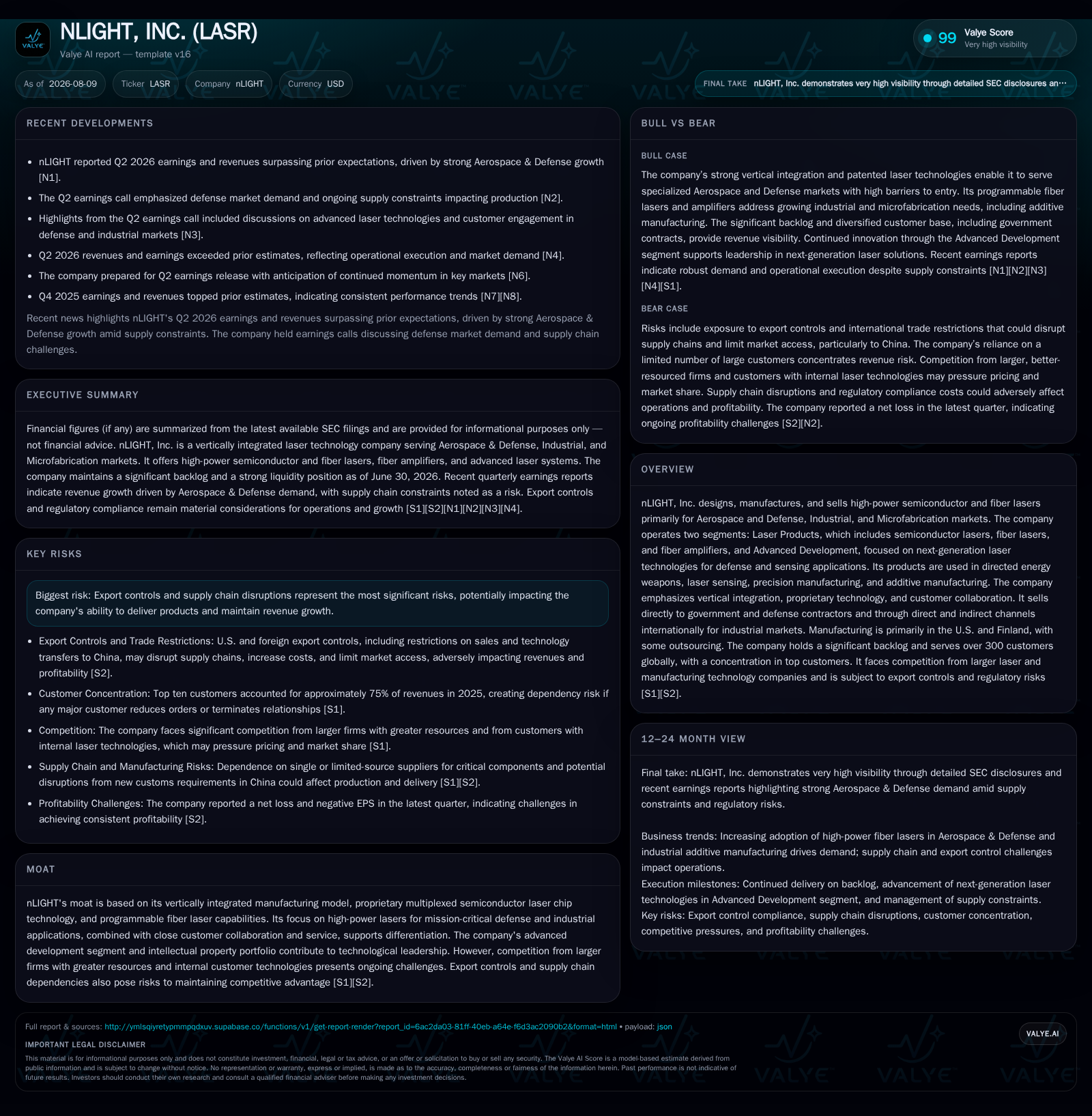
nLIGHT, Inc. reported solid second-quarter 2026 performance anchored by sustained growth in Aerospace and Defense laser products, reinforcing its leadership in high-power semiconductor and fiber lasers. The company’s vertically integrated manufacturing and proprietary multiplexed laser chip technology provide a competitive moat, particularly in mission-critical defense applications. However, escalating export controls—especially involving China—and supply chain disruptions weigh on near-term operational complexity and cost. Continued investment in advanced development programs supports future technological differentiation. Tight backlog visibility and evolving government budgets remain key demand indicators to monitor alongside margin pressure from pricing dynamics.
Recent Operating Update: Q2 2026 Performance Highlights
In its latest quarterly filing dated August 7, 2026, nLIGHT reported continued strength in Aerospace and Defense (A&D) laser product demand which drove revenues above Street expectations [S2][N1]. The company highlighted a sizable backlog that supports future shipments over the next 24 months—a critical leading indicator given long production cycles in this sector [S1][N1]. While Industrial market sales remain constrained by macroeconomic softness, the A&D segment's resilience demonstrates structural tailwinds from rising defense budgets focused on directed energy weapons and laser sensing capabilities [N2]. Management emphasized the challenges posed by new export controls impacting shipments to China and increased compliance complexity due to Chinese customs tightening introduced in mid-2026 [S2][S3]. This dual challenge of regulatory friction coupled with global supply chain constraints is increasing operational costs and risks delaying customer deliveries.
Business Model: Vertically Integrated High-Power Laser Solutions
nLIGHT operates two segments: Laser Products, encompassing high-power semiconductor lasers, fiber lasers, fiber amplifiers, and beam combining technologies; and Advanced Development focusing on research into next-generation high-energy directed energy lasers (HEL), beam control, and laser sensing technologies primarily for defense applications [S1][S8]. Revenue generation principally derives from sales of semiconductor laser chips based on patented multiplexed single-chip architectures that combine multiple gallium arsenide laser elements into highly brilliant light sources. Complementing this are proprietary doped fiber amplifiers enabling programmable fiber lasers with adjustable beam shapes and pulse modulation tailored to precision manufacturing or mission-specific defense needs [S1].
Monetization hinges on direct contracts with government agencies, defense primes (e.g., BAE Systems, Northrop Grumman), OEM industrial tool builders (e.g., Mazak), plus channel partners supporting industrial markets internationally [S22]. The company's vertical integration—from semiconductor substrate through to finished laser modules—allows tight control over design iteration cycles, quality yields, cost management, and rapid responsiveness to bespoke customer specifications [S1][S23]. This capability is vital for cutting-edge defense applications requiring exacting reliability standards measured by mean time between failures (MTBF) and rigorous environmental operability.
Industry Structure and Competitive Positioning
The high-power laser equipment industry is technology intensive with rapid innovation cycles heavily dependent on sustained R&D investments. nLIGHT competes against large fiber laser incumbents like IPG Photonics who dominate industrial markets broadly; diversified photonics firms such as Coherent, Inc.; specialized semiconductor chip producers like Lumentum; alongside major aerospace & defense contractors Raytheon Technologies and Lockheed Martin developing internal directed energy systems.
nLIGHT’s moat resides in its proprietary multiplexed laser chip technology enabling 'brilliant' semiconductor lasers unmatched commercially, combined with flexible programmable fiber lasers serving both weapon systems and advanced manufacturing tools [S1][S6]. Its vertical integration contra-distinguishes it from competitors reliant on outsourced components. However, intense competition persists due to the higher scale, diversified portfolios, integrated supply chains, and deep pockets enjoyed by these peers. Added pressure arises from OEM customers electing internal production or vertically integrating their suppliers.
Government export restrictions further complicate competitive dynamics by limiting market access particularly in China while complicating supply chains globally through component sourcing uncertainties—a risk less acute for global giants with broader sourcing options but impactful nonetheless for firms of nLIGHT’s scale [S2][S16].
Growth Drivers
Structural growth is being propelled by several convergent trends:
- Rising Defense Spending: Escalating U.S. government investment in directed energy weapons programs directly expands demand for high-energy laser sources where nLIGHT holds a technology leadership position [N1][S1].
- Additive Manufacturing Expansion: The trend toward multi-laser programmable fiber systems to improve throughput for complex metal parts fabrication drives broad industry adoption of nLIGHT’s products within industrial OEMs focused on electric vehicles, aerospace components, medical devices [S23].
- Technological Advances: Continuous innovation of semiconductor chips to enhance brilliance (power density) coupled with programming features increases system efficacy—supporting price premium positioning.
- Vertical Integration Benefits: In-house capability allows quicker iteration on product improvements that meet evolving customer needs faster than competitors reliant on external suppliers.
- International Expansion: Incremental revenue from Asia Pacific (excluding China) and EMEA regions growing modestly off a low base despite geopolitical tension-driven constraints on China exposure [S17].
Key KPIs to watch include order backlog size relative to prior quarters (indicator of sustained demand), time-to-market for new programmable multi-laser offerings targeting additive manufacturing customers (reflecting pipeline strength), production yield rates affecting gross margin profile, R&D spend efficacy measured as a percentage of revenue maintaining technological edge (historically ~18%–20%), customer retention trends especially among top 10 accounts driving ~75% revenue concentration [F1][S22][S6][S7]
Risks and Growth Constraints
Among principal risks articulated in filings are:
- Export Controls: U.S. restrictions particularly targeting sensitive laser technologies shipped to China or other countries may constrain market opportunities or necessitate costly licensing compliance regimes causing delays or lost sales. Chinese retaliation via tightened customs declarations disrupts inbound component flows heightening operational complexity [S2][S16].
- Supply Chain Disruptions: Dependency on rare-earth elements doping fibers as well as gallium arsenide wafers risk interruptions impacting production schedules.
- Competitive Pricing Pressure: Larger vertically integrated competitors may leverage economies of scale undercutting price points forcing margin erosion.
- Customer Concentration Risks: Heavy reliance on several large defense contractors subject to government budget cycles introduces volatility.
- Long Sales Cycles: Extended negotiation periods for military contracts can delay recognition of revenues.
- Technological Obsolescence: The rapid pace of innovation necessitates sustained R&D investment failing which market relevance could erode.
- Litigation/IP Risk: Protection of patents against infringement challenges is critical given competitor overlap.
Industrial end market cyclicality tied to economic conditions contrasts with somewhat steadier defense orders but both remain susceptible to macroeconomic shocks or political budget re-prioritizations.
What to Watch Next
Upcoming milestones include quarterly releases validating backlog conversion momentum especially within A&D; progress updates on programmable multi-laser platforms integrating into additive manufacturing OEM tools; any shifts in export license approval cadence or changes in global trade policies impacting cross-border product flows; operational improvements evidenced by margin expansion from higher production yields or beneficial product mix; capital expenditure deployments indicated in filings reflecting scale-up capacity; new contracts secured especially with prime defense contractors or government agencies.
Monitoring competitor announcements around technological advancements or vertical integration moves also contextualizes nLIGHT’s positioning.
Financial Profile Discussion
As of June 30, 2026, nLIGHT held cash and equivalents of approximately $296 million with current assets totaling $447 million against current liabilities of about $55 million, resulting in a strong current ratio of 8.17x, indicating robust short-term liquidity coverage [F1]. The company’s balance sheet reflects minimal outstanding debt, consistent with a conservative capital structure [F1]. The company reported a net loss narrowing to $23.5 million in 2025 from $60.8 million the prior year alongside revenue growth driven principally by volume gains within the Laser Products segment [S29][F1].
Gross margin improvement was evident with Laser Products achieving nearly 40% gross margin attributed largely to favorable sales mix towards higher-margin directed energy lasers combined with improved manufacturing yields indicating operational execution progress though ongoing cost pressures from inflationary inputs such as labor or logistics were noted [S6][N2]. Future margin trajectories will critically depend on sustaining favorable product mix shifts alongside managing pricing concessions necessitated by competitive dynamics.
Overall, the capital structure offers resilient liquidity supporting strategic investments required for technological leadership notwithstanding near-term margin headwinds emanating from export control compliance costs and channel disruptions.
This analysis synthesizes available regulatory disclosures along with public news reports up to August 2026 focusing strictly on verifiable facts supported by filed documents without speculative forward-looking assessments beyond stated company guidance or official commentary.
Disclaimer: This is research-only, informational analysis and not investment advice. It may include AI-generated interpretation and general industry context. Always verify important details using primary sources.

Comments