
Ambarella’s Growth Depends on Automotive and AI Design Wins Amid Concentration and Supply Risks
Ambarella’s AI-enabled system-on-a-chip solutions are gaining traction in automotive and IoT markets, but heavy reliance on a single distributor and supply chain volatility pose critical challenges to sustained growth and margin expansion.
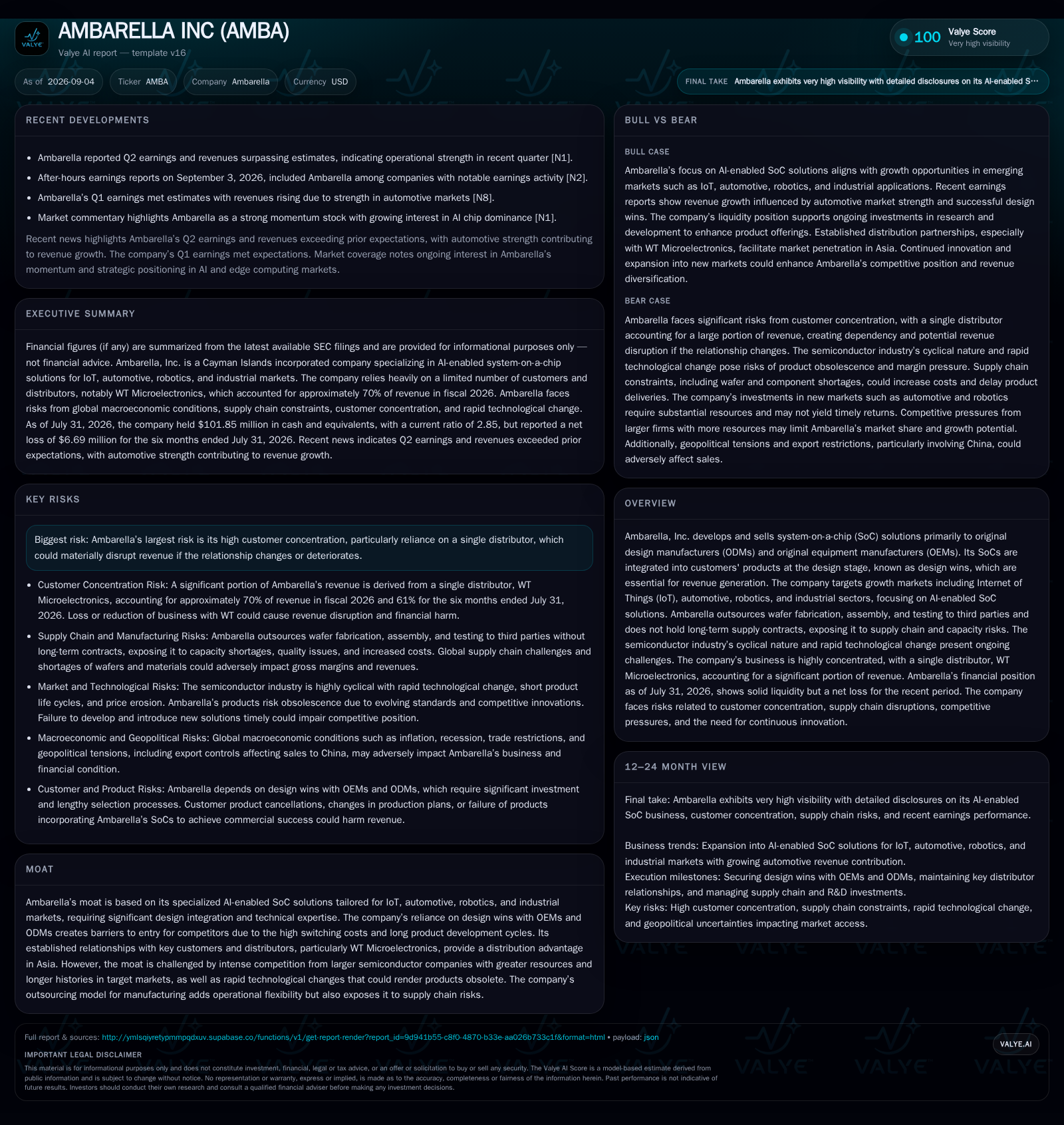
Ambarella’s recent earnings beat driven by automotive strength underscores the firm’s progress in AI-enabled SoC markets. However, its business model’s dependence on design wins and a highly concentrated customer base, particularly WT Microelectronics, introduces revenue vulnerability. Outsourced manufacturing without long-term contracts exacerbates supply risk amid semiconductor industry cyclicality. The company’s success will depend on securing diversified design wins, managing geopolitical export controls, and navigating rapid technological evolution to avoid obsolescence. Key future milestones include sustaining automotive momentum, expanding customer diversification, and mitigating supply chain disruptions.
Ambarella, Inc. is advancing its position in the AI-enabled system-on-a-chip (SoC) market with a strategic focus on automotive, IoT, robotics, and industrial applications. Recent quarterly results revealed revenue growth fueled by automotive demand, signaling successful design wins that embed the company’s chips early in product development cycles. However, the business model’s high customer concentration, with approximately 70% of revenue stemming from a single distributor, WT Microelectronics, presents a notable vulnerability. Coupled with outsourced manufacturing lacking long-term supply commitments, Ambarella faces potential disruptions from supply chain constraints and rapid technological shifts. Navigating these structural risks while capitalizing on AI-driven market opportunities will shape its medium-term trajectory.
Automotive-Driven Revenue Growth Counters Concentration and Supply Challenges
Ambarella’s Q2 2026 earnings and revenues surpassed expectations, driven primarily by strength in the automotive market segment, indicating positive momentum in its AI-enabled SoC solutions for vehicles [N1] [N8]. The company’s Q1 earnings also met estimates with automotive demand contributing to revenue growth, which underscores the importance of this sector for near-term top-line expansion [N8].
Despite these gains, the company’s revenue remains heavily concentrated, with WT Microelectronics accounting for approximately 70% of fiscal 2026 revenue and 61% for the first half of fiscal 2027 [S2]. This single-distributor dependency creates a significant risk of revenue disruption if the relationship changes. Additionally, Ambarella outsources wafer fabrication, assembly, and testing without long-term contracts, exposing it to supply chain capacity constraints and quality risks that could impact product availability and margins [S1] [S2].
Design Wins and Outsourcing Drive Revenue but Amplify Operational Leverage and Risks
Ambarella generates revenue through design wins, where its AI-enabled SoCs are integrated into customers’ products at the design stage. This model hinges on securing OEM and ODM commitments early, which often involves long, competitive selection processes and significant upfront R&D investments. Successful design wins translate into product shipments and revenue, creating a high fixed-cost base with operating leverage when volumes ramp. However, the long sales and development cycles introduce revenue lags and increase cash flow unpredictability [S1].
The company’s outsourcing of wafer fabrication and assembly to third parties without long-term supply contracts reduces fixed capital intensity but transfers capacity and quality risks to suppliers. This variable cost structure can mitigate capital expenditure but introduces supply chain volatility, especially given semiconductor industry cyclicality and material shortages. Ambarella’s gross margins and operating leverage thus depend on stable volume growth and efficient contract manufacturing execution, which could be disrupted by external shocks or supplier constraints [S1] [S2].
Specialized AI SoCs and Design Win Barriers Face Pressure from Industry Giants and Rapid Innovation
Ambarella’s moat derives from its specialized focus on AI-enabled SoCs tailored for IoT, automotive, robotics, and industrial markets. The design win model creates customer switching costs and technical integration barriers, as OEMs and ODMs embed Ambarella’s chips early in their product cycles. Its established distribution relationship with WT Microelectronics enables access to key Asian markets, strengthening market penetration [S1] [S2].
Nevertheless, the company confronts intense competition from larger semiconductor firms with broader portfolios, deeper R&D resources, and stronger supply chain control. Rapid technological evolution in AI chip design and shifting standards require Ambarella to innovate continuously to avoid obsolescence. Additionally, its customer concentration exposes it to pricing pressure and negotiation leverage by dominant customers or distributors, weakening its competitive position if diversification does not improve [S1].
Expanding Automotive and AI SoC Adoption Drives Diversification and Margin Expansion
In a favorable scenario, Ambarella capitalizes on accelerating AI adoption in automotive safety, advanced driver-assistance systems (ADAS), and smart IoT devices, securing multiple new design wins across diverse OEMs and ODMs. Diversification beyond WT Microelectronics and expansion into robotics or industrial automation markets could reduce concentration risk and stabilize revenue streams. Such success would enhance operating leverage, allowing fixed R&D and SG&A costs to be spread over larger volume, improving profitability [N1] [S2].
Confirmation of this scenario would include growing revenue contributions from new customers and sectors, improving gross margins through scale economies in outsourced manufacturing, and steady or rising R&D investment yielding differentiated products. Failure to observe revenue diversification or margin improvement over successive quarters would challenge this outlook, indicating persistent customer concentration or competitive pressures limiting growth.
Automotive Demand Supports Revenue While Concentration and Supply Risks Continue
The most plausible near-term outcome is continued revenue growth driven by automotive market strength, offset by limited progress in customer diversification and ongoing supply chain constraints. Ambarella’s design wins sustain its revenue base, but the bulk of sales remain tied to WT Microelectronics, maintaining concentration risk. Supply chain disruptions, such as wafer shortages or assembly delays, may intermittently impact shipments and margins but not cause systemic declines [N1] [S2].
This scenario would be supported by stable or modestly increasing revenue from automotive and IoT segments, maintenance of the WT relationship under existing terms, and consistent R&D spending without major breakthroughs. Evidence of persistent supply challenges or failure to attract new large customers would reinforce this base case, while any material loss of WT orders or worsening geopolitical restrictions would falsify it.
Loss of Major Distributor or Supply Disruptions Trigger Revenue Decline and Margin Compression
In a downside scenario, Ambarella faces a significant disruption from the loss or reduction of orders from WT Microelectronics, which accounts for a disproportionately large share of revenue. Such a development could stem from distributor strategy shifts, geopolitical export controls, or competitive displacement. Concurrent supply chain constraints—such as wafer fabrication capacity shortages or quality issues—could further delay product deliveries and increase costs, compressing margins [S1] [S2].
This would manifest as declining revenue growth or outright contraction, negative operating leverage as fixed costs remain elevated, and increased R&D spending pressures. Confirmation would include reported loss of major customer orders, missed design wins, and widening net losses. Conversely, stable distributor relations or easing supply bottlenecks would falsify this scenario.
Design Win Diversification, Supply Chain Stability, and Export Control Impact Remain Crucial
Critical metrics to watch include the share of revenue contributed by WT Microelectronics and whether Ambarella can increase the proportion of revenue from other distributors or direct customers. Tracking new design wins in automotive, robotics, and IoT markets, if disclosed, would help assess diversification progress.
Supply chain indicators such as manufacturing lead times, defect rates, and contract manufacturing capacity utilization would help evaluate operational risks. Monitoring R&D expenditure relative to revenue offers insight into innovation investment and potential product cycle competitiveness.
Additionally, the impact of export controls or geopolitical restrictions—especially on sales to Chinese customers—would be important to gauge. Finally, gross margin trends and operating leverage evolution will indicate whether volume growth translates into improved profitability or is offset by cost pressures.
Disclaimer: This is research-only, informational analysis and not investment advice. It may include AI-generated interpretation and general industry context. Always verify important details using primary sources.

Comments