
AIG's Q2 Boost: Underwriting Strength Meets Regulatory Complexity
AIG’s Q2 2026 results reveal a disciplined underwriting performance alongside regulatory challenges shaping its operating and capital strategies.
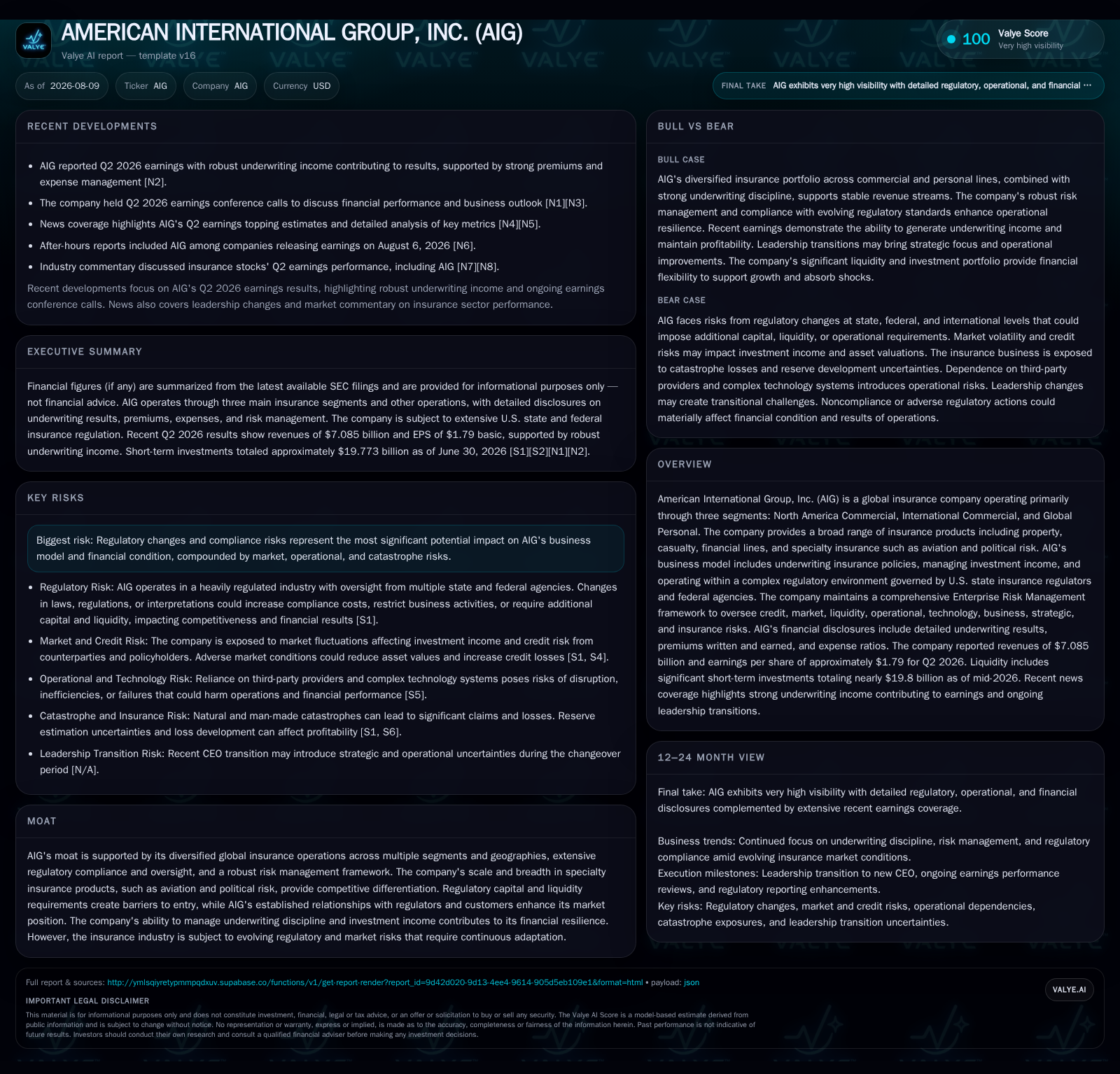
In its second quarter 2026 filing, American International Group, Inc. (AIG) showcased notable improvement in underwriting income driven by disciplined premium growth and favorable loss trends. The company's diversified insurance segments underpin steady net premiums earned despite a complex regulatory environment that imposes capital constraints and limits on dividend distributions. Specialty insurance lines like aviation and political risk contribute to differentiation, while enterprise risk management frameworks mitigate catastrophe exposures and reserve adequacy risks. Looking ahead, monitoring claims development, combined ratios, and capital deployment will be critical in assessing AIG’s operational resilience within evolving market and regulatory pressures.
Q2 Operational Momentum Anchored in Underwriting Discipline
AIG’s second-quarter 2026 results demonstrated robust underwriting strength with underwriting income rising sharply compared to prior periods [S2]. This improvement was supported by an accident year combined ratio excluding catastrophe losses that reflected effective claims management and prior years’ reserve developments contributing positively to profitability [S2]. Net premiums written moderated but remained resilient across the three core commercial and personal segments, reflecting sustained policyholder demand despite overall industry softening observed elsewhere [N1][N2]. The company also maintained expense discipline with acquisition costs aligning closely to premiums earned metrics reinforcing underwriting margin expansion [S2]. These operational dynamics underscore AIG’s ongoing commitment to disciplined risk selection and pricing responsiveness amidst an environment of heightened claim severity particularly outside catastrophe impacts.
Multi-Segment Model Driving Diversified Premium Flows and Risk Mix
AIG’s revenue streams emanate from three strategic segments: North America Commercial, International Commercial, and Global Personal lines [S1][S23]. Each segment caters to distinct customer profiles; for example, North America Commercial serves clients ranging from small businesses to multinational corporations with products spanning property, casualty, and financial lines insurance [S26]. International Commercial expands geographic diversity through regional insurers addressing emerging market needs. Global Personal caters primarily to individual clients with personal property coverages. This diversification stabilizes overall premium inflows by balancing exposure across geographies and business lines [S1]. Specialty products — including aviation insurance and political risk coverage — add material differentiation given their technical complexity and higher barriers to entry [S1], anchoring premium yields in niche markets less prone to commoditization.
Market-Driven Pricing Power Tested by Regulatory Capital Frameworks
While AIG demonstrates prudent pricing enabled by strong market relationships in commercial lines, its pricing power is circumscribed by comprehensive U.S. state-level insurance regulations alongside international solvency mandates [S1]. These frameworks enforce minimum capital adequacy standards that shape AIG’s underwriting appetite by limiting exposure to underpriced risks or poorly collateralized contracts [S1]. Regulatory impositions on dividend payments further constrain free cash flow usage — dividends require approval based on subsidiary financial health — placing dividends as a negotiated output of regulatory compliance rather than unrestricted capital allocation [S1][S7]. Acquisition costs including commissions reflect competitive pressures within broker-distributed channels yet are managed strategically to preserve margins aligned with net premiums earned growth [S2]. Peers such as Chubb Limited face similar industry-specific regulatory constraints reinforcing the structural nature of these limitations across global commercial insurers.
Specialty Insurance Segments: Navigating Niche Risks with Scale Advantage
AIG’s specialty insurance operations in aviation and political risk represent high-skill-intensive underwriting domains requiring deep actuarial expertise and global regulatory compliance [S1]. These areas function as curated niches characterized by limited competition owing to entrance barriers including licensing requirements, capital intensity, and reputational considerations associated with catastrophe exposures. Such segmentation enables AIG not only to command superior premium rates but also benefit from client sticky-ness given complex risk profiles these products cover [S1]. This positions the company competitively against broader commercial insurers focused primarily on commoditized standard lines.
Enterprise Risk Management: Balancing Catastrophe Exposure and Reserve Adequacy
The robustness of AIG’s Enterprise Risk Management framework is central to maintaining underwriting confidence amid volatile claim environments [S1][S2][S17]. The company employs forward-looking reserve methodologies incorporating scenario analysis for loss reserves under various catastrophe event assumptions contributing toward adequate reserving levels upon which underwriting profitability depends [S1]. Catastrophe losses are carefully mitigated through external reinsurance arrangements quantified rigorously in quarterly disclosures [S2]. ERM governance additionally encompasses technology risk oversight pivotal for claims handling efficiency within increasing digital engagement paradigms [S1]. Maintaining control over attritional losses versus unpredictable catastrophic losses is vital for preserving combined ratio improvements observed this quarter.
Growth Catalysts: Geographic Expansion, Product Innovation, and Investment Strategy
Given industry drivers outlined broadly across commercial insurers, AIG pursues growth through selective expansion into emerging markets via its International Commercial segment where insurance penetration remains below developed market averages [S1][N2]. Rising global cyber threats alongside geopolitical instability catalyze demand for related specialty insurance lines augmenting political risk product relevance. Product innovation aimed at environmental risk coverage correlates with increased regulation-awareness among customers necessitating tailored solutions [S1]. Furthermore, strategic partnership initiatives such as investments in Convex Group Limited enhance access to alternative specialty platforms diversifying risk pools beyond traditional underwriting revenues [S1]. Parallelly, managing investment income remains key — AIG invests premiums collected conservatively while seeking yield enhancements consistent with regulated asset guidelines [S1][N4].
Regulatory Oversight: Compliance Costs and Dividend Controls as Constraints
The pervasive regulatory environment forms both a shield ensuring customer confidence but also a ceiling on operational flexibility for AIG [S1][S7]. Compliance extends beyond mere capital adequacy into policy wordings approval, reinsurance acceptability criteria enforcement, distribution practices scrutiny, as well as IT controls integral for data security compliance under evolving mandates [S1]. Dividend payout decisions are entwined with regulator approvals at subsidiary levels enforcing prudential balances between shareholder returns versus capitalization adequacy essential for claim-paying ability assurance [S1][S3]. Though these regimes impose constraints on rapid capital redeployment strategies observed in less-regulated sectors, they enhance long-term franchise stability validated by recent insurer rating upgrades assigned by Fitch, S&P, Moody's and AM Best reflecting improved underlying creditworthiness supported by disciplined management execution [S1][N4].
Watchpoints Ahead: Monitoring Combined Ratios, Capital Efficiency, and Market Conditions
Looking forward, near-term indicators requiring close tracking include the trajectory of accident-year combined ratios excluding catastrophes which illuminate underlying underwriting discipline persistence independent of external shocks [S2][N5]. Changes in net premiums earned relative to prior periods provide insight into market demand elasticity whereas shifts in acquisition cost ratios flag potential margin pressures linked to distribution channel competitiveness or promotional activity intensity [S2]. Capital returns—dividends plus share repurchases—should be assessed relative to insurer financial strength ratings dynamics within tightening regulatory scrutiny parameters affecting payout capacity [N4][N5]. Macroeconomic factors such as interest rate movements impact investment yields integral to overall profitability complementing underwriting income streams particularly given fixed maturity securities concentrations held as required reserves [S1][N5]. These variables collectively paint an evolving picture where execution effectiveness amid external complexities dictates performance sustainability.
Financial Profile Discussion: Recent Earnings Strength Amid Debt Leverage Context
F1][S8][N4]. Return on equity figures around mid-single digits alongside core operating ROE above 11% signal constructive earnings quality derived from calibrated underwriting plus complementary investment returns achievements underpinning resilient financial health position even under fluctuating market conditions.
This analysis synthesizes publicly filed disclosures without offering investment advice or predictions. It frames AIG’s reported results within the broader context of insurance industry operating fundamentals emphasizing underwriting discipline amid regulatory complexity alongside financial resilience supported by diversified segmental contributions.
Disclaimer: This is research-only, informational analysis and not investment advice. It may include AI-generated interpretation and general industry context. Always verify important details using primary sources.

Comments