
Sylvamo’s Q2 2026 Outperformance Highlights Margins in a Cyclical Paper Market
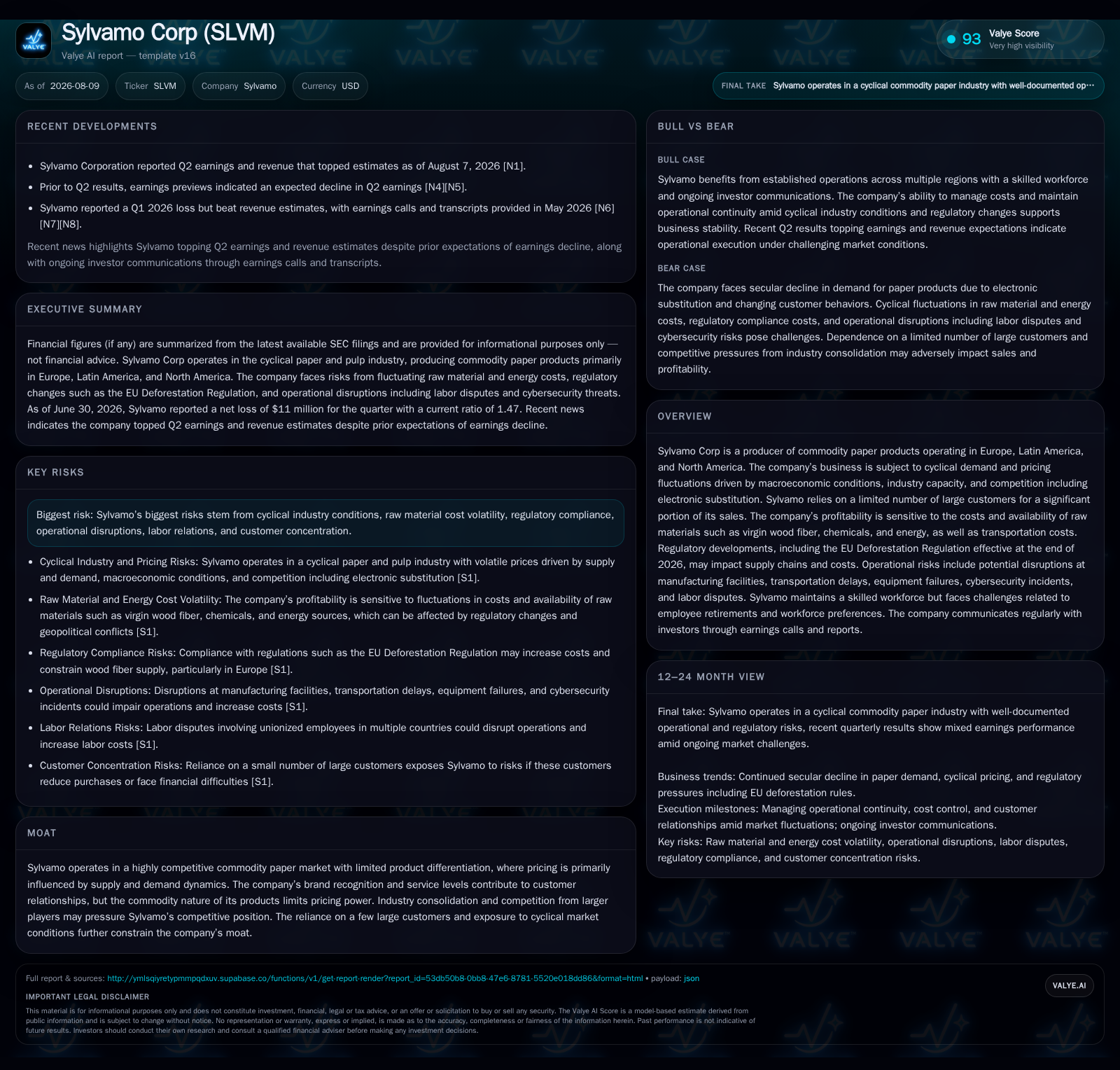
Sylvamo’s better-than-expected Q2 financial results underscore its operational resilience amid raw material volatility and cyclical demand pressures in commodity paper products.
Sylvamo reported Q2 2026 earnings that surpassed expectations, reflecting solid volume levels and disciplined cost management despite persistent raw material price fluctuations. The company’s reliance on volume-driven sales in largely undifferentiated commodity paper markets exposes it to cyclicality and customer concentration risks. Regulatory headwinds, notably the upcoming EU Deforestation Regulation, add compliance cost pressures mainly on European operations. Sylvamo's profitability remains sensitive to capacity utilization and input costs, typical of its sector. The company’s leverage and liquidity metrics suggest moderate financial flexibility but also constraints given the capital-intensive nature of the industry and cyclical market conditions.
Q2 Results Surpass Estimates While Revealing Cost Pressure Dynamics
Sylvamo’s Q2 2026 earnings report released August 7 demonstrated a tangible outperforming trend relative to market estimates. Revenue advanced driven by stable production volumes amid challenging macroeconomic conditions affecting input costs. Operating income benefited from disciplined cost controls even as raw material prices—especially for virgin wood fiber and chemicals—continued oscillating [S2][N1]. This beat signals continued operational resilience despite secular headwinds faced by commodity paper manufacturers globally.
The ability to sustain margins amid persistent input inflation underscores Sylvamo’s effective pricing lag strategies and supply chain management but also highlights ongoing exposure to price volatility inherent in its business model. Confirmation will come from subsequent quarters showing margin stability post any material softening or tightening in raw materials markets.
Revenue Drivers Highlight Volume Reliance Amid Pricing Pressure in Commodity Sector
Sylvamo fundamentally operates as a volume-driven producer focused primarily on uncoated freesheet—a commodity paper product with limited differentiation. Its customer base is concentrated: the top ten customers account for approximately 41% of net sales, with one single customer representing about 15% [S1][S12]. This concentration subjects the company to significant risk if purchasing patterns shift or major customers consolidate suppliers.
Sales contracts generally lack minimum purchase commitments, so revenues warp closely with fluctuating customer demand influenced by macroeconomic factors such as commercial printing activity, industrial output, and consumer confidence levels. The limited pricing power stems from substitutability within commodity grades and competition from larger integrated peers who benefit from economies of scale.
Consequently, revenue growth depends heavily on sustaining high capacity utilization rates while navigating cyclical price swings. Future confirmation would involve observing stable or increasing average selling prices per ton concurrent with resilient volumes.
Operating Margin Trends Reflect Raw Material Cost Volatility and Capacity Utilization Shifts
Margins remain tightly tethered to variable costs including wood fiber procurement, chemical additives, energy consumption per ton produced, and transportation expenses—each subject to external market forces beyond Sylvamo’s control [S1][S2]. Given the capital-intensive nature of mill operations, operating leverage amplifies margin sensitivities; when demand softens leading to reduced capacity utilization rates, fixed costs spread less efficiently.
Q2 results revealed that modest improvements in capacity utilization partially offset rising raw material prices. However, the company remains exposed to any resurgence in energy cost inflation or supply chain disruptions that could weigh on profitability. Observation over coming quarters will determine whether cost pressures abate or intensify as supply/demand balances adjust.
Relative peers such as International Paper and UPM-Kymmene report analogous margins constrained by similar input price volatility but vary based on geographic exposure and product mix.
Competitive Pressures and Customer Concentration Shape Sylvamo’s Market Positioning
Sylvamo inhabits a highly competitive environment characterized by consolidations among producers that often bring scale advantages detrimental to smaller players' pricing leverage [S1][S18]. Its commodity-grade product lineup restricts differentiation efforts; competitive positioning depends more on supply chain agility, customer service levels, and operational efficiency than unique proprietary features.
Customer concentration compounds revenue risk—losing one or more major accounts could materially impact sales given the absence of binding purchase minima. Industry consolidation among buyers can also strengthen their negotiating power, pressuring prices downward.
While brand recognition exists for Sylvamo products such as HP-branded copy papers under license agreements, these do not confer significant pricing insulation. Monitoring contract renewals or shifts in buying patterns should signal any emerging customer relationship risks.
Regulatory Compliance Costs Set to Rise with EU Deforestation Regulation Impacting Supply Chains
Upcoming enforcement of the EU Deforestation Regulation at year-end 2026 poses increased compliance complexity especially for Sylvamo's European mills in France and Sweden [S1][S13]. This regulation demands greater traceability concerning sustainable sourcing of wood fiber which could elevate administrative overheads and raw material sourcing costs.
Additionally, environmental standards encompassing air emissions, water discharge permits, waste management obligations impose ongoing capital expenditure requirements alongside potential operational limits if non-compliance occurs. The company discloses uncertainty around timing and financial impact but anticipates incremental compliance spending.
Progress indicators will include adjusted cost structures post regulatory implementation plus disclosures around capital investments for environmental upgrades.
Growth Outlook Constrained by Secular Paper Demand Decline But Supported by Cost Initiatives
Uncoated freesheet paper faces a secular demand contraction owing largely to digital substitution disrupting traditional print media channels—a trend well-documented across industry peers [S1][N1]. This decline constrains organic revenue growth potential.
However, growth opportunities exist within packaging materials driven by e-commerce expansion—a segment partially pursued through strategic initiatives albeit relatively nascent for Sylvamo. Concurrently, ongoing emphasis on improving manufacturing efficiencies and reducing per-unit production costs aims at bolstering profitability despite volume headwinds.
Execution success on these fronts would manifest as margin stabilization gains notwithstanding falling aggregate volumes.
Risks From Cyclical Demand Fluctuations, Energy Prices, and Labor Disruptions Require Monitoring
Operational hazards persist including vulnerability to labor disputes that may disrupt mill productivity elevating unit costs transiently [S1][S2]. Similarly, energy price spikes threaten margin erosion given dependency on electricity and fuel for pulp production processes.
Transportation logistics interruptions represent further cost pressures with rail/truck/ship freight maintaining relative stability so far but without assurance this will endure long term [S27]. Cybersecurity incidents remain potential disruptors of critical IT infrastructure impacting order processing or compliance reporting.
Persistent monitoring of these risk vectors is essential given their direct influence on operational continuity and expense profiles.
What To Watch: Upcoming Milestones Including Capacity Decisions and Regulatory Updates
Key near-term indicators include tracking capacity utilization rates that mediate fixed cost absorption directly affecting operating income volatility [S2]. Additionally, adherence progress toward EU environmental regulations will be pivotal for European segment cost outlooks.
Customer contract renewals or attrition announcements could signal shifts in demand concentration risks. Price trends relative to raw material inputs will clarify Sylvamo's pricing pass-through effectiveness during input inflation episodes.
Any capital allocation moves—such as share buybacks or dividend adjustments—will reflect financial health perceptions influenced by operating cash flow generation capability.
Financial Profile Discussion: Leverage Levels And Liquidity Influence Strategic Flexibility
As of 2026-06-30, Sylvamo reported total debt standing at approximately $843 million alongside current assets totaling about $1.11 billion versus current liabilities near $752 million yielding a current ratio of roughly 1.47 [F1]. These figures convey moderate liquidity coverage adequate for near-term obligations but highlight dependence on continuous cash flow amid cyclical earnings fluctuations.
In summary, Sylvamo demonstrates resilient operational execution amidst an inherently volatile commodity paper sector challenged by secular decline and regulatory complexity. Its future performance hinges materially on managing cyclical input costs deftly while cautiously navigating evolving customer relationships and regulatory landscapes.
Disclaimer: This is research-only, informational analysis and not investment advice. It may include AI-generated interpretation and general industry context. Always verify important details using primary sources.

Comments