
Johnson Outdoors Sustains Solid Liquidity Amid Seasonal Demand in Outdoor Equipment
The company’s latest quarter highlights operational stability with strong balance-sheet metrics reflecting sound cash management in a cyclical sector.
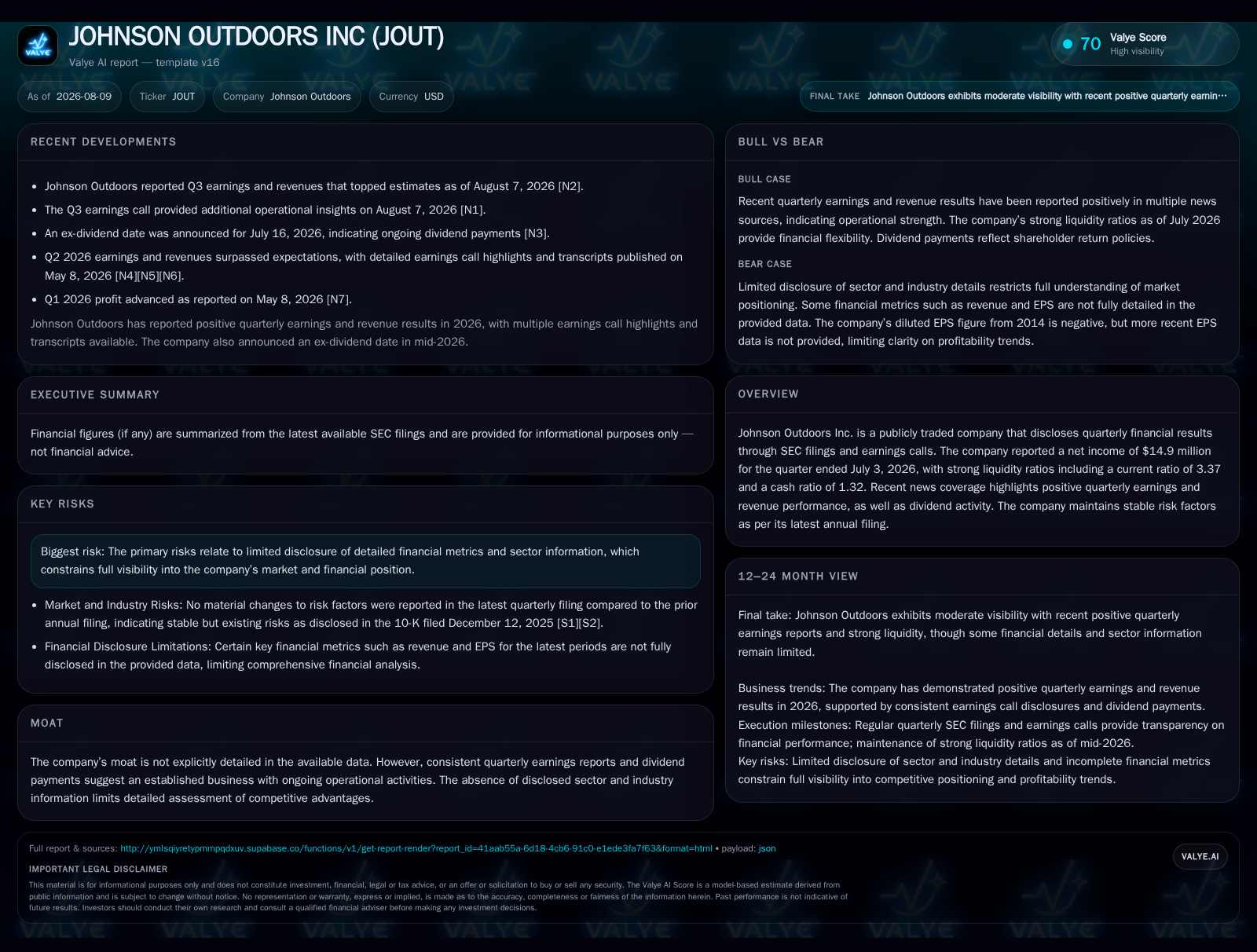
Johnson Outdoors Inc. reported a net income of $14.9 million for the quarter ending July 3, 2026, demonstrating operating resilience within the recreational outdoor equipment space. The company maintains robust liquidity with a current ratio of 3.37 and no outstanding debt as of quarter-end, supporting its capacity to navigate seasonal demand fluctuations. Despite limited disclosure on product-level performance, Johnson Outdoors’ diversified portfolio across water sports and camping gear aligns with industry trends emphasizing brand loyalty and distribution channel expansion.
Recent Operating Update: Encouraging Q3 Earnings Reflect Operational Stability
Johnson Outdoors Inc.'s third fiscal quarter, ending July 3, 2026, yielded a net income of approximately $14.9 million [S2][N1]. This marks an improvement from prior periods where the company experienced operating losses, signaling a move toward consistent profitability. The results came alongside solid revenue performance which exceled analyst estimates [N2]. Such earnings underscore resilience within a segment marked by seasonality and discretionary consumer spending patterns.
Financial disclosure for the period confirms robust cash liquidity at $175.2 million with no recorded debt liabilities as of quarter-end [F1]. Maintaining zero debt affords considerable financial flexibility to fund operations or strategic initiatives without reliance on external borrowings.
Business Model: Revenue Generation Through Diversified Outdoor Gear Portfolio
Johnson Outdoors operates principally as a manufacturer and distributor of branded recreational outdoor equipment with product categories spanning water sports gear (including diving apparatus), camping equipment, and related hardware products [S1]. The company utilizes a multichannel approach incorporating wholesale distribution relationships with specialty retailers and sporting goods stores alongside growing direct-to-consumer e-commerce channels.
Revenue drivers hinge on volume sold across these categories subject to pronounced seasonal demand cycles aligned with peak outdoor activity seasons. The monetization model is primarily product sales at retail prices set through wholesale contracts or direct retailing. Key operating variables influencing revenue include unit volume shifts driven by outdoor activity participation trends, product mix variations influenced by innovation or category focus, and average selling price adjustments reflecting market pricing dynamics.
Margins are susceptible to fluctuations in raw material costs and supply chain efficiency impacting cost of goods sold, while inventory turnover is a crucial indicator given the durable goods nature of the portfolio and potential obsolescence risks during rapid product innovation [S1]. Aftermarket accessories also contribute ancillary revenues enhancing brand engagement over product lifecycles.
Industry Structure and Competitive Positioning
Within the broader recreational outdoor equipment manufacturing sector, Johnson Outdoors competes alongside peers such as Vista Outdoor, Brunswick Corporation, and Columbia Sportswear. These competitors emphasize continuous product innovation cycles to enhance user experience through materials technology or feature upgrades. Channel diversification balancing wholesale legacy relationships with emergent e-commerce growth remains common strategic pillars among competitors.
The industry's value chain sees companies like Johnson Outdoors managing sourcing of components from global suppliers followed by assembly into finished consumer-ready durable goods before distribution through specialty retailers and digital platforms. Brand loyalty constitutes a significant competitive lever given consumers' trust dependency for safety compliance standards in sports gear like diving apparatus [S1].
Seasonal sales variance demands agile inventory management to avoid excess stock post-peak seasons while ensuring readiness during high-demand periods. Peer benchmarking focuses on gross margin stability, measured inventory turnover ratios signifying operational efficiency, and mix improvements balancing higher-margin new products against legacy items.
Growth Drivers
Key growth catalysts for Johnson Outdoors include rising global participation rates in outdoor recreational pursuits influenced by health/wellness trends promoting active lifestyles. Expansion into emerging markets where outdoor recreation penetration is still developing offers long-term opportunity.
Product innovation—such as introducing lighter-weight materials or enhanced designs—can command premium pricing improving average selling prices per unit sold. The company’s push into direct-to-consumer channels facilitates better margins by reducing intermediary layers.
Strategic acquisitions could broaden product breadth but require careful capital deployment aligned to organic capabilities.
Marketing initiatives timed seasonally support brand visibility during demand surges while environmental sustainability efforts appeal increasingly to eco-conscious consumers seeking responsible brands.
Risks and Constraints
Johnson Outdoors faces typical sector risks including supply chain disruptions that may delay component availability or inflate procurement costs due to commodity price volatility. Consumer preference shifts necessitate continuous innovation lest product portfolios become outdated.
Competitive pressure stems both from established brands defending market share as well as new entrants leveraging digital-native go-to-market models.
Product liability risks require adherence to rigorous safety standards especially for gear used in regulated activities such as scuba diving. Currency fluctuations affect international sales profitability consonant with geographic distribution exposure.
Retail channel consolidation poses challenges for negotiating shelf space while economic downturns may reduce discretionary spending adversely impacting quarterly revenues.
Inventory obsolescence risk rises if innovation cycles accelerate beyond current stocking strategies necessitating nimble supply chain management [S1].
What to Watch Next
Future updates will likely center on Johnson Outdoors’ ability to sustain above-trend inventory turnover ratios resolving seasonal imbalances effectively. New product launch cadence will provide signals regarding pipeline vitality supporting mid-term top-line growth.
Close attention should be paid to shifts in distribution channel mix especially increases in direct-to-consumer penetration impacting margin profiles positively.
Monitoring supply chain cost trends alongside raw material price developments will offer insights into future margin trajectories. Any capital allocation moves toward acquisitions or increased marketing spend warrant scrutiny relative to free cash flow generation capacity.
Furthermore, observing how newly appointed CFO Asad Rahman manages financial priorities during his transition period through late fiscal 2026 may reveal tactical adjustments in cost structure or investment focus [S23]
Financial Profile Discussion
Johnson Outdoors’ balance sheet exhibits substantial strength heading into late fiscal 2026 with cash reserves totaling approximately $175 million offsetting negligible debt load resulting in a net cash position around -$175 million [F1]. This exceptional liquidity supports operational continuity through seasonal slowdowns common in recreational outdoor equipment sales cycles.
With no reported debt outstanding as of July 2026 [F1], Johnson Outdoors avoids interest expense burdens affording margin protection amid cost pressures from inflation or logistics constraints common within global supply chains servicing durable goods manufacturers.
It does not constitute investment advice or research views regarding securities transactions.
Disclaimer: This is research-only, informational analysis and not investment advice. It may include AI-generated interpretation and general industry context. Always verify important details using primary sources.

Comments