
Home BancShares Advances Credit Quality and Profitability with National Lending Platforms
Home BancShares’ Q2 2026 results reflect successful acquisition integration, strong loan portfolio growth, and credit quality anchored by a community banking model.
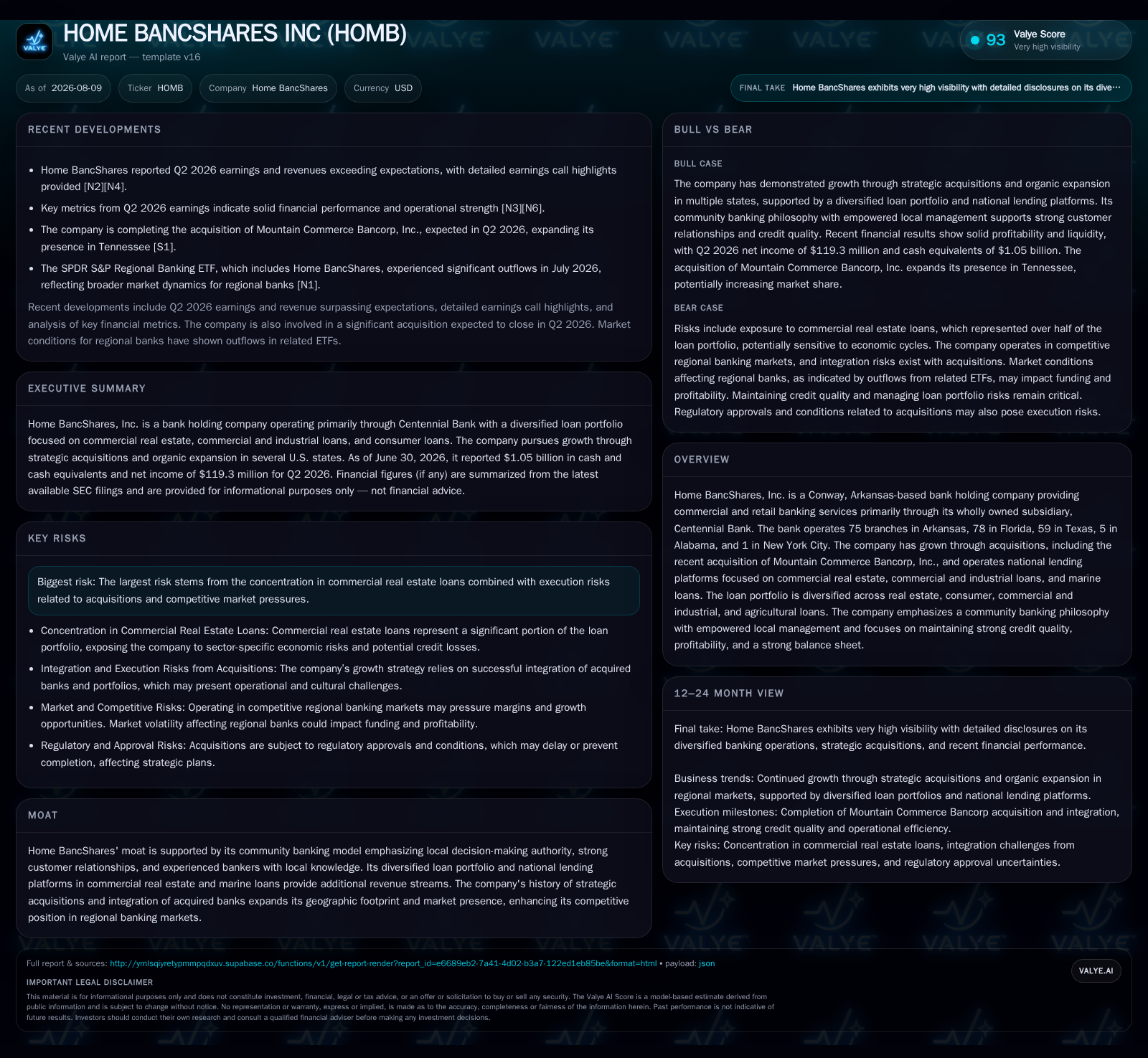
Home BancShares reported robust loan growth in Q2 2026, supported by the Mountain Commerce Bancorp acquisition and organic expansion. The company’s community banking approach enables localized credit decisions that maintain stable asset quality despite commercial real estate concentration. Diversified lending platforms in commercial real estate and marine loans enhance revenue streams and mitigate concentration risks. Regulatory capital ratios remain well above minimums, supporting continued growth and acquisitions. Key watchpoints include deposit base stability amid competitive pressures and integration execution risks.
Q2 Operating Update Highlights Acquisition-Driven Loan Growth
Home BancShares’ second quarter ended June 30, 2026, showcased strong loan portfolio expansion primarily fueled by the completion of its acquisition of Mountain Commerce Bancorp on April 1, 2026 [S2][S17]. This transaction strategically extended Home’s footprint into Texas, adding substantial loans and deposits without immediate cash outflow due to stock issuance consideration [S17]. The acquisition broadened Home’s branch network to approximately 218 locations across Arkansas, Florida, Texas, Alabama, and New York City under its Centennial Bank brand [S1].
The enlarged footprint supports deeper market penetration and reinforces localized decision-making authority—foundational to Home’s community banking philosophy—enabling swift credit adjudication attuned to regional economic conditions [S1][N2]. Loan yields benefited from accretive contributions of the acquired portfolio, enhancing net interest income [N1][N3]. While initial integration expenses may pressure efficiency metrics temporarily, expense rationalization is expected over time as synergies are realized [N1].
Given deposits represent the primary funding source for lending activities, preserving deposit base stability through effective client retention during the integration phase remains a critical operational focus [S2][F1]
Community Banking Model Supports Stable Credit Quality Despite CRE Concentration
Home BancShares maintains disciplined asset quality through its decentralized credit approval process managed by empowered local teams familiar with their markets’ nuances [S1]. Despite a loan portfolio where commercial real estate loans constitute over half of gross loans—a segment prone to cyclical volatility—the company reports stable non-performing loan ratios in recent filings [S1][S2]. This reflects rigorous risk management practices including stress testing, ongoing portfolio monitoring, and proactive borrower engagement.
Localized credit authority facilitates timely workout strategies when borrowers face challenges, preserving asset quality without eroding shareholder equity [S7]. This contrasts with larger regional banks relying on centralized underwriting that may delay responsiveness.
Diversified Lending Platforms Mitigate Concentration Risk and Enhance Revenue
Complementing its core community banking operations, Home BancShares operates national lending platforms such as Centennial Commercial Finance Group (commercial real estate and industrial loans) and Shore Premier Finance (marine lending) which provide specialized expertise in niche markets [S1]. These platforms diversify revenue streams beyond traditional deposit-taking and standard loan products.
This diversification reduces reliance on commercial real estate concentrations by targeting distinct borrower segments with differentiated collateral profiles. The marine lending platform targets both commercial and consumer vessels, offering premium spreads derived from specialized underwriting capabilities [S1].
Such platforms contribute non-interest income through fees and servicing charges while improving capital deployment efficiency [S19]. This diversified asset base also supports regulatory capital adequacy by distributing risk exposures across less correlated business lines consistent with heightened supervisory expectations for institutions exceeding $10 billion in assets
Competitive Positioning Amid Regional Bank Peers
In a competitive landscape featuring peers like Regions Financial Corporation or Fifth Third Bancorp, Home BancShares leverages its community banking ethos as a differentiator against larger banks expanding regionally and fintech entrants reshaping customer behaviors.
While larger banks benefit from scale in technology investments and product breadth, Home’s nimble local decision-making fosters rapid underwriting adaptation and personalized service valued in mid-sized markets. Its niche national lending operations further differentiate it by providing broader product offerings that deepen customer relationships.
However, competition for retail deposits remains intense industry-wide. Maintaining low-cost core deposits is essential to minimize dependence on wholesale funding sources.
Growth Strategy Balances Organic Expansion with Strategic Acquisitions
Home BancShares pursues growth through organic expansion driven by regional economic activity stimulating credit demand in construction, development, and small business financing sectors alongside targeted acquisitions such as Mountain Commerce Bancorp that rapidly scale footprint and diversify balance sheet composition [S1][S3].
Organic growth depends on sustained economic momentum within key markets supporting robust loan pipelines especially in commercial & industrial segments. Acquisitions enable accelerated scale gains but carry integration risks including cultural alignment and client retention challenges impacting return on invested capital.
Physical branch saturation could limit future expansion prompting increased investment in digital channels to complement traditional presence — a strategic consideration for capital allocation.
Risks Centered on CRE Concentration and Regulatory Compliance Costs
Commercial real estate concentration remains a notable risk given it accounts for roughly half of gross loans. Downturns impacting property values or cash flows could stress asset quality [S1][S2]
Additionally, crossing $10 billion in total assets subjects Home to enhanced regulatory oversight including elevated capital planning standards and risk committee requirements per Dodd-Frank mandates [S1][S4][S15]. Compliance costs could rise materially compressing margins if not offset by revenue growth or operational efficiencies
Although exempt from certain stress testing due to legislative threshold changes, regulators continue close supervision emphasizing sound portfolio risk controls.
Competitive pressures from larger banks with broader service arrays require ongoing innovation in product offerings while maintaining conservative credit risk postures.
Watchpoints: Integration Execution and Deposit Trends
Investor focus should monitor progress integrating Mountain Commerce throughout 2026 particularly regarding technology platform consolidation, operational cost control, staffing alignment, and client retention which directly affect deposit attrition risks post-acquisition [S3][N1][N3]
Deposit trends warrant close observation amid rising industry costs for deposits that impact net interest margin dynamics [F1][N2]. Stable or growing core deposits would indicate successful cross-selling efforts preserving low-cost funding critical for sustaining margins over time
Efficiency ratios will reveal synergy realization pace versus incremental expenses from acquisitions. Quarterly non-performing loan trends will flag emerging asset quality issues linked to economic softness within markets served.
Financial Profile Discussion: Capital Adequacy Supports Growth Ambitions
As of June 30, 2026, Home BancShares held approximately $1.05 billion in cash & equivalents against roughly $1.27 billion of total debt resulting in a modest net debt position near $217 million providing ample liquidity for ongoing lending activities and operational flexibility [F1]
Regulatory capital ratios remain robust with total risk-based capital around 19%, CET1 near 16%, indicating strong solvency even after recent acquisitions expanded total assets beyond $22 billion triggering enhanced supervisory scrutiny under Dodd-Frank provisions [S19][F1]
This financial strength underpins the company’s ability to pursue organic growth while selectively acquiring smaller franchises without compromising prudential safety standards or requiring dilutive capital raises.
Management’s establishment of a dedicated risk committee aligned with federal expectations enhances enterprise-wide risk governance assuring regulators of institutional resilience amid evolving regulatory frameworks or economic uncertainties [S4][S15].
Disclaimer: This is research-only, informational analysis and not investment advice. It may include AI-generated interpretation and general industry context. Always verify important details using primary sources.

Comments