
Strategic Loan Composition and Capital Adequacy Drive Hanmi Financial's Earnings Momentum
Hanmi Financial leverages a diversified loan portfolio and disciplined capital management to sustain net interest margin expansion and credit quality amid competitive regional banking dynamics.
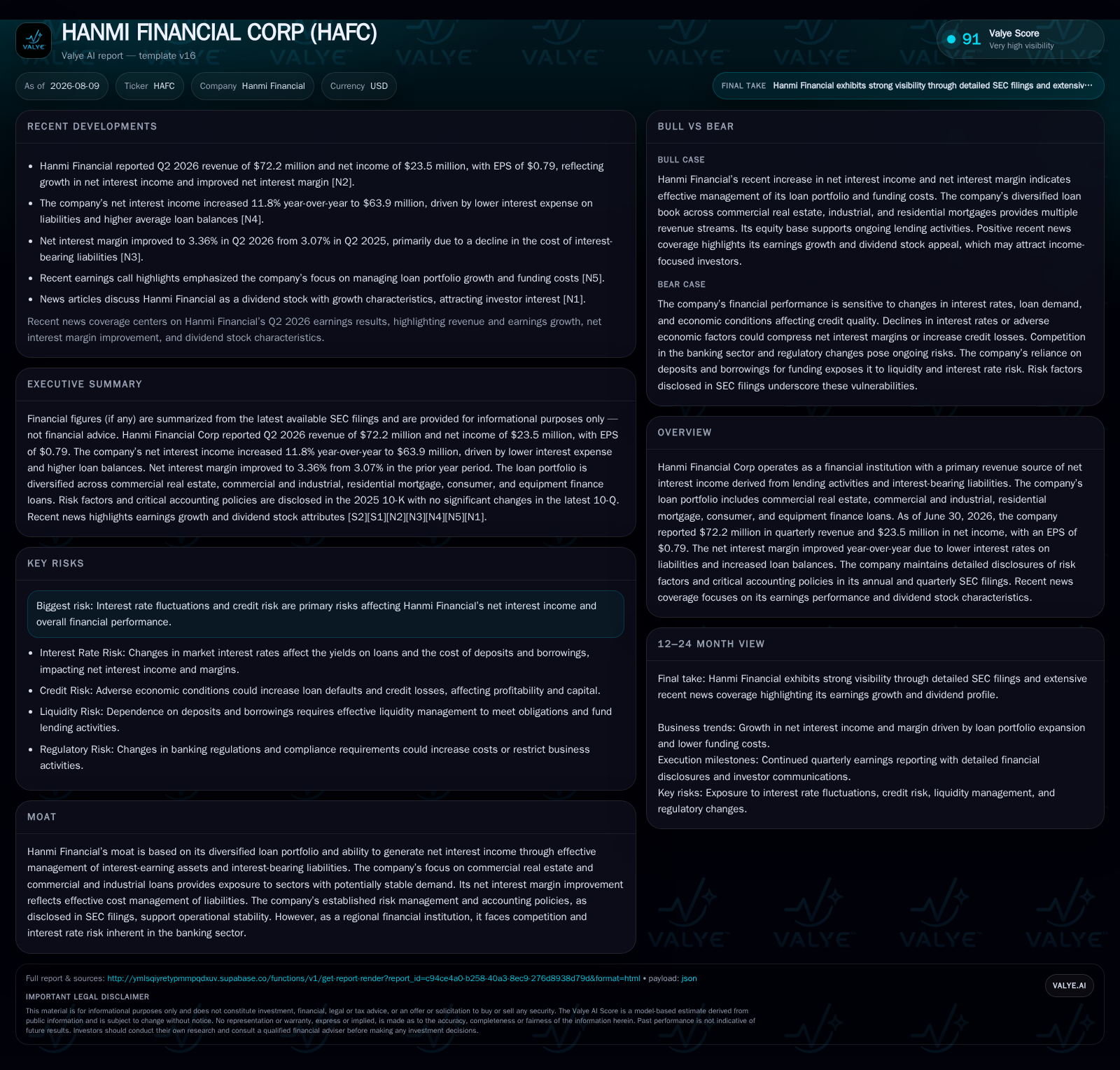
In its latest quarterly report, Hanmi Financial delivered $72.2 million in revenue and $23.5 million in net income, supported by an improved net interest margin driven by effective liability cost control amid a challenging interest rate environment [S2]. The company’s revenue base remains anchored in a diverse loan portfolio centered on commercial real estate and commercial & industrial loans, serving primarily Korean-American and multi-ethnic communities across several U.S. states [S1]. Capital adequacy remains robust, enabling continued dividend payments without regulatory strain [S5], while credit risk indicators have improved with declining non-performing loans [S19]. Going forward, execution on loan growth, deposit funding costs, and maintaining credit discipline will be key to sustaining earnings momentum in this competitive regional banking landscape.
Q2 Operating Performance Highlights: Margin Expansion and Loan Portfolio Growth
Hanmi Financial reported second quarter 2026 revenue of approximately $72.2 million alongside net income of $23.5 million, achieving earnings per share (EPS) of $0.79 driven by an improved net interest margin (NIM) compared to prior periods [S2], [N3]. This margin advance is attributable primarily to lower interest expense on liabilities, notably deposit funding costs that declined due to disciplined liability mix management despite a still-competitive lending yield environment reflecting current market rate pressures. The quarter’s results demonstrate tactical asset-liability management optimizing volume and pricing to navigate the ongoing volatile interest rate landscape—a crucial factor given regional banks’ sensitivity to Fed policy changes.
Loan balances grew during the quarter, with increases across core segments including commercial real estate and commercial & industrial loans that continue to underpin the firm’s primary source of net interest income. This operating leverage contributed to incremental revenue gains amidst ongoing competition within the regional banking sector [S2]. The steady improvement in core lending volumes combined with disciplined cost controls effectively boosted profitability metrics for the quarter.
Business Model Fundamentals: Loan Composition Drives Revenue Stability
Hanmi Financial’s business model centers on generating net interest income from a diversified portfolio comprising commercial real estate, commercial & industrial loans, residential mortgages, consumer lending, and equipment finance loans—each contributing varied yield profiles supporting overall revenue stability [S1], [S2]. This diversification reduces single-segment concentration risk while aligning closely with the financial needs of its niche markets.
The company predominantly serves Korean-American and other multi-ethnic immigrant communities across California, Colorado, Georgia, Illinois, New Jersey, New York, Texas, Virginia, and Washington—a footprint that supports culturally tailored banking solutions enhancing customer loyalty and deposit retention. Its localized full-service offices capitalize on deep community relationships which help maintain a steady deposit base crucial for funding lending activities at attractive spreads.
Revenue monetization focuses primarily on net interest income derived from these diversified loans funded through both noninterest-bearing and interest-bearing deposit accounts alongside borrowings. Fee income from service charges on accounts as well as gains from sales of SBA and residential mortgage loans further supplement earnings streams providing some insulation from net interest margin compression typical in lower-rate environments.
Industry Context: Competing in Regional Banking with a Multi-Ethnic Market Focus
In the broader regional banking landscape dominated by players like Regions Financial Corporation, Fifth Third Bancorp, and East West Bancorp, Hanmi's strategic concentration on ethnic niche markets offers differentiated customer acquisition advantages through tailored product bundles aligned with cultural nuances [S1].
Regulatory constraints notably impact dividend policies as capital adequacy thresholds mandate careful balance between shareholder returns and operational stability—an area where Hanmi has demonstrated prudent discipline maintaining a "well capitalized" status per regulatory definitions.
Loan Portfolio Composition: Balancing Credit Quality Against Growth Aspirations
Hanmi’s non-performing loans (NPLs) contracted sharply to $9.9 million at June 30, 2026 or just 0.12% of total assets—a marked improvement from $20.1 million or 0.26% at year-end 2025—reflecting both effective underwriting discipline and proactive credit surveillance during economically cautious periods [S19]. Specific allowances tied to these impaired loans similarly declined signaling confidence in recoverability.
The company continues managing concentrated exposures in commercial real estate segments that historically present cyclical vulnerability but remain a core growth engine given demand patterns within targeted communities. Such balance is monitored continually through stress testing scenarios outlined in the latest filings ensuring provisioning adequacy aligned with evolving risk landscapes.
Deposit Dynamics: Funding Costs and Liability Mix Management
Liability management strategies have notably reduced funding costs over recent quarters despite challenging rate environments that typically increase deposit pricing pressure. Hanmi finely tunes its deposit product offerings—from noninterest-bearing checking accounts favored by businesses requiring liquidity to higher-yield savings/money market accounts—to optimize cost efficiency consistent with liquidity needs [S1], [S2].
Interest-bearing deposits stood at approximately $4.78 billion with average rates paid dropping sequentially to about 3.17%, down from prior levels above 3.6% last year. Borrowings were also strategically scaled down where possible reducing expensive wholesale funding reliance; recent subordinated notes issuance reflects selective capital market access reinforcing liquidity without excessive leverage expansion [S18], [S3].
Such liability cost controls are critical contributors to sustaining net interest margins amid competitive lending spreads compressing due to external monetary policy influences.
Growth Drivers: Economic Trends and Demographic Tailwinds Supporting Demand
Underlying macroeconomic conditions shaping Hanmi's target markets continue providing favorable tailwinds for loan demand particularly within fast-growing Korean-American and immigrant business sectors exhibiting stable entrepreneurial activity across California and nearby regions covered by branch networks [S1].
Cross-selling opportunities across deposit accounts, SBA loans facilitated through government programs, equipment financing supported by growing small-business ecosystems further enhance growth potential beyond traditional commercial lending boundaries.
Technology investments improving digital banking experience also promise increased wallet share gains within younger demographic cohorts among these communities though explicit capex details were limited in the filings.
Risks to Monitor: Interest Rate Volatility, Credit Risk Exposure, Regulatory Compliance
Hanmi acknowledges principal risks including fluctuations in federal monetary policy impacting yield curves which directly influence the spread between asset yields versus funding costs affecting NIM sustainability; any prolonged inversion or rapid shifts pose challenges for asset-liability repricing velocities [S1], [S2].
Credit risk remains an operational focus despite improving NPL trends; economic slowdowns or industry disruptions could impair borrower payment capacity necessitating elevated provisioning which would pressure earnings.
Competitive threats arise not only from larger entrenched regional banks but also agile fintech lenders offering streamlined lending alternatives potentially eroding market share if not countered effectively.
Regulatory compliance burdens persist with capital adequacy ratios setting hard boundaries limiting excessive risk-taking or aggressive dividend distributions which require cautious internal capital planning.
What to Watch Next: Upcoming Milestones in Capital Adjustments, Loan Performance, and Dividend Policy
Investors should focus near term on ongoing quarterly updates tracking net loan growth velocity especially within core commercial real estate/industrial segments indicating sustained demand trends or early signs of softness post recent rate hikes.
Monitoring changes in deposit base compositions post issuance of new subordinated notes—the latter expected to close soon per July filings—will be informative regarding funding cost trajectories extending into late 2026 [S3], [S23].
Dividend declarations remain key signals of confidence balancing payout ratios against evolving capital buffers as highlighted by recent quarterly $0.28 per share distributions announced consistently over recent quarters affirming operational cash flow sufficiency while complying with state regulatory guidelines [S15]
Earnings calls accompanying next reporting cycles will clarify management’s outlook regarding competitive positioning adaptations including potential technology enhancements or market expansion steps relevant for long-term trajectory validation.
Financial Profile Discussion: Capital Adequacy Status and Dividend Sustainability
Hanmi maintains solid capital metrics characterized by total risk-based capital ratios above 14%, common equity Tier 1 (CET1) ratios near 13%, well above regulatory "well-capitalized" thresholds ensuring resiliency against economic downturn shocks or unexpected credit losses [S5],[S16],[S25].
This cushion underpins the company's ability to return capital via dividends without invoking undue supervisory restrictions while preserving flexibility for organic growth investment or opportunistic strategic initiatives.
Recent issuance of subordinated debt accords additional tier 2 capital augmentation enhancing overall balance sheet robustness facilitating measured expansion within prudential limits imposed by federal/state regulators [S3],[S23].
Overall financial position confirms Hanmi’s operational health rooted in strong recurring net interest income generation supplemented marginally by fee-income streams stabilizing profitability against an environment marked by ever-shifting external uncertainties inherent in regional banking operations.
Disclaimer: This analysis is based exclusively on publicly available information including SEC filings dated up to August 7, 2026, supplemented by verified news releases as referenced; it does not constitute investment advice or research view.
Disclaimer: This is research-only, informational analysis and not investment advice. It may include AI-generated interpretation and general industry context. Always verify important details using primary sources.

Comments