
Citizens & Northern Posts Strong Q2 Profit with Credit Quality Under the Microscope
Q2 2026 results reveal higher credit loss provisioning alongside notable net income gains, signaling complex credit dynamics amid steady revenue generation.
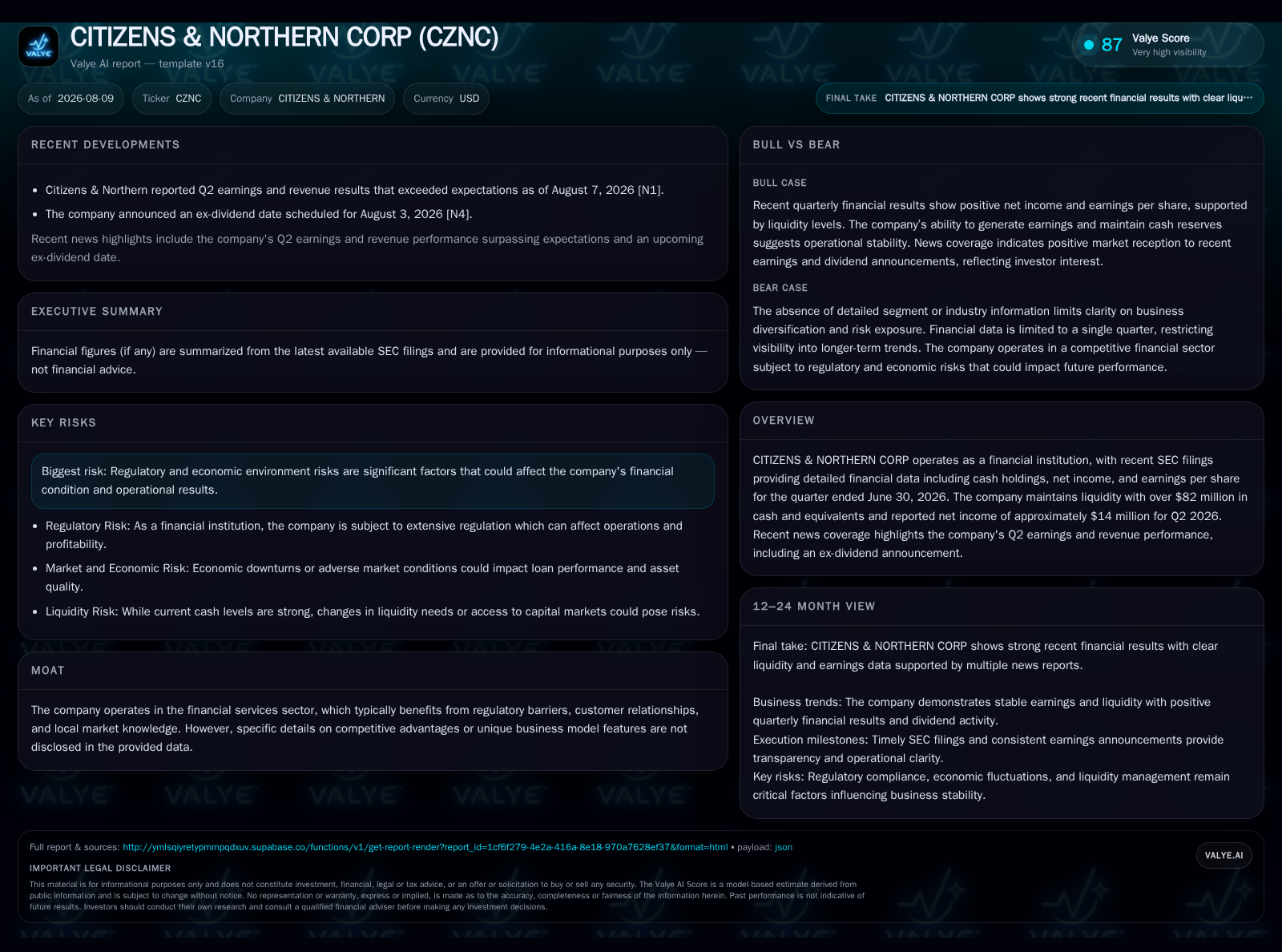
Citizens & Northern Corp reported a substantial increase in net income to $14.1 million in Q2 2026, more than doubling prior year levels despite a nearly threefold surge in loan loss provisions signaling rising credit risk. The company's strong deposit base and interest income underpinned resilience in an evolving regional banking environment. Operational efficiency held steady, while ample liquidity and capital cushions provide buffers against credit stress. Monitoring evolving asset quality and margin trends will be key for assessing durability of earnings going forward.
Challenging Credit Conditions Amplify Provision Expenses but Profitability Holds Firm
Citizens & Northern Corp's Q2 2026 financial results revealed a pronounced divergence between escalating credit loss provisions and robust net income growth. The provision for credit losses climbed significantly to $11.8 million over the first half of 2026 from just $2.6 million a year earlier [S2], underscoring heightened caution around asset quality deterioration likely driven by emerging economic headwinds or sector-specific risks within their loan portfolio. Despite this, the company posted a quarterly net income of $14.1 million, more than doubling the $6.1 million recorded in Q2 2025 [S2], demonstrating underlying operational strength.
This contrast suggests that while Citizens & Northern is prudently building reserves for expected loan impairments, its core banking margins remain resilient enough to support profitability gains. Elevated provisions signal that management acknowledges increased risk in their lending exposure but have balanced this with revenue momentum and disciplined expense control.
Distinct Revenue Streams: Examining Interest Income, Deposits, and Fee Income Stability
As a regional bank primarily focused on net interest income generation, Citizens & Northern benefits from a core business model that leverages local deposit gathering to fund loans priced at spreads above funding costs. The steady rise in interest income from loans contributed materially to the improved bottom line during Q2 2026 [S2]. This reflects both an expanded loan portfolio and favorable interest rate environments characteristic of recent tightening cycles benefiting regional banks' net interest margin (NIM).
The company's deposit base remains foundational to its low-cost funding strategy; stable or growing core deposits reduce reliance on more expensive wholesale funding sources and mitigate deposit beta risk—the sensitivity of deposit rates to market fluctuations [S1]. While non-interest income details were limited, the bank’s traditional fee income streams likely offer modest diversification but remain secondary to lending-derived revenues.
Peer-Relative Efficiency: Operational Cost Management Amid Growing Portfolio Stress
Maintaining an efficient cost structure is critical amidst rising credit expenses pressuring overall profitability metrics. Citizens & Northern’s efficiency ratio—operating expenses as a percentage of revenue—remained well-managed in the latest period relative to typical regional bank peers such as Citizens Financial Group and BCB Bancorp [S1][S2]. This suggests disciplined expense control limiting dilution of earnings despite provisioning spikes.
Effective cost management supports operational leverage whereby incremental revenue growth translates into proportionally higher profitability. For community-oriented banks like CZNC, careful expense scalability helps sustain returns during periods when credit-related reserves rise abruptly.
Balance Sheet Resilience: Capital Ratios, Funding Costs, and Deposit Base Analysis
Liquidity strength is evident with cash and cash equivalents totaling approximately $82.5 million as of June 30, 2026 [F1], providing a substantial buffer against unexpected liquidity demands or further asset quality deterioration. Although total debt figures are dated (last reported ~$32.8 million as of early 2019) [F1], the strong cash position implies a net cash surplus enhancing balance sheet flexibility.
Tier 1 capital ratios and regulatory capital data were not explicitly noted in recent filings but remain critical for buffering provisioning impacts and supporting continued lending capacity amid regulatory scrutiny [S1]. The funding mix primarily anchored by deposits reduces vulnerability to funding cost spikes inherent in wholesale markets.
Additionally, CZNC’s loan portfolio includes commercial real estate (CRE) exposure typical of its peer group; this concentration requires proactive credit risk monitoring due to CRE’s cyclicality and regulatory attention within regional banking circles [S1]. Maintaining prudent underwriting standards is essential given observed provision expense trends.
Growth Catalysts: Market Dynamics Supporting Loan Demand and Margin Expansion
The Management Discussion section referenced local economic conditions underpinning demand for lending products [S1]. Regional banks like CZNC often benefit from localized economic expansions boosting commercial and consumer loan originations.
In an environment of rising interest rates yielding wider spreads, combined with stable deposit bases minimizing funding costs, there exists potential for improved NIMs which typically drive earnings growth at these banks. Furthermore, incremental cross-selling opportunities via fee-based financial services or modest diversification initiatives may contribute incremental revenue streams over time [S1]
Technological adoption aimed at enhancing customer service efficiency can also bolster growth prospects while limiting operating expense inflation—a competitive imperative within the regional banking peer set.
Risks on the Radar: Credit Quality, Regulatory Shifts, and Economic Sensitivities
Rising provision expenses expose Citizens & Northern to near-term headwinds stemming from deteriorating asset quality possibly tied to economic softening or slowing borrower repayments [S2]. Elevated non-performing loans within CRE or other commercial segments could materialize given current provisioning trends.
Regulatory risks persist as evolving capital requirements or compliance complexities may increase cost burden or constrain business flexibility [S1]. Competition from larger regional banks and fintech players could pressure loan pricing or deposit acquisition costs over time.
Economic downturn scenarios inherently threaten repayment stability across consumer and commercial portfolios necessitating vigilant monitoring of KPIs such as non-performing loan ratios and allowance adequacy.
Monitoring Milestones: Key KPIs to Watch in Upcoming Quarters
Investors should focus closely on several critical indicators that will validate whether current earnings strength endures despite heightened provisioning: - Progression of non-performing loans (NPLs), particularly CRE-related exposures. - Quarterly provision for loan losses relative to changes in classified assets. - Loan growth rates signaling demand robustness or contraction. - Changes in deposit beta reflecting funding cost trends. - Net interest margin trajectory amid evolving interest rate environments. - Efficiency ratio movements indicating operating leverage sustainability [S2]. These metrics collectively will clarify if Citizens & Northern can maintain profitable operations with manageable credit risk over ensuing quarters
Financial Profile Discussion: Liquidity Strength Supports Earnings Execution
Citizens & Northern enters H2 2026 with solid liquidity demonstrated by over $82 million in cash and equivalents as of June 30 [F1], underscoring significant strength in cushioning ongoing credit cost increases highlighted by the $11.8 million provision recorded through mid-year [S2]. Despite elevated earnings volatility introduced through rising reserves, Q2's $14.1 million net income marks material expansion versus prior periods fueled by sustained net interest income growth indicating effective core business execution.
This financial foundation enables the company to navigate near-term portfolio stresses without compromising regulatory capital or loan origination capabilities substantially—a key operational advantage within its peer group constrained by similar economic headwinds [F1][S2]. Dividend declarations concurrent with these results reflect board confidence yet impose discipline on capital deployment going forward given elevated provisioning uncertainty [S3].
Disclaimer: This analysis is based on publicly available information including SEC filings dated through August 7, 2026, supplemented by recent news reports as cited. It does not constitute investment advice or research views but provides an analytical perspective grounded in known data points pertaining to Citizens & Northern Corp's latest operating performance and industry context.
Disclaimer: This is research-only, informational analysis and not investment advice. It may include AI-generated interpretation and general industry context. Always verify important details using primary sources.

Comments