
Geospace Technologies Advances Through Diversification and Seismic Innovation
Geospace leverages a strong multi-year contract backlog and diversified segments to stabilize revenue amid energy market cyclicality.
Geospace Technologies' latest Q3 2026 disclosures reveal a substantial $98 million backlog of unsatisfied performance obligations primarily tied to contracts recognized over time, supporting near-term revenue visibility. The company’s diversified business model spanning Smart Water, Energy Solutions, and Intelligent Industrial segments helps mitigate the inherent cyclicality in oil and gas exploration spending. R&D investments underpin innovations in seismic data acquisition and IoT-enabled smart water management devices, bolstering competitive differentiation. Financially, Geospace maintains a solid liquidity position with no conventional debt beyond customer-financed promissory notes collateralized by sold products.
Near-Term Revenue Visibility Brightened by Strong Contract Backlog
The predominance of cost-to-cost revenue recognition requires accurate project execution tracking but also signals transparent contract accounting aligned with performance progress. The combination of contract duration extending past one year yet recognized steadily through project costs allocated supports smoother revenue streams that partially buffer volatility seen in oilfield services peers reliant on discretionary capex cycles.
Multi-Segment Business Model Mitigates Energy Sector Volatility
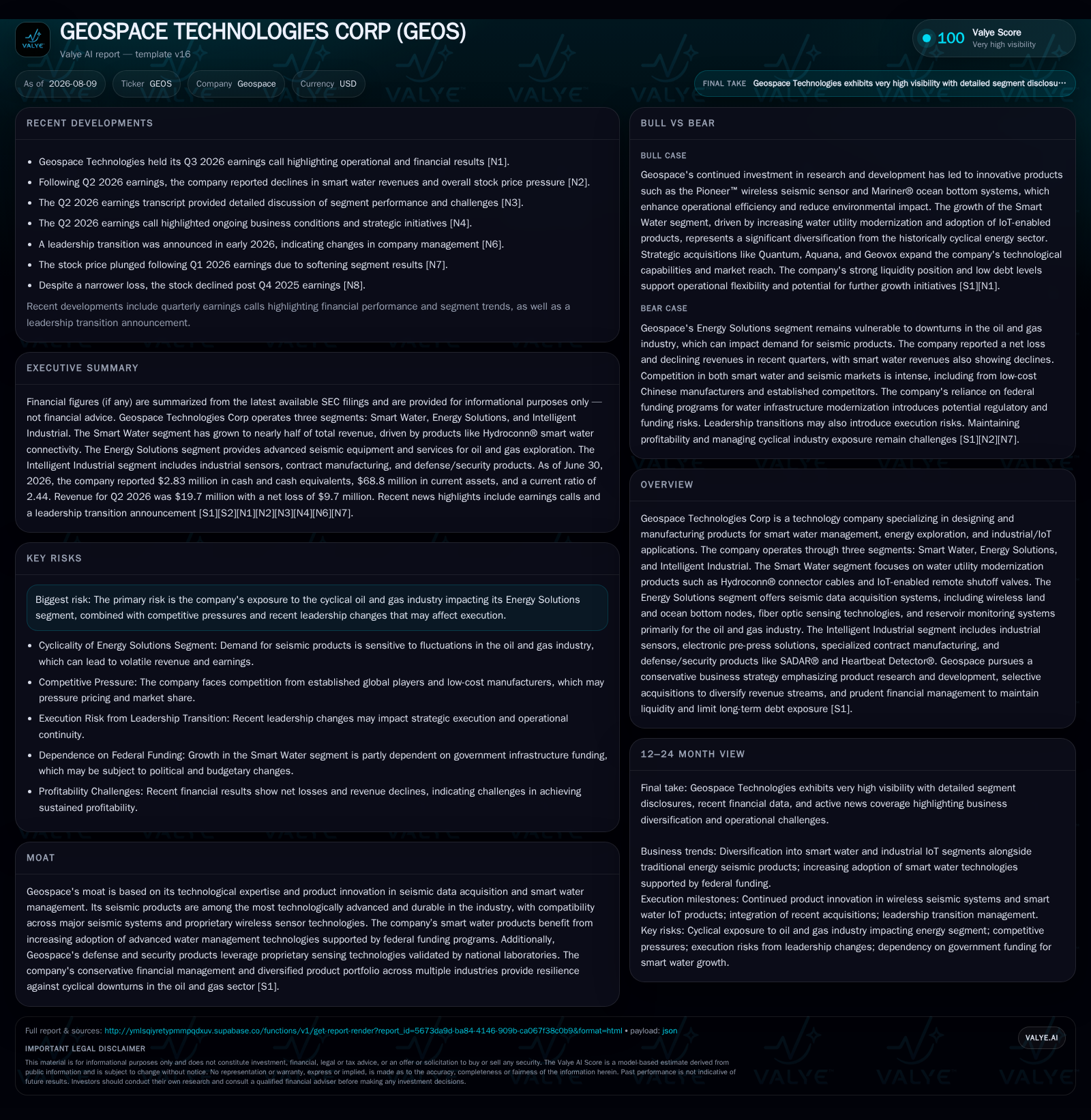
Geospace categorizes its offerings into three reportable business segments: Smart Water, Energy Solutions, and Intelligent Industrial [S1]. As outlined in the November 2025 annual report, nearly half of the company's total revenue now derives from Smart Water solutions focusing on water utility modernization products such as the Hydroconn® waterproof connector cables and IoT-enabled remote shutoff valves. This shift towards infrastructure-related smart devices aligns with broader federal and state funding programs targeting aging water systems modernization.
Conversely, the Energy Solutions segment continues concentrating on seismic data acquisition hardware including wireless land nodes, ocean bottom nodes (OBN), fiber optic sensing technologies, and reservoir monitoring systems aimed at hydrocarbon exploration [S1]. While providing strategic exposure to energy exploration markets integral to global oil and gas supply chains, this segment's performance is sensitive to commodity price-driven exploration cycles observed broadly among seismic equipment peers like CGG or Halliburton.
The Intelligent Industrial segment further diversifies revenues by offering industrial sensors, electronic pre-press solutions, specialized contract manufacturing services leveraging manufacturing capabilities across segments, as well as defense/security-oriented products such as SADAR® sensing systems validated through national laboratory partnerships [S1]. This broad product set provides partial insulation against cyclical pressures seen in energy markets by tapping growing industrial automation trends.
Recent changes in cost allocation methodology between segments suggest active resource prioritization management reflecting shifting demand patterns and strategic focus [S1].
Technological Differentiation in Seismic Data and Smart Water Devices
A cornerstone of Geospace's competitive positioning lies in its sustained investment in R&D activities which totaled approximately $13.1 million for the nine months ended June 30, 2026—a slight reduction from $14.4 million in the comparable period prior year—underscoring continued emphasis on engineering innovation [S4]. Engineering personnel constitute a majority of these expenditures given their centrality to new product development across all three core segments.
Innovations include proprietary wireless sensor technologies embedded in seismic acquisition systems enhancing durability and interoperability across various exploration platforms. Fiber optic sensing technology developments enable advanced reservoir monitoring capabilities critical for real-time hydrocarbon extraction efficiency. In smart water management applications, Geospace's Hydroconn® connector cables offer reliable connectivity solutions increasingly adopted by municipal utilities inclined toward digital transformation.
Competitive Dynamics Shaping Segment Growth Opportunities
In Energy Solutions, Geospace operates within a volatile market subject to shifting upstream capital budgets governed largely by global crude price dynamics [S1]. Peers such as CGG exemplify how seismic providers endure booms during high exploration spending and busts during downturns. Proprietary wireless node designs contribute some pricing resilience due to switching costs associated with deployment compatibility.
Smart Water products benefit from regulatory mandates driving water utility modernization nationwide. Comparable firms like Xylem or Mueller Water Products illustrate growing adoption trends fueled by infrastructure grants—segments less sensitive to oil cycles but more dependent on public sector funding availability.
The Intelligent Industrial division's diversification into contract electronics manufacturing aligns structurally with firms like Flex or Jabil but focuses more heavily on ruggedized sensor solutions tailored for defense/security sectors [S1]. These markets demand reliability certifications potentially restricting commoditized competition but requiring sustained R&D investment.
Overall pricing power varies segment-wise: Energy Solutions face cyclical pricing pressure balanced partially by technology differentiation; Smart Water benefits from steady regulated demand; Intelligent Industrial depends on niche high-spec product uniqueness.
Emerging Growth Catalysts from IoT and Industrial Automation
Growth drivers are multifaceted: advancing adoption of IoT-enabled devices underpin expanding Smart Water revenues through increased installation of remote shutoff valves providing utilities digitized monitoring/control capabilities [N1]. Federal/state infrastructure funding programs serve as external accelerants supporting capital deployments in aging water systems.
In industrial automation, client interest in sophisticated industrial sensors combined with specialized contract manufacturing capability positions Geospace favorably to capitalize on secular trends toward connected factory deployments enhancing operational efficiencies.
Energy Solutions’ long-term growth hinges on improving hydrocarbon exploration activity driven by global energy demand recovery phases coupled with elevated exploration spending that leverages Geospace’s reservoir monitoring enhancements via fiber optic sensing technology.
Recurring revenues via subscriptions or maintenance services remain a smaller proportion but represent an expansion opportunity for solution stickiness especially within Smart Water where IoT platform integration can drive ongoing service contracts [S1]. Monitoring the evolving share of recurring revenue will clarify stability prospects.
Watchpoints: Oil Market Cycles, Contract Execution Risks, and Leadership Stability
Critical risks persist around the inherent cyclicality linked directly to commodity price fluctuations impacting Energy Solutions’ order intake and backlog conversion rates [S1]. Contract execution complexity under ASC Topic 606 cost-to-cost revenue recognition demands precise project management; any deviations could delay revenue realization or affect operating income.
Leadership changes cited without detail remain potential execution risks necessitating scrutiny particularly around R&D prioritization consistency and cross-segment coordination.[S1] Vigilance is warranted regarding customer concentration especially given sizeable promissory notes linked to specific customers totaling approximately $11 million collateralized by sold products entered during FY 2026 [S2]. Such financing arrangements introduce credit risk considerations albeit mitigated by collateral securing principal repayment.
Execution discipline surrounding long-duration contracts remains key going forward; confirmation of sustained backlog conversion will be instrumental for validating near-term earnings visibility [N1]
Upcoming Indicators: Backlog Conversion Rates and R&D Pipeline Milestones
Analysts should closely monitor subsequent quarterly communications detailing order intake trends alongside re-contracting or renewal rates for multi-year energy solutions agreements [S2]. The cadence at which the $98 million backlog transforms into reported sales will give tangible evidence regarding operational momentum.
Additional meaningful signals will come from emerging R&D outputs translating into commercialized product upgrades or novel offerings across smart water connectivity or seismic monitoring product lines that could drive future orders [S4]
Customer diversification patterns will also merit evaluation given historical reliance on a few major clients for large orders; broader customer base penetration may reduce concentration risk effects inherent in specialized technology markets.
Financial Profile Discussion: Liquidity Strength Amid Conservative Capital Strategy
As of June 30, 2026, Geospace reported cash and equivalents totaling approximately $2.83 million supported by current assets amounting to nearly $68.8 million versus current liabilities just over $28.2 million resulting in a robust current ratio around 2.44—implying sufficient short-term liquidity coverage [F1]
The company carries no traditional bank debt apart from several customer-financed promissory notes related to product sales aggregating about $11 million bearing interest rates between 8.75% and 10%, maturing between January 2027 and January 2029 with monthly repayment schedules secured against the sold product collateral [S2]. This structure preserves financial flexibility while offloading certain credit risks onto customers under predefined terms.
Operating losses persist reflecting ongoing investments focused primarily on technology development; however, these reflect deliberate strategy execution rather than structural weakness.[F1][S1]
Conservative balance sheet management buttresses runway for continuous innovation spending essential for sustaining competitive advantage amid evolving industry demands.
This analysis integrates recent filings through August 7, 2026 ([S1], [S2], [S3], [S4]) with industry context drawn from standard sector knowledge frameworks. It refrains from speculative forward-looking statements not supported directly by disclosed metrics or verified corporate disclosures.
Disclaimer: This is research-only, informational analysis and not investment advice. It may include AI-generated interpretation and general industry context. Always verify important details using primary sources.

Comments