
Simpson Manufacturing Strengthens Market Leadership Through Product Innovation and Operational Efficiency
Simpson Manufacturing’s Q2 2026 results demonstrate robust margin performance and strategic progress amid housing market cyclicality.
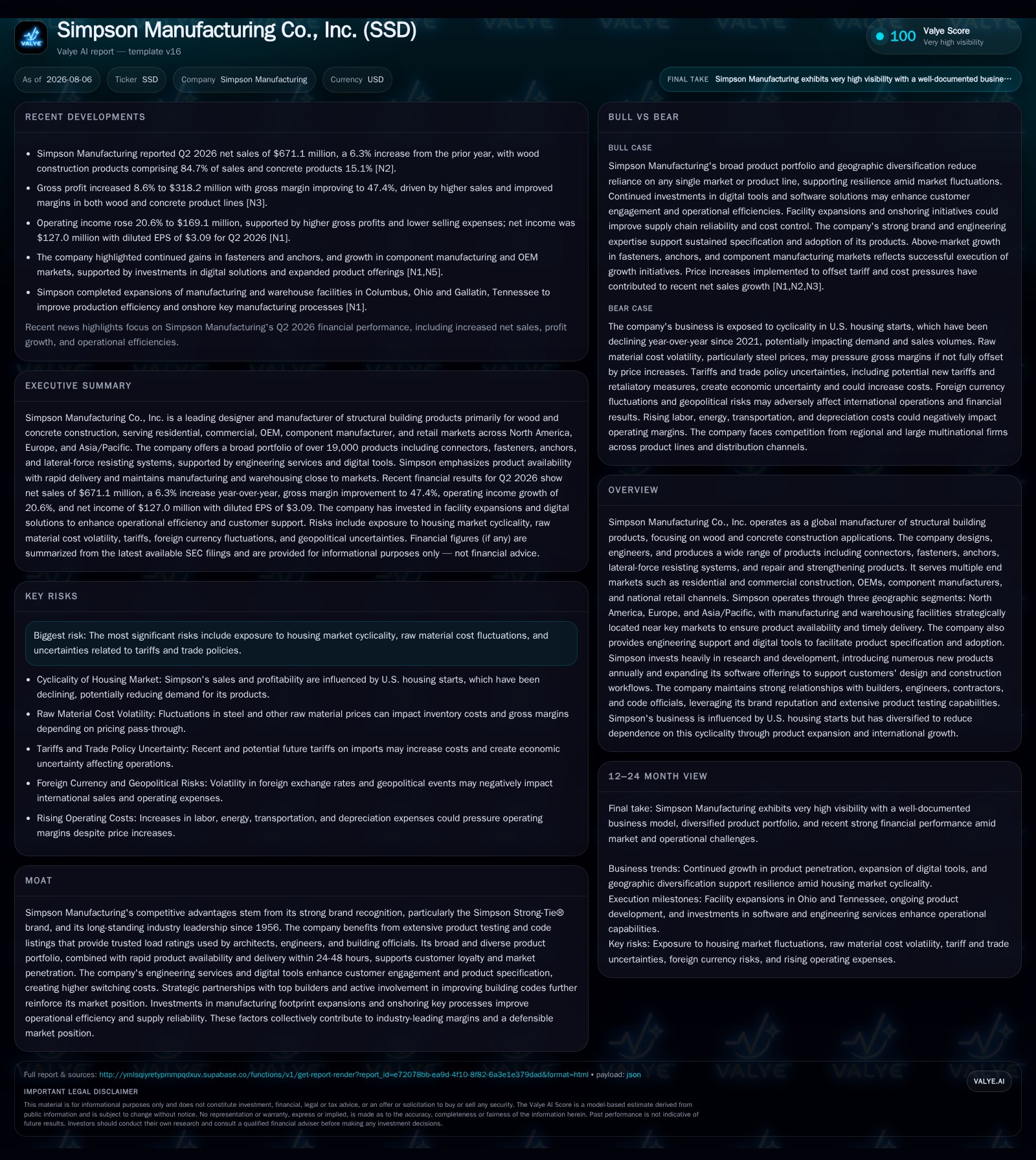
In its Q2 2026 filing, Simpson Manufacturing Co., Inc. reported solid net sales growth and expanding operating income margins driven by effective pricing strategies, cost management, and sustained product innovation. The company’s leadership in engineered structural connectors, fasteners, and anchors is underpinned by rigorous product testing, broad regulatory compliances, and a manufacturing footprint emphasizing rapid delivery to key markets. While exposure to residential construction cycles remains a risk factor, Simpson’s commitment to engineering services, digital specification tools, and geographic diversification supports resilient demand and incremental market penetration. The company’s strong liquidity and conservative balance sheet position it well to pursue ongoing R&D investments and expand its product portfolio.
Q2 2026 Results Highlight Margin Resilience Amid Construction Cycles.
Such results are notable given the company’s significant exposure to U.S. housing starts—the primary driver of demand for wood construction products like structural connectors and fasteners—and residential remodeling activity, both of which have shown weakness since 2021 [S1][S2]. Simpson’s ability to maintain operating income margins at or above their target (~20%) amidst these dynamics underscores the durability of their business model anchored on differentiated product offerings supported by engineering expertise.
Engineering Innovation as Core Backbone: Proprietary Product Pipeline Development
Central to Simpson's competitive positioning is its sustained commitment to research and development aimed at expanding its suite of load-rated construction products. R&D efforts focus on proprietary designs safeguarded through patents or trade secrets coupled with continuous enhancements that meet evolving building codes across North American and international markets [S1]. This facilitates entry into new geographic markets while reinforcing existing share through expanded product lines such as lateral-force resisting systems for wood framing or fiber-reinforced polymer repair materials for concrete applications.
The rigor of Simpson’s product testing protocols—frequently validated by independent labs ensuring compliance with seismic, wind uplift, and other structural load requirements—generates trusted load ratings referenced by architects, engineers, contractors, and building officials alike. This comprehensive code-listing coverage creates substantial switching costs because alternative suppliers often lack comparable certifications or breadth at similar quality standards. Such characteristics solidify the company's moat vis-à-vis peers like Hilti or Fastenal that operate with narrower product scopes or less integrated engineering services.
Manufacturing Footprint Proximity Enables On-Time Delivery Excellence
A key enabler for customer satisfaction and market penetration is Simpson’s strategically located manufacturing and warehouse network positioned near major demand centers across North America as well as European operations primarily servicing residential and commercial construction segments there [S1][S2]. This proximate footprint allows adherence to industry-critical just-in-time logistics expectations—with product delivery turnaround times generally within 24 to 48 hours—even for special orders.
This manufacturing agility supports high on-time delivery rates—a KPI intimately tied to retaining builder loyalty who rely on uninterrupted project schedules—and mitigates risks inherent in complex supply chains characterized by raw material sourcing volatility or transportation delays common in construction markets. By contrast, competitors with more centralized production or inventory allocation may face longer lead times impairing service levels.
Broad End-Market Exposure with Strategic Emphasis on Residential Growth
Simpson's revenue streams are diversified across several end-use categories: residential construction remains the largest segment where products such as connectors, fasteners, truss plates, lateral-force systems are heavily utilized; commercial projects follow; alongside sales to OEMs producing prefabricated components; component manufacturers; and through national retail distribution channels servicing contractors directly [S2][S1]
This multi-channel distribution strategy broadens the company’s addressable market but also introduces variability linked to fluctuations in housing starts—a historically cyclical factor—as well as capital spending patterns in light commercial builds. Management explicitly acknowledges this exposure as a principal risk alongside economic conditions impacting builder confidence or financing availability that could dampen demand volumes [S1].
Competitive Edge Through Brand Recognition Supported by Rigorous Product Testing
The longstanding industry presence dating back to 1956 combined with the strength of the Simpson Strong-Tie® brand provides formidable competitive advantage in gaining customer trust and maintaining premium pricing power relative to lesser-known or commoditized players. Extensive catalogues backed by technical data sheets detailing rigorous load ratings—verified through third-party testing laboratories—enable architects and engineers to confidently specify Simpson products in code-compliant designs.
Competitors such as Hilti similarly prioritize anchoring customer relationships via product reliability but often focus more narrowly on fastening technologies or power tools without the comprehensive wood framing connector offering that Simpson maintains. Meanwhile distributors like Fastenal cater broadly to fastener needs but do not typically match Simpson’s integration of engineering support services nor their comprehensive code certification footprint.
Growth Catalysts: New Product Introductions and Digital Tool Expansion
In addition to physical product innovation, Simpson has ramped investment into software solutions facilitating digital specification workflows that reduce builder labor time/costs while improving accuracy during design phases—critical for scaling adoption among component manufacturers, builders, lumber yards, DIY home improvement segments and others [S1][N1]. These digital specification tools deepen customer engagement thereby raising switching costs while enabling more seamless integration within complex construction supply chains.
Business commentary from mid-2026 highlighted continued pipeline activity introducing enhanced connectors with improved load capacities aligned with recent code updates plus expanding mass timber system solutions catering to sustainability trends—further supporting incremental growth opportunities across existing customer bases [N1]
Risks from Housing Cyclicality and Raw Material Volatility Demand Vigilance
Principal risks remain tied tightly to macroeconomic factors affecting residential construction cycles including consumer confidence, interest rates, capital availability for builders/developers/consumers along with raw material cost fluctuations impacting gross margins directly (e.g., steel prices) [S1][S2]. Additionally noted is supplier consolidation among distributors increasing bargaining power thereby potentially pressuring margins if price pass-through capabilities diminish.
Management initiated proactive cost control measures during fiscal year 2025—including workforce rationalization aligned with demand forecasts—targeted at achieving roughly $30 million annualized savings mainly via reduced operating expenses demonstrating prudent stewardship amid uncertainty [S27]. Monitoring long-term impacts of tariff policy changes or commodity inflation remains critical given their effects on pricing strategies applied through the supply chain.
Execution Triggers: Watch for Backlog Dynamics and Customer Adoption Rates
Key indicators going forward will include order backlog volume shifts signaling builder confidence trends plus measurable uptake rates for newly launched digital collaboration tools evidencing deeper customer penetration beyond traditional physical components [S2][N1]. Observing any meaningful divergence between price- versus volume-driven net sales changes can also illuminate demand elasticity under varying housing market conditions.
Incremental expansion into regions outside core North America markets—namely Europe where relatively smaller scale exists but growth potential is rising per favorable regulatory shifts—warrants attention as part of assessing strategic execution effectiveness against stated objectives around achieving above-market volume increases relative to U.S. housing starts [S2][S1]
Financial Profile Discussion: Solid Liquidity Supports Strategic Initiatives
From a financial perspective at June 30, 2026 quarter-end, Simpson held cash and equivalents of approximately $451 million alongside a strong current ratio near 3.29, reflecting ample short-term asset coverage of liabilities [F1]. It does not constitute investment advice or research views.
Disclaimer: This is research-only, informational analysis and not investment advice. It may include AI-generated interpretation and general industry context. Always verify important details using primary sources.

Comments