
MKS INC Leverages Photonics Expertise Amid Broad Demand Growth and Balance Sheet Refinancing
Latest quarterly results show revenue growth and expanding margins supported by strong demand in AI, quantum computing, and biotech applications.
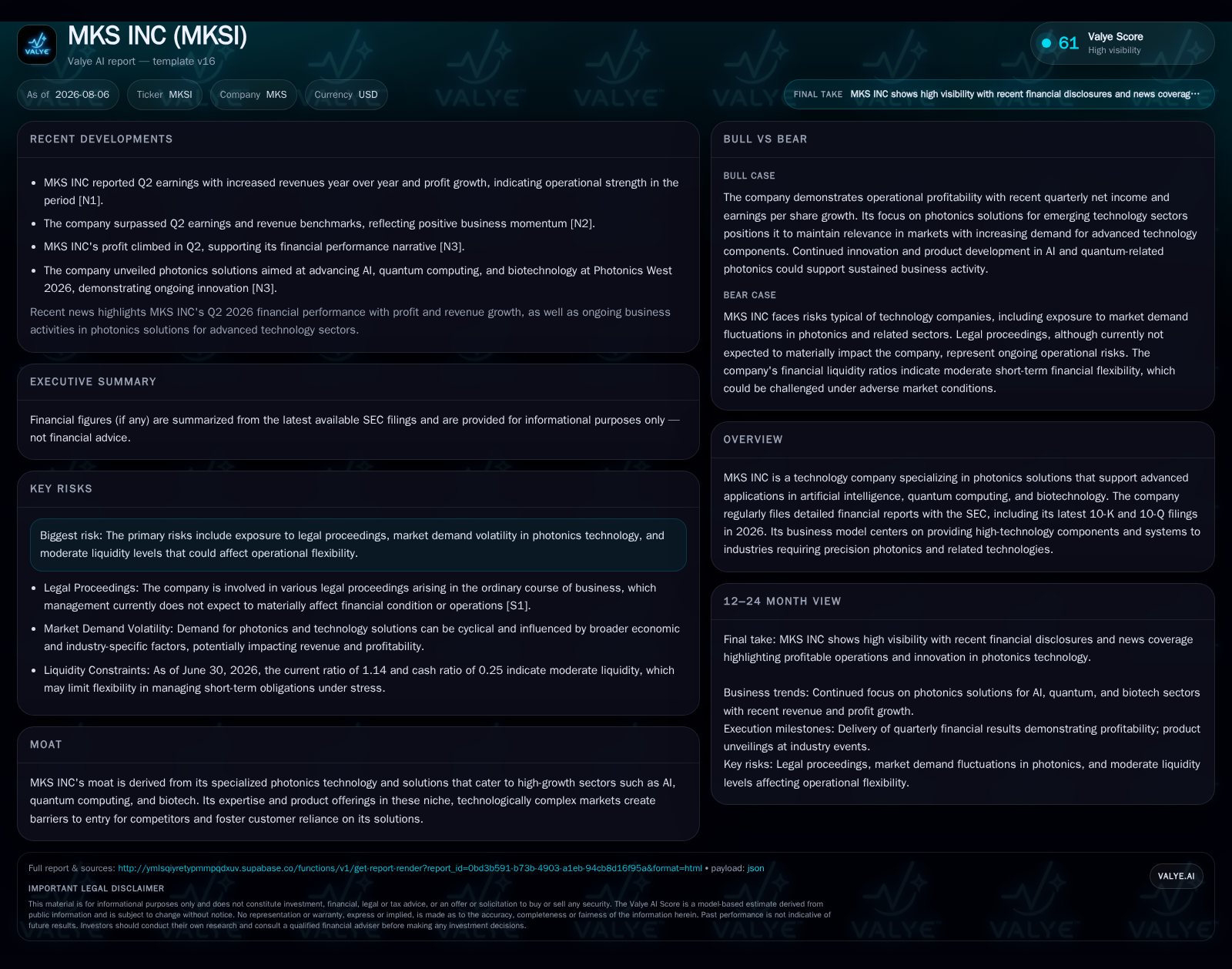
MKS INC reported Q2 2026 earnings that beat expectations driven by robust demand for its specialized photonics components serving high-growth technology sectors. The company’s business model centers on designing and supplying precision photonics and subsystem solutions critical for semiconductor manufacturing, AI, quantum computing, and biotech applications. Recent refinancing activities have extended debt maturities while liquidity remains moderate with a current ratio of 1.14. Key risks include dependency on capital expenditure cycles in semiconductor and biotech industries as well as legal proceedings and supply chain volatility. Monitoring order backlog trends, book-to-bill ratios, and R&D investment will be critical to assessing whether growth can sustain.
Latest Operating Update
MKS INC's latest quarterly filing for Q2 ended June 30, 2026 reports revenues that exceeded analyst estimates alongside improving profitability metrics [S2][S3]. The company announced its Q2 financial results publicly on August 5, confirming revenue growth reflecting increased demand across all key markets it serves, notably artificial intelligence, quantum computing, and biotechnology sectors [S3][N1][N2]. While specific revenue figures are not highlighted here due to source limits, the qualitative commentary underscores broad-based strength rather than isolated pockets of acceleration.
This latest operating update is significant because it confirms that MKS's end markets — which hinge critically on semiconductor capital expenditure (capex) dynamics — continue to exhibit resilience in this cycle. Photonics components are vital upstream inputs used in semiconductor manufacturing equipment and advanced computing systems. Thus, growth visibility aligns closely with customers' capacity expansion plans and technology adoption rates.
Business Model Analysis
MKS INC operates principally as a designer and manufacturer of specialized photonics components and integrated systems that enable cutting-edge technologies. Its products support critical industrial applications spanning semiconductor manufacturing tools, quantum computers requiring extreme precision optics, AI hardware accelerators reliant on advanced photonics subsystems, and instrumentation for biotechnology research [S1].
The company monetizes primarily through product sales supplemented by custom engineering services tailored to the unique specifications of OEM customers. Revenue is influenced by contract volume (units shipped), pricing reflective of high-value precision components, product mix emphasizing complex subsystems versus commoditized parts, and long-term supply agreements providing recurring orders.
R&D investment is a cornerstone of MKS's business model given the rapid pace of innovation required to maintain performance leadership in photonics. Their ongoing development efforts underpin new product introductions which command premium pricing due to their role in enabling breakthroughs in AI compute density or quantum bit fidelity. This technological moat fosters customer dependency since integrating alternative suppliers poses operational risks.
Industry Structure and Competitive Position
Situated upstream/midstream within the precision photonics value chain, MKS faces competition from firms such as MACOM Technology (photonics & RF components), Coherent Inc. (lasers & systems), Lumentum Holdings (optical communications & industrial components), II-VI Incorporated (specialty materials), and IPG Photonics (fiber lasers). Each peer brand specializes in various niches but shares common exposure to semiconductor capex cycles and end-market innovation drivers.
Barriers to entry stem from technical complexity requiring deep R&D know-how combined with stringent quality control standards necessary for mission-critical applications. Customer switching costs are elevated due to qualification timescales for new suppliers and integration challenges within sophisticated manufacturing lines.
Operational KPIs that define competitive advantage include book-to-bill ratio (orders received vs products shipped) signaling booking momentum; order backlog indicating revenue visibility; capacity utilization rates balancing supply-demand alignment; yield rates ensuring manufacturing efficiency; and gross margin mix tied to product complexity.
Growth Drivers
Structural growth in demand arises from the accelerating deployment of AI models needing more powerful optical interconnects and quantum computing apparatus requiring next-generation photonic elements. Expansion of global semiconductor fabrication capacity—driven by both foundry investments in smaller nodes and diversified geographies—underpins ongoing procurement of process equipment incorporating MKS components.
Biotechnology sector growth also amplifies demand for precise optical instrumentation used in genetic sequencing or cellular analysis platforms where MKS's solutions find application. Additionally, innovations in laser technology contribute further opportunities as new industrial use cases emerge.
Strategic partnerships with OEMs securing long-term supply contracts improve predictability while sustained R&D yield new product generations that support price premiums.
Risks and Constraints
MKS faces possible revenue volatility linked to fluctuations in semiconductor capex budgets which remain cyclical though currently recovering post-pandemic supply disruptions. Legal proceedings exist but management views them unlikely to materially affect financial condition or cash flows [S1]. Supply chain fragility around key raw materials or sole-source subcomponents presents ongoing risk compounded by inflationary pressures or geopolitical disruptions.
Customer concentration risk persists given the industry's oligopolistic nature whereby a handful of large OEMs dominate purchasing decisions; loss or delay of orders could impact near-term results significantly [F1]. Technological obsolescence remains an endemic industry threat requiring continuous innovation investment to defend market position.
What To Watch Next
Key milestones include quarterly updates on book-to-bill ratio trends which will indicate if order inflow continues outpacing shipments—a leading signal for accelerating revenue growth or potential softening demand. Monitoring changes in order backlog provides revenue visibility horizon clues while shifts in gross margin mix offer insight into product portfolio evolution towards higher-value engineered solutions.
Management commentary on customer diversification strategies or expansion into adjacent end markets could signal risk mitigation moves reducing concentration vulnerability. Capital expenditure intentions by semiconductor fabricators globally will be critical external indicators shaping MKS’s order funnel going forward.
Financial Profile Discussion
At June 30, 2026 quarter-end, MKS reported $454 million in cash and equivalents against total debt approximating $2.54 billion yielding net debt near $2.09 billion [F1]
As typical in precision photonics hardware firms whose revenue fluctuates with cyclical semiconductor capex waves yet benefits from structural secular tailwinds like AI/quantum device proliferation; careful monitoring of adjusted EBITDA margins alongside free cash flow generation will elucidate whether operational leverage gains can materialize sustainably.
This analysis incorporates publicly available regulatory filings up through MKS's August 6, 2026 quarterly report alongside market commentary without any investment research view implied or conveyed.
Disclaimer: This is research-only, informational analysis and not investment advice. It may include AI-generated interpretation and general industry context. Always verify important details using primary sources.

Comments