
Metalpha Technology's Quantitative Trading Edge Amid Crypto Volatility Challenges
Metalpha’s latest quarterly filing reveals operational refinements in risk management and trading strategy amid persistent cryptocurrency market uncertainties.
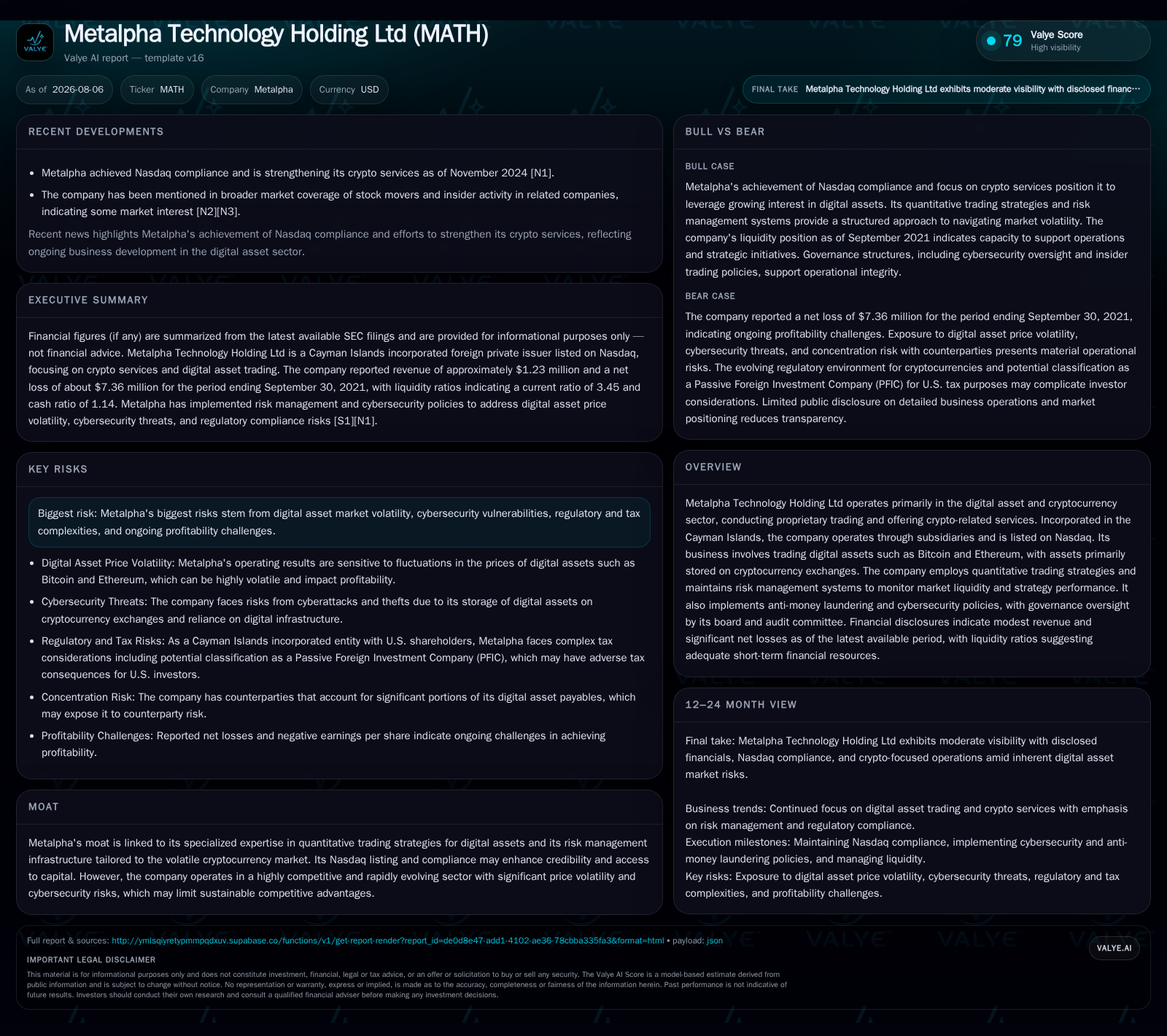
Metalpha Technology Holding Ltd, a Nasdaq-listed Cayman Islands entity specializing in proprietary trading of digital assets like Bitcoin and Ethereum, disclosed its Q1 FY2026 operational update emphasizing reduced counterparty concentration risk and enhanced cybersecurity measures. The company’s business model leverages quantitative trading strategies executed on major cryptocurrency exchanges, navigating extreme price volatility through continuous risk controls and systematic performance analytics. Despite modest trading revenue and significant net losses reflective of broader sector challenges, Metalpha maintains adequate liquidity as indicated by a strong current ratio. Industry-wide risks including market fluctuations, regulatory ambiguity, and cyber threats remain central to the firm’s outlook.
Latest Quarterly Filing Spotlight: Operating Shifts and Risk Profile Adjustments
Metalpha Technology Holding Ltd’s August 6, 2026 Form 6-K situates its latest quarterly disclosures within its ongoing proprietary digital asset trading operations [S2]. Notably, the company reports a reduction in concentration risk among counterparties that interact with its digital assets payable accounts: as of March 31, 2026, only one counterparty accounted for more than 10% of liabilities compared to multiple counterparties in prior years [S1]. This portfolio diversification reduces dependency risks typical in concentrated crypto counterparties and signifies improved distribution of counterparty exposure.
Complementing this credit risk mitigation are strengthened cybersecurity defenses detailed through continuous monitoring protocols. The IT team employs multifaceted evaluations—including manual scans and third-party threat assessments—to identify evolving cyber threats targeting exchanged-held crypto assets [S1][S22]. Governance structures channel these findings to the audit committee ensuring enterprise-level risk oversight. These adjustments respond to the critical industry challenge of safeguarding digital asset custody predominantly stored on third-party exchanges without insurance coverage [S1].
Quantitative Trading: Core Model Effectiveness under Market Volatility
Metalpha's core business model revolves around executing quantitative trading strategies across cryptocurrency exchanges focusing chiefly on major digital assets such as Bitcoin (BTC) and Ethereum (ETH) [S1]. Revenue derives principally from net trading gains generated by algorithm-driven transactions exploiting market pricing inefficiencies. Volatility in digital asset prices directly influences profitability; marked swings can cause pronounced profit-and-loss volatility as recognized in the firm’s disclosures [S1].
The company maintains a unique risk management system leveraging data analytics to monitor strategy success rates continuously and adjust algorithmic parameters accordingly. Such dynamic oversight is pivotal given the susceptibility of quantitative models to defective algorithms or unforeseen market dislocations resulting in significant mark-to-market losses [S1]. Market liquidity triggers are embedded within their systematic alerts to preempt adverse conditions undermining trade executions.
Layered Risk Controls: Cybersecurity and Counterparty Credit Management
In addition to quant models, Metalpha emphasizes robust risk controls encompassing credit risk assessments and anti-money laundering (AML) compliance. Credit exposures arise from loan receivables and counterparties related to trading operations; however, high-credit-quality banking institutions reduce cash-related credit risks [S1][S4]. Delegated teams enforce credit limits and approvals while regularly reviewing impairment requirements to cover irrecoverable debts.
Cybersecurity measures form an integral protective layer given that asset custody relies heavily on cryptocurrency exchange platforms susceptible to hacking [S1][S22]. Policies include incident response plans, encryption standards, access controls, vendor management requiring contractual obligations on third-party providers, and disaster recovery protocols. Integration of cybersecurity within overall enterprise risk management highlights administration’s priority of safeguarding proprietary data and digital assets.
Industry Framing: Comparing Peer Approaches to Digital Asset Custody and Trading
Within the broader digital asset ecosystem, Metalpha shares structural parallels with firms like Galaxy Digital that combine diversified crypto merchant banking with strategic trading approaches or Alameda Research’s quantitative-focused models. Metalpha remains exposed to systemic risks including exchange outages or rapid asset price fluctuations.
Distinctively, Metalpha's reliance on exchange custody contrasts with entities like BitGo that specialize in institutional-grade custodial services offering insurance products reducing cyber theft consequences. This divergence frames a tradeoff between operational agility inherent in exchange-based custody favoring active trading versus reduced uninsured risk exposure from external storage vulnerabilities.
Growth Prospects: Catalysts from Institutional Adoption and Market Infrastructure Expansion
Growth vectors for Metalpha are tied closely to increasing institutional participation in digital asset markets which can enhance liquidity depth essential for effective algorithmic trading gains. Regulatory evolution providing clearer frameworks may bolster confidence among sophisticated investors enabling scaling of assets under management.
Technological advancements including AI-powered enhancements integrated into algorithm development promise improved execution fidelity and adaptive responses to emerging market anomalies. Additionally, expansions in global crypto infrastructure—broader exchange networks and DeFi innovations—create new arbitrage opportunities enhancing potential profit pools.
Watchpoints: Navigating Price Volatility, Regulatory Ambiguity, and Algorithm Risks
Persistent price volatility inherent to cryptocurrencies continues exposing Metalpha to potential severe mark-to-market losses during extreme events [S1]. Regulatory uncertainties remain salient as shifting AML regimes or enhanced enforcement could impose additional operational burdens or constrain certain trade strategies.
Next Milestones: Upcoming Financial Indicators and Operational Metrics to Monitor
Investors should track Metalpha's forthcoming quarterly disclosures focusing on trends in net trading revenue which directly indicate algorithm effectiveness combined with trading volume patterns across supported exchanges [S2]. Algorithm failure rates or system abnormalities reported could signify erosion of competitive advantages.
Changes in counterparty concentration metrics will reveal ongoing credit diversification progress while evolving descriptions of cybersecurity incidents or governance actions provide insights into resilience enhancements. Balance sheet composition updates illuminating shifts toward increased liquid assets would indicate preparedness for volatility shocks.
This analysis consolidates recent disclosures highlighting Metalpha’s integration of advanced quantitative techniques balancing aggressive trading pursuits against stringent risk controls amid a challenging crypto environment. The company’s resilience depends heavily on ongoing improvements to cybersecurity defenses, diversification across counterparties, and agility adapting algorithms amidst fluctuating market liquidity conditions. Investors should prioritize monitoring upcoming quarterly results for key signals regarding trade volume trajectories, net revenue firmness, counterparty exposures evolution, and regulatory developments impacting operational latitude.
All quoted figures derive from Form 6-K (August 6, 2026), Form 20-F (August 6, 2026), and company-provided financial data [S2][S1][F1]. This report does not constitute investment advice but aims to provide a comprehensive industry-informed overview grounded solely on publicly available SEC filings.
Disclaimer: This is research-only, informational analysis and not investment advice. It may include AI-generated interpretation and general industry context. Always verify important details using primary sources.

Comments