
Atlanticus Leverages Proprietary Tech and Bank Partnerships to Navigate Near-Prime Consumer Credit Risks
Atlanticus’ latest quarterly update underscores the critical interplay of credit risk management, technology platform scalability, and bank partner dynamics in sustaining growth within underserved consumer segments.
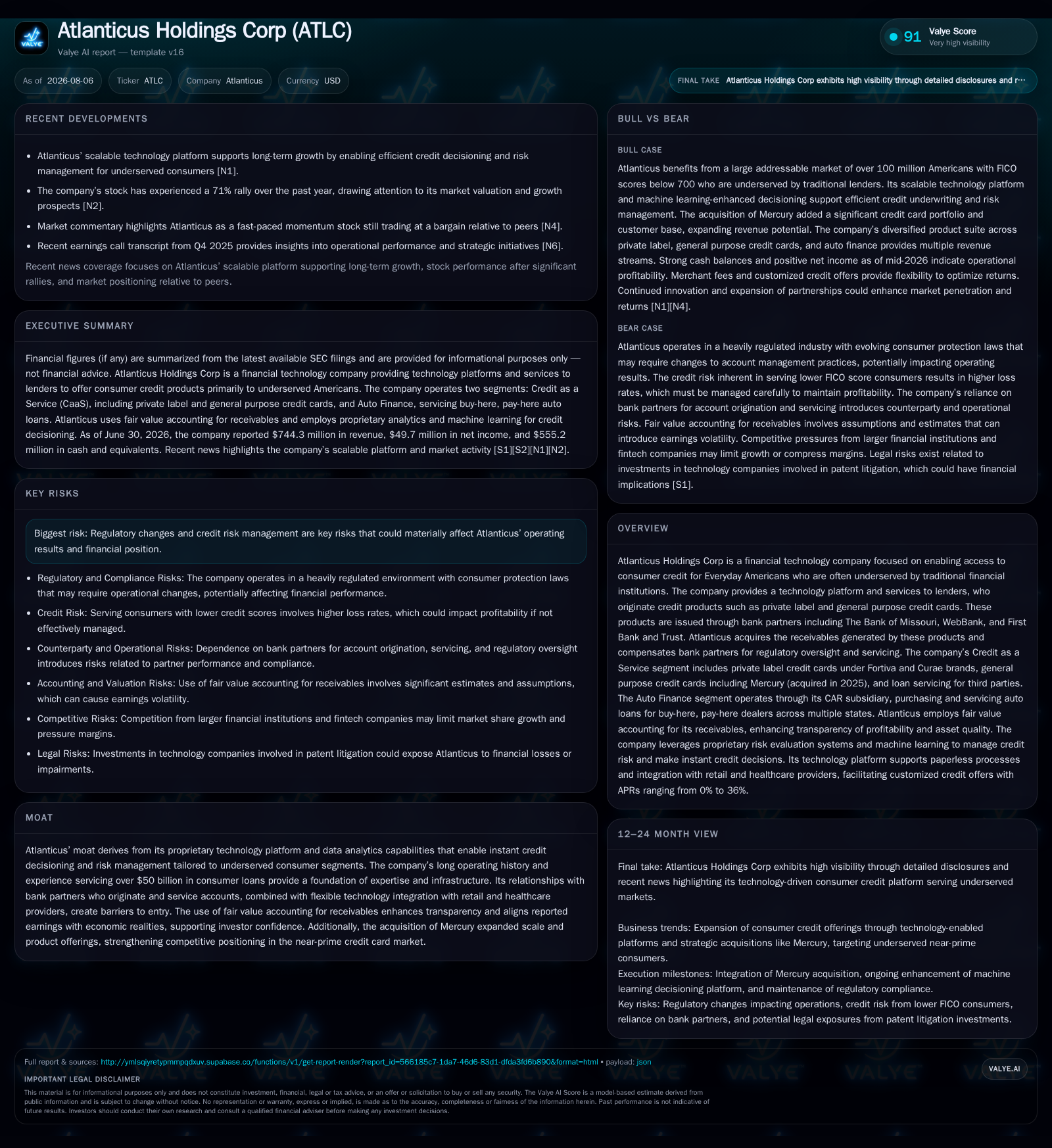
Atlanticus Holdings Corp reported operational developments in its August 2026 quarter emphasizing receivables acquisition from near-prime consumers through proprietary credit decisioning technology integrated with bank partners. The company’s business model centers on fees from lenders for platform services and acquiring loan receivables while compensating banks for regulatory oversight and servicing. With exposure concentrated in less-than-prime credit profiles, Atlanticus faces elevated credit loss sensitivity to economic cycles and regulatory risks. Recent strategic moves, including the Mercury acquisition, have expanded product offerings, but managing portfolio performance volatility remains critical. Financially, Atlanticus maintains substantial cash reserves alongside significant debt used to fund portfolio growth.
Recent Operating Update
Atlanticus Holdings Corp’s Q2 2026 filing confirms sustained growth in its core consumer credit receivables portfolio sourced via bank partners including The Bank of Missouri, WebBank, and First Bank and Trust [S2], [S1]. The quarter reaffirmed that revenues stem largely from fees charged to those partners for access to Atlanticus’ proprietary credit decisioning platform, combined with economic returns achieved by acquiring loan receivables primarily from near-prime borrowers—consumers often excluded by conventional lenders due to credit risk profiles. Recent filings highlight that the company's operating results remain sensitive to varying delinquency rates and credit losses influenced heavily by broader economic conditions [S2], [S1]. This dynamic is accentuated due to substantial application of fair value accounting on acquired receivables, causing reported net income to fluctuate with variations in expected loss assumptions and payment patterns.
Business Model Analysis
Atlanticus functions principally as a fintech-enabled program manager within the consumer credit value chain. It offers a technology platform encompassing paperless application processing and instant underwriting powered by machine learning-based predictive analytics that incorporate hundreds of data inputs beyond typical FICO scores. These capabilities facilitate rapid credit decisions tailored specifically to underserved or near-prime Americans at retail and healthcare point-of-sale locations as well as through direct marketing channels [S1].
Revenue streams primarily derive from contractual fees paid by bank partners who retain ownership of the accounts. These banks originate private label and general purpose credit cards under brands such as Fortiva, Curae, and Mercury (acquired in 2025). While banks maintain servicing responsibility — including regulatory oversight — Atlanticus acquires the associated loan receivables at principal amounts. Additionally, some programs generate merchant fees shared with Atlanticus that enhance returns on certain portfolios [S1]. The company then reimburses its banking partners through a combination of fixed and variable monthly fees indexed to portfolio performance metrics. This complex revenue model aligns incentives but embeds exposure to repayment behavior variances.
Loan servicing operations exist both internally (for its acquired portfolios) and externally via third-party contracts within the Credit as a Service (CaaS) segment. This diversification leverages their technology infrastructure while contributing incremental servicing income independent of portfolio interest spreads or charge-offs [S1]. Furthermore, Atlanticus maintains limited strategic investments in emerging consumer technology fintech companies aligned with its expertise, yielding gains or losses reported separately from core lending activities
Industry Structure and Competitive Position
Operating within the fintech consumer credit sector focused on near-prime borrowers distinguishes Atlanticus relative to traditional prime-targeted banks like Capital One or broad-spectrum specialty finance companies. Its competitive moat is underpinned by a proprietary credit decisioning engine that integrates deeply with bank partners’ origination systems across multiple channels including retail networks—a complexity barrier for new entrants lacking established relationships or technology platforms calibrated for higher risk cohorts [N3], [S1].
Peers such as Enova International similarly target near-prime consumers but often employ direct lending models rather than program management with bank reliance. Synchrony Financial serves as a relevant comparator on private label card scale but is more entrenched with large retailers targeting prime consumers, making Atlanticus’s niche more specialized yet potentially exposed to cyclical credit risks more acutely.
The company’s ability to maintain flexible underwriting powered by machine learning analytics permits granular risk segmentation essential for managing delinquencies and losses amid economic volatility—a persistent headwind given the borrower risk profiles involved. Furthermore, the use of fair value accounting provides transparency into real-time portfolio performance but adds earnings volatility correlated with macroeconomic shifts [S1], [S2].
Growth Drivers
Atlanticus's growth catalysts include expanding demand among underserved customers for accessible credit alternatives outside prime lending pools. Technological enhancements in data analytics improve underwriting efficacy, enabling scalable expansion while managing loss trends more tightly [S1]. The 2025 Mercury acquisition added general purpose credit card products complementing existing private label lines (Fortiva, Curae), broadening market reach into near-prime consumers seeking widely accepted payment options
Partnerships extending into healthcare providers represent another growth avenue where point-of-sale financing is increasingly crucial for consumer affordability—leveraging Atlanticus’s process automation eases integration complexity for these diverse merchants.
Investment in digital marketing channels enhances customer acquisition efficiency; however, sustained growth depends on balancing volume gains against rising customer acquisition costs typical in competitive fintech segments. Additionally, outsourced loan servicing arrangements executed via CaaS segment contribute ancillary revenue while deepening brand presence among fintech lenders outsourcing technology platforms and collections functions.
Risks and Growth Constraints
Major risks persist around credit quality deterioration given the concentration in less-than-prime borrowers whose repayment is highly susceptible to economic downturns or inflationary pressures leading to spikes in delinquencies or charge-offs [S2], [S1]. Such fluctuations directly impact Atlanticus’s net income due to fair value adjustments on acquired receivables, potentially pressuring capital deployment capacity if unexpected losses accelerate prepayment obligations owed back to financing sources.
Regulatory uncertainty remains salient since the company depends heavily on third-party bank partners for origination compliance; changes in lending laws or enforcement standards could necessitate costly process revisions or constrain product designs.
Furthermore, extensive reliance on capital markets financing facilities exposes funding availability risk especially during periods of market disruption affecting cost or willingness of counterparties. Failure to obtain adequate financing on acceptable terms could slow receivable acquisition growth materially.
Model risk exists inherent to machine-learning underwriting systems that may misestimate borrower risk amid evolving consumer behavior patterns or data shifts requiring continuous validation.
Competition from both traditional banks stepping up their fintech initiatives (e.g., Capital One) and emerging peer fintech firms intensifies pricing pressure on technology fees or merchant partnerships.
What To Watch Next
Key indicators will include monitoring delinquency rate trends broken down by vintage cohorts reported in upcoming quarterly disclosures, which signal potential earnings volatility ahead. Likewise, tracking net interest margin compression or expansion tied to pricing adjustments sheds light on revenue sustainability amidst competitive pressures.
Further evidence of synergy realization post-Mercury integration via increased issuance volume or expanded product uptake would confirm scale leverage benefits.
Management commentary on capital markets access will be critical—particularly renewal status of financing facilities governing receivable purchases amidst evolving macroeconomic conditions.
Finally, any material changes announced regarding bank partnership structures (fee renegotiations or regulatory impacts) would warrant close scrutiny given their centrality to revenue generation mechanics.
Financial Profile Discussion
As of June 30, 2026, Atlanticus held cash and equivalents totaling approximately $555 million against total debt near $829 million as per latest available data—a net debt position around $274 million when adjusted for cash reserves suggests moderate leverage oriented toward funding ongoing receivable acquisitions [F1]. This balance sheet position reflects the standard capital structure of fintech program managers reliant on short-to-medium term financing facilities rather than permanent equity capital for asset growth.
Reported trailing twelve months revenue approximated $1.97 billion alongside net income nearing $122 million (year-end 2025 figures), indicating healthy scale though subject to variability driven by fluctuating fair value gains/losses tied to portfolio performance metrics [F1]. Given high operating expense ratios typical of platform-intensive fintechs plus provisioning demands related to subprime exposure, profitable scaling hinges strongly on tuning underwriting precision while controlling collection costs.
Conclusion Disclaimer
This analysis synthesizes public SEC filings alongside industry frameworks without offering investment advice or specific forward-looking predictions about Atlanticus Holdings Corp's stock performance.
Disclaimer: This is research-only, informational analysis and not investment advice. It may include AI-generated interpretation and general industry context. Always verify important details using primary sources.

Comments