
Peloton’s Subscription Growth Amid Hardware Evolution and Operational Challenges
Peloton Interactive Inc advances its connected fitness ecosystem with expanding membership and new products, while managing supply chain and financial constraints.
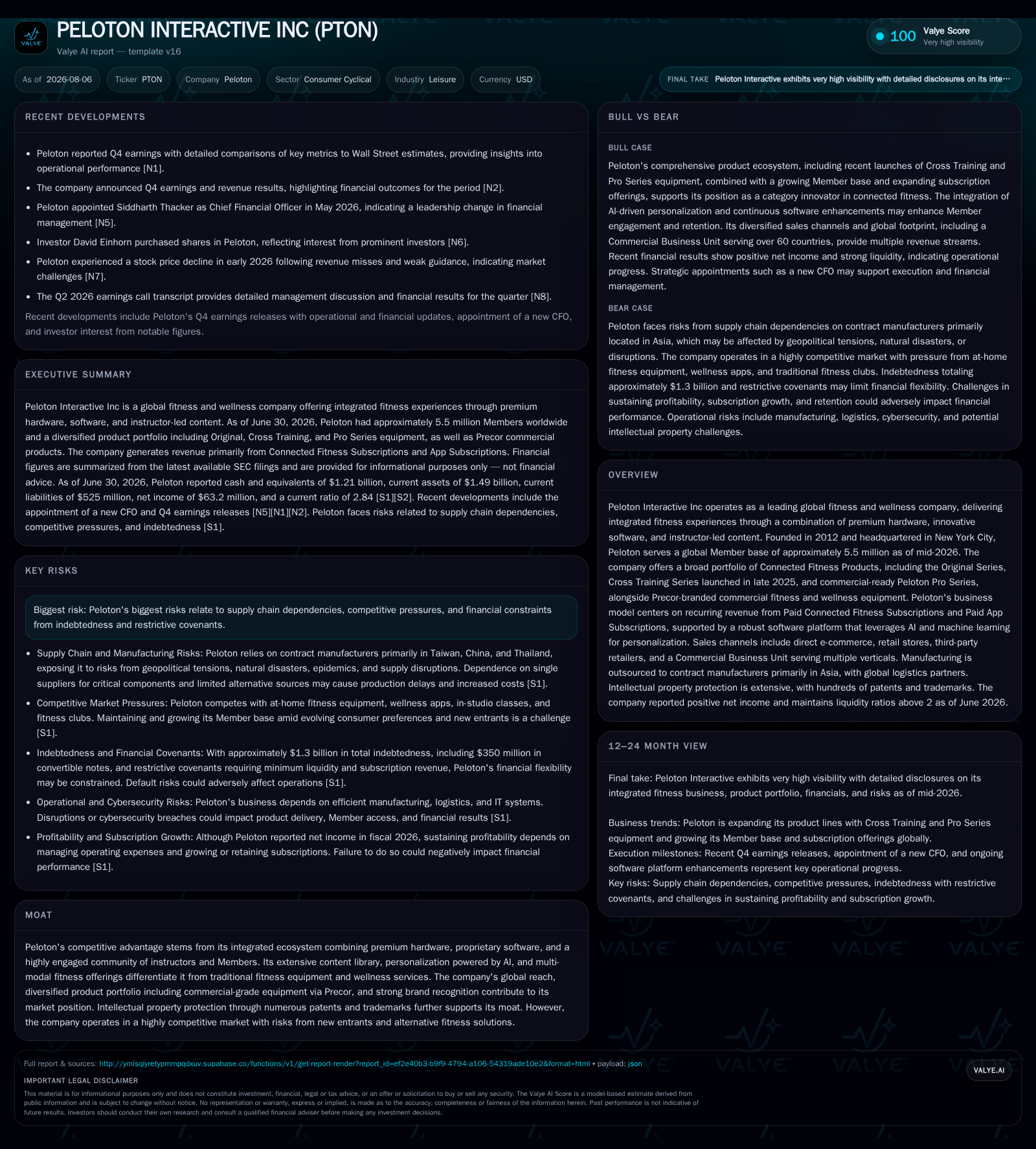
Peloton reported sustained gains in subscription base to approximately 5.5 million Members as of mid-2026, driven by a broadening portfolio including the Cross Training Series and Precor commercial equipment. The company continues to leverage its hardware-software integration and AI-driven content personalization to differentiate in a crowded connected fitness market. However, Peloton's growth dynamics remain tempered by supply chain complexities, legal and regulatory scrutiny relating to product safety, and substantial indebtedness with restrictive covenants. Monitoring subscription retention, new product adoption, and margin expansion will be critical indicators of Peloton’s ability to sustain its repositioned growth trajectory.
Latest Operating Update
Peloton Interactive Inc’s latest quarterly filing for Q3 fiscal 2026 (ending June 30) reports active Members totaling approximately 5.5 million globally across multiple subscription offerings inclusive of Connected Fitness Subscriptions and Paid App Subscriptions [S1]. This figure incorporates engagement metrics based on completed workouts across an expansive content portfolio that includes live/ondemand instructor-led classes, scenic rides, game-inspired Lanebreak workouts, strength sessions, and Breathwrk breathwork classes
Recent product portfolio evolution saw discontinuation of Original Series Tread models following the introduction of the Cross Training Series launched in late 2025; refurbishment sales of Original Bike models continue alongside the commercial-ready Peloton Pro Series and Precor-branded equipment [S1]. These hardware developments reflect a strategic shift toward diversified fitness modalities beyond indoor cycling into strength training and rowing
Business Model Analysis
Peloton monetizes through a blend of premium hardware sales combined with recurring revenues from subscription services offering immersive fitness content. Consumers pay upfront for durable Connected Fitness Products—such as stationary bikes or treadmills—and then commit to monthly subscriptions delivering access to instructor-led digital content designed for motivation and community interaction. The Company defines a "Member" by workout engagement intensity within the trailing twelve months, anchoring monetization largely on continued content consumption rather than one-time device sale.
The multi-channel sales distribution encompasses direct e-commerce platforms with high-touch Inside Sales support, retail locations offering trial experiences (microstores, inline stores), third-party retailers such as Amazon and Dick's Sporting Goods, plus an expanding Commercial Business Unit serving business-to-business clients across clubs, multifamily residences, hospitality venues, education institutions, government facilities, and corporate wellness programs globally [S8][S11]
Content differentiation is key: proprietary AI-driven personalization algorithms curate workout plans tailored to individual Member preferences and progress. The extensive content library spans multiple fitness modalities benefiting from instructor charisma and community-building features designed to reduce churn—a vital dynamic given Subscription Revenue constitutes the largest portion of recurring income.
Operational execution complexity arises from managing a hybrid manufacturing model: in-house production complemented by third-party contract manufacturers predominantly in Asia [S11][S25]. This necessitates sophisticated supply chain orchestration amid fluctuating component availability and trade tariff risk exposure affecting costs
Industry Structure and Competitive Position
Peloton inhabits the intersection of connected fitness hardware manufacturing, media content production, software platform development, and community management within the broader leisure sector focused on wellness technology. Its closest peer sets include companies like Nautilus (Precor segment) for commercial-grade equipment manufacturing; Mirror (Lululemon) and Tonal as digitally native fitness content providers; Life Fitness or Technogym as traditional equipment players; plus emerging digital wellness apps providing complementary services.
The competitive moat centers on seamless Hardware-Software Integration powering AI-enabled customized experiences alongside a robust instructor network facilitating engagement across millions of users internationally. By integrating fitness modalities beyond cycling—strength training via Cross Training Series products—and expanding commercial client reach with Precor offerings in over 60 countries, Peloton elevates differentiation beyond single-focus competitors reliant solely on hardware sales or software subscriptions alone [S8][S28][S29]
The platform relies heavily on renewal rates driven by consistent content introduction quality metrics such as workout minutes completed per Member. While competition emerges from boutique fitness apps or in-studio chains like SoulCycle diverting consumer attention or spend, Peloton’s brand cachet combined with multi-modal fitness positioning affords it structural advantages underpinned by data analytics capabilities.
Growth Drivers
Several factors underpin Peloton's growth trajectory:
- Subscription Expansion: Increasing acceptance of home-based connected fitness supports steady expansion of active Members paying for recurring content access; international market penetration remains an opportunity area.
- Product Portfolio Innovation: The launch of Cross Training Series products diversifies the appeal beyond core cycling disciplines; integration with commercial-grade Precor equipment fuels B2B revenue avenues.
- AI-Driven Personalization: Continuous enhancement of personalization algorithms facilitates higher user engagement levels that correlate with improved retention.
- Community Features: Instructor-led interactive experiences coupled with social dynamics create switching costs reducing churn risks.
- Wearables & Ecosystem Integration: Potential synergy between Peloton’s platform data streams with third-party wearable health devices could extend user value propositions.
- Corporate Wellness Programs: Growing adoption amongst businesses aiming at workforce health provides an incremental B2B revenue vector.
- Global Geographic Expansion: Widening availability beyond core U.S., UK, Canada markets into Germany, Australia, Austria alongside further international distribution could drive membership growth.
Risks and Growth Constraints
Despite progress there are material risks:
- Supply Chain Disruptions: Complex global manufacturing dependencies expose Peloton to delays impacting inventory availability—mismatches could impair revenue recognition or elevate costs [S11][S25].
- Product Safety Litigation: Past recalls involving Bike+ and Tread+ models have spurred regulatory investigations along with class action lawsuits potentially triggering adverse financial impacts or reputational damage [S18][S20][S13].
- Competitive Pressures: New entrants leveraging lower-cost models or alternate wellness apps pose erosion risks for both acquisition pace and retention levels.
- Financial Covenants: Over $1.3 billion indebtedness accompanied by restrictive liquidity requirements under revolving credit facilities limit operational agility especially if subscription revenue growth decelerates below thresholds [F1][S5].
- Consumer Spending Cyclicality: Fitness discretionary spending is sensitive to macroeconomic shifts potentially influencing buying patterns for premium-priced offerings.
- Technological Obsolescence: Failure to innovate in user experience or software functionalities could result in attrition as consumers switch platforms.
- Regulatory Compliance Complexity: Evolving privacy laws governing personal health data collected through devices impose ongoing compliance cost burdens.
What To Watch Next
Key milestones that could clarify Peloton’s near-term prospects include:
- Quarterly tracking of Active Member net additions versus churn rates indicating subscription momentum stability.
- Average Revenue Per User (ARPU) trends segmented between Connected Fitness Subscriptions versus App-only memberships.
- Hardware unit sales volumes as older Original series bicycles phase out fully in favor of more profitable Pro Series or Cross Training equipment.
- Quarterly gross margin progression reflecting mix shifts from hardware dependent towards recurring subscription revenue contribution enhancements.
- Installation success rates improvement signaling reduced delivery bottlenecks supporting customer satisfaction levels.
- Regulatory developments including resolution timelines around outstanding personal injury litigations related to prior equipment recalls.
- Management commentary on capital expenditure plans for future product innovations especially involving AI enhancements or new modality introductions.
Financial Profile Discussion
Peloton exited Q3 fiscal 2026 with a net income of $63.2 million supported by operating income of $160.7 million—a reflection of improving profitability amid ongoing investments [F1]. The balance sheet shows cash & equivalents totaling roughly $1.21 billion against total debt near $1.33 billion resulting in low net debt approximately $123 million as of June 30, 2026 [F1]. This yields a healthy current ratio near 2.84x mitigating near-term liquidity stress concerns [F1].
However, significant indebtedness bears close monitoring due to associated covenants requiring minimum liquidity floors ($250 million) and trailing subscription revenue floors ($1.2 billion), directly linking capital access contingencies to operational performance [S5][S10]. Free cash flow generation consistency tied to converting recurring subscription revenue growth into margin expansion remains crucial for deleveraging paths without dilutive financing actions.
In summary, Peloton demonstrates improved operating fundamentals benchmarked against prior loss-making periods but must navigate execution risks tied to supply chain management constraints alongside legal/regulatory scrutiny while maintaining innovation-led subscriber growth momentum across hardware-software segments.
Disclaimer: This analysis reflects information available up to August 6, 2026 based on SEC filings and credible news sources, without providing investment research views.
Disclaimer: This is research-only, informational analysis and not investment advice. It may include AI-generated interpretation and general industry context. Always verify important details using primary sources.

Comments