
Excelerate Energy Expands LNG Footprint While Managing Integration and Market Risks
Strong contractual revenues and strategic acquisitions reinforce Excelerate Energy’s position in global LNG infrastructure amid evolving energy demand.
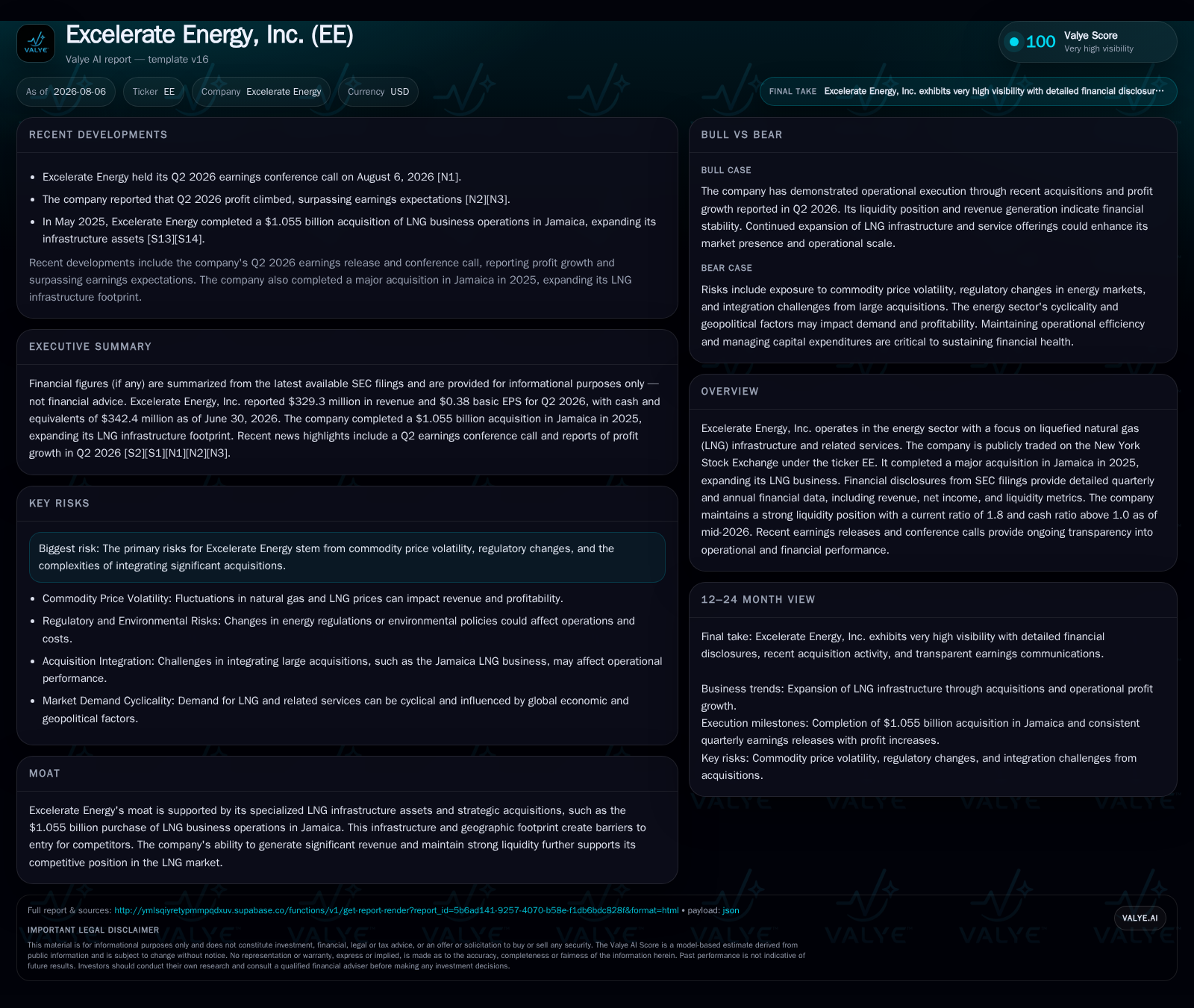
Excelerate Energy, Inc. continues to solidify its role as a global provider of floating regasification terminals and LNG infrastructure through a major acquisition in Jamaica and the forthcoming delivery of a new terminal for Iraq. Its business model leverages long-term take-or-pay contracts that deliver consistent cash flow despite commodity price volatility and operational complexities inherent to LNG infrastructure. The company's liquidity profile remains robust with a current ratio of 1.8 and manageable net debt levels as of mid-2026. Growth depends on expanding capacity utilization, developing new infrastructure projects, and navigating regulatory and geopolitical challenges.
Latest Operating Developments Anchor Strategic Expansion
Excelerate Energy’s most recent quarterly filing (10-Q dated August 6, 2026) confirms continuation of growth via strategic acquisition and asset expansion while managing operational execution risks [S2]. Notably, the company completed the acquisition of a major LNG business operation in Jamaica during 2025 for about $1.055 billion, reflecting an opportunistic move to consolidate floating regasification assets in key emerging markets [S1]. This deal extends Excelerate’s contracted capacity footprint and strengthens its competitive moat given the complexity of establishing new LNG import infrastructure due to technical barriers and regulatory scrutiny.
In addition to acquisitions, Excelerate awaits delivery of a newly built floating regasification terminal expected in Q2 2026 from Hyundai Heavy Industries. This terminal is tied to a five-year regasification and supply contract with Iraq’s Ministry of Electricity starting in Q3 2026 [S1]. These developments collectively signal deliberate expansion aligned with forecasted demand in underserved regions emphasizing energy security.
Business Model Anchored in Long-Term Contractual Revenue
Excelerate operates predominantly through owning and managing floating storage and regasification units (FSRUs), along with an onshore terminal and power generation assets. Its core revenue mechanism is taking fees under long-term take-or-pay contracts where customers—generally sovereign entities or large industrial consumers—commit to pay for fixed regasification capacity regardless of actual usage [S1]. This contract structure ensures revenue resilience independent of volatile LNG spot prices but places emphasis on maintaining asset availability to meet contracted volumes.
Revenue drivers therefore crystallize around several operating KPIs: capacity utilization rates at regasification terminals; volume throughput measured in billion cubic feet (Bcf) of LNG regasified; frequency of ship-to-ship transfers enabling flexible logistics; and operational uptime guaranteeing minimal downtime penalties. Excelerate announced it has safely delivered more than 8,000 Bcf of natural gas through its terminals since inception with over 3,800 ship-to-ship transfers conducted [S1], underscoring operational scale.
The company also leverages combined heat and power generation as part of integrated customer solutions on select sites, potentially augmenting contract value via bundled services. Monetization channels thus combine infrastructure fees plus limited direct energy sales agreements.
Industry Structure Highlights Capital Intensity and Contractual Stability
Operating within the midstream LNG infrastructure segment places Excelerate amid capital-intensive projects demanding sophisticated engineering capabilities (e.g., floating terminal design) and strict regulatory compliance across varied jurisdictions. High upfront capex requirements act as barriers deterring new entrants while favoring incumbents with established assets and customer lock-in via long-duration contracts.
Global energy transitions toward lower-carbon sources enhance long-term growth prospects for LNG infrastructure providers since natural gas serves as a bridging fuel replacing coal or oil in power generation. However, this market remains exposed to LNG commodity price fluctuations upstream impacting feedstock availability, requiring careful contract management.
Peers like Cheniere Energy integrate export terminals alongside import facilities but typically engage different customer segments focusing on upstream liquefaction economics. Golar LNG concentrates on floating lithium storage vessels similar to Excelerate’s FSRUs but sometimes pursues vessel conversions adding operational variability.
Growth Drivers Focused on Emerging Markets and Infrastructure Builds
Excelerate’s growth vectors align with expanding natural gas consumption globally—especially in emerging economies requiring rapid energy security improvements through flexible imports rather than fixed pipeline connections [S1]. The company’s geographic footprint spans key markets including Argentina, Bangladesh, Brazil, Finland, Germany, Iraq, Jamaica, Pakistan, the UAE, and the U.S., allowing diversified exposure to various demand drivers.
Capitalizing on multi-year contracts underpinning its current assets supports predictable cash flow reinvestment into new project development or selective acquisitions targeting incremental contracted capacity [S1]. The imminent Iraq Project represents such an expansion leveraging a newly constructed FSRU underpinned by sovereign backing.
Moreover, technological advances reducing unit operating costs or increasing vessel efficiency may further boost margin profiles provided utilization rates remain strong. The company's plan to launch additional terminals as required signifies flexibility responsive to evolving market demand.
Risks Center on Integration Complexity and Market Dynamics
Notwithstanding stable contractual revenue streams, Excelerate faces several risks. Acquisition integration challenges are prominent given their recent large-scale purchase in Jamaica which requires seamless operational assimilation to realize targeted cost synergies or earnings accretion [S1]. Failure here would pressure margins.
Regulatory environments vary widely across regions exposing the company to permit delays or compliance costs impeding timely project commissioning. Geopolitical tensions or civil unrest in jurisdictions like Iraq could disrupt operations or contract enforcement [S1][S2].
The evolving supply-demand balance of global LNG affects feedstock availability which can constrain regasification volumes or increase procurement costs difficult to offset if contracts do not cover pass-through mechanisms fully.
Operational risks particular to FSRUs include technical failures leading to downtime affecting contractual obligations with costly penalties. Crew shortages or maritime regulations impose additional layers to operational risk management.
Competition from alternative energy sources or pipeline expansions can also gradually erode market share if emerging technologies materially shift energy supply economics over time.
What To Watch Next: Execution Milestones And Demand Indicators
Key near-term monitors include successful commissioning and commercial ramp-up at the Iraq FSRU starting Q3 2026 which will validate management's execution capability on new infrastructure deployments [S1][N1]. Measurements such as initial capacity utilization once operational will provide early signals around market demand strength in that region.
Ongoing integration progress following the Jamaican acquisition offers clues to margin improvement trajectories or potential operating disruptions flagged quarterly thereafter [S2][N2]
Additionally, contract extensions or new long-term take-or-pay awards across existing terminals could further strengthen backlog visibility impacting valuation perspectives.
Macroeconomic factors such as global natural gas price trends will remain watchpoints given their indirect influence on broader sector financial health despite contract insulation.
Monitoring competitor announcements regarding new FSRU deliveries or strategic partnerships will help contextualize Excelerate’s positioning relative to peers such as Golar LNG or Cheniere Energy.
Financial Profile Discussion
At the end of Q2 2026, Excelerate held approximately $342 million in cash and equivalents versus total debt near $940 million resulting in net debt around $597 million—a leverage level consistent with capital-intensive infrastructure firms demonstrating balanced capital structuring [F1]. The current ratio stands comfortably at 1.8 indicating solid short-term liquidity coverage over current liabilities which totaled roughly $331 million compared to current assets close to $595 million [F1].
This liquidity scale provides cushion for ongoing capital expenditure needs exemplified by the recently commissioned Iraqi terminal construction while maintaining flexibility for additional selective acquisitions should suitable opportunities arise.
Capital expenditure profiles remain pivotal going forward as infrastructure growth plans require continuous reinvestment though largely offset by contracting visibility fostering confidence around return metrics [S1]. Debt servicing covenants linked primarily with floating terminal assets underscore financial discipline albeit limiting refinancing flexibility depending on credit markets conditions [S1].
Conclusion: Balancing Growth Ambitions With Operational Discipline Amid Market Transitions
Excelerate Energy presents a compelling midstream infrastructure operator leveraging take-or-pay contractual mechanics that sustain revenue integrity amidst volatile commodity markets. Strategic geographic expansion combined with asset additions—all supported by sovereign-backed long-term contracts—positions the company favorably within the evolving global LNG supply chain where demand is poised for structural growth driven by decarbonization imperatives.
Nonetheless risks inherent in integrating sizeable acquisitions alongside navigating complex regulatory landscapes necessitate vigilant execution monitoring while operational reliability remains paramount for sustaining contract performance metrics such as capacity utilization and uptime.
Financially sound liquidity metrics coupled with manageable leverage underpin continued investment capability though capital intensity dictates ongoing focus on cost control measures ensuring scalable margins aligned with growth investments.
Analysts tracking Excelerate should prioritize updates around new terminal commercial operational milestones coupled with any material changes in contracted backlog providing forward visibility into earnings quality amid shifting geopolitical dynamics influencing natural gas flows globally.
Disclaimer: This is research-only, informational analysis and not investment advice. It may include AI-generated interpretation and general industry context. Always verify important details using primary sources.

Comments