
United Bankshares Expands Regional Footprint and Scale via Piedmont Acquisition Amid Stable Asset Quality
Recent quarterly results illustrate the integration benefits of the Piedmont acquisition, supporting United Bankshares’ regional growth strategy and risk management framework.
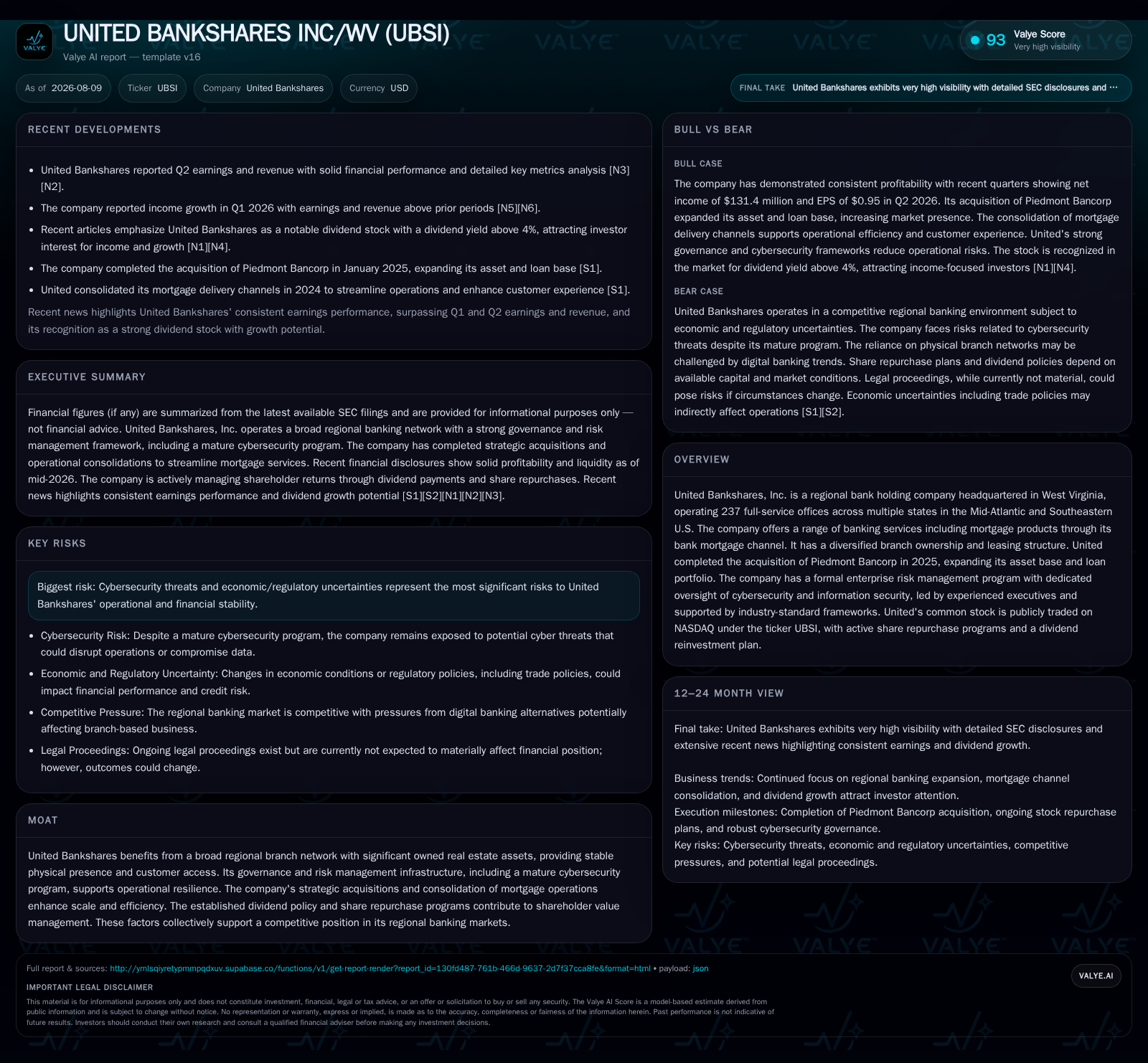
United Bankshares, Inc. (UBSI) has solidified its position as a regional bank with a broad branch network spanning multiple Mid-Atlantic and Southeastern states following its 2025 acquisition of Piedmont Bancorp. The latest quarterly filing reveals steady net interest income growth driven by expanded loan and deposit balances from the acquisition, alongside modest increases in credit loss provisions reflective of sound asset quality. The company maintains robust capital ratios and liquidity buffers, underpinned by disciplined risk oversight and a mature cybersecurity program. Going forward, United’s scale enhancements and mortgage business consolidation should support revenue diversification and operational efficiency, whereas sensitivity to economic cycles and cybersecurity threats remain notable risks.
Recent Operating Update
United Bankshares’ latest quarterly filing dated August 7, 2026 [S2] confirms continued integration benefits from its January 2025 acquisition of Atlanta-based Piedmont Bancorp [S12]. The merger boosted UBSI’s total assets by over $2.3 billion, including $2.1 billion in loans and $2.1 billion in deposits from Piedmont alone [S12]. Second quarter results showed net interest income growth attributed primarily to these enlarged balances despite a competitive rate environment [N1],[N2]. While provision for credit losses slightly increased compared to prior periods, this was proportionate to portfolio expansion rather than deterioration in asset quality. Noninterest income reflected stability with mortgage volume consolidation efforts paying off operationally after exiting third-party origination in late 2023 and merging mortgage businesses under the United Bank umbrella in early 2024 [S1],[S4]. Noninterest expenses increased due to costs related to additional branches and employees acquired through Piedmont but remain controlled relative to revenue growth.
Business Model Overview
United Bankshares operates as a regional bank holding company headquartered in West Virginia with an extensive network of 237 full-service branches spanning West Virginia, Virginia (including Northern Neck), Maryland, Washington D.C., North Carolina, South Carolina, Georgia (notably Atlanta), Ohio, Pennsylvania, and adjoining markets [S1],[S4]. Their product offering comprises traditional deposit accounts (checking, savings including money market), a diverse loan portfolio emphasizing commercial real estate—including owner-occupied and nonowner-occupied properties—construction loans, consumer credit including bankcard portfolios, residential real estate loans primarily originated through their bank mortgage channel after recent consolidation efforts [S4],[N1].
Unlike pure-play mortgage lenders or fintech disruptors that focus heavily on digital origination channels or broker networks, UBSI monetizes a relationship-driven model enriched by physical presence supported extensively by owned real estate assets stabilizing branch economics [S1]. This creates switching costs beneficial in community banking though it also exposes them to geographic economic cycles.
United supplements interest income with non-interest revenue streams such as fees from trust brokerage services, wire transfers, safe deposit boxes, investment advisory fees as well as bank-owned life insurance income whose value improved amid market conditions recently [N1],[S23]. This diversification mitigates pressure on margins during fluctuating interest rate environments.
Strong risk infrastructure is evident through formal enterprise risk management overseen at board level by the Risk Committee focusing on credit exposure as well as cybersecurity robustness led by an experienced Chief Information Security Officer who supervises teams that use industry-leading frameworks (NIST Cybersecurity Framework) for threat detection and incident response—critical given rising cyberattack risks for financial institutions [S1].
Industry Positioning & Competitive Context
Operating primarily as a regional community bank places United amongst peers such as Regions Financial Corporation, M&T Bank Corporation, PNC Financial Services Group and former BB&T (now Truist) though each peer has nuances around geographic reach or business model emphasis. Unlike national banks like Wells Fargo which leverage enormous scale and advanced digital platforms broadly across national markets; UBSI’s strength lies in its concentrated regional footprint anchored in multi-state Eastern U.S. markets where localized banking relationships matter deeply.
Within these markets competition stems not only from banks but increasingly fintech firms offering niche lending or digital deposit alternatives plus credit unions enjoying tax advantages yet often limited product breadth. UBSI’s strategy of maintaining owned branches alongside consolidating mortgage channels suggests prioritization of operational control over mortgage originations—a competitive advantage versus pure brokers—and reinforces cross-selling opportunities.
Net interest margin (NIM) remains a key performance lever; while overall rising rates usually widen spreads temporarily for regional banks like UBSI due to repricing loans faster than deposits; prolonged rate volatility or flattening yield curves could pressure margins requiring active asset-liability management overseen by their Asset Liability Committee [S5],[S6].
Growth Drivers
United’s pipeline for growth is multifaceted:
- Geographic Expansion: The Piedmont acquisition notably added Atlanta metro area exposure—a significant new market for UBSI increasing deposit capacity and loan demand potential stemming from growing Southeast U.S. economies [S12],[N3].
Management commentary during earnings calls regarding cost synergies realization following recent acquisitions will also be insightful along with updates on market penetration strategies especially within the new Atlanta MSA corridor.
Financial Profile Discussion
Regulatory capital ratios are strong with Common Equity Tier 1 at 13.44%, well above minimum well-capitalized thresholds facilitating ongoing lending capacity expansion while supporting dividend policies announced including approximately $212 million paid out during 2025 alongside share repurchase activities intended to optimize capital structure without compromising liquidity [S6],[S26].
Provision for credit losses remains moderate relative to loan balances ($332 million allowance against multi-billion dollar portfolio), signaling prudent underwriting controls even amid broader economic uncertainties [S21]
Operational cash flows remain robust driven by core banking activities although merger-related expenses related to integration consume some cash flow prematurely while investments continue in technology platforms enhancing scalable operations long term.
This analysis synthesizes public disclosures up to August 2026 without investment advice or forecasts. It emphasizes UBSI's strategic positioning as a regional bank growing through acquisition combined with disciplined risk management amidst evolving banking sector dynamics.
Disclaimer: This is research-only, informational analysis and not investment advice. It may include AI-generated interpretation and general industry context. Always verify important details using primary sources.

Comments