
CBL & Associates Advances Portfolio Optimization and Tenant Diversification Amid Retail Market Shifts
Latest quarterly results highlight CBL’s ongoing transformation strategy focusing on enhancing occupancy and rent growth through portfolio repositioning and balance sheet management.
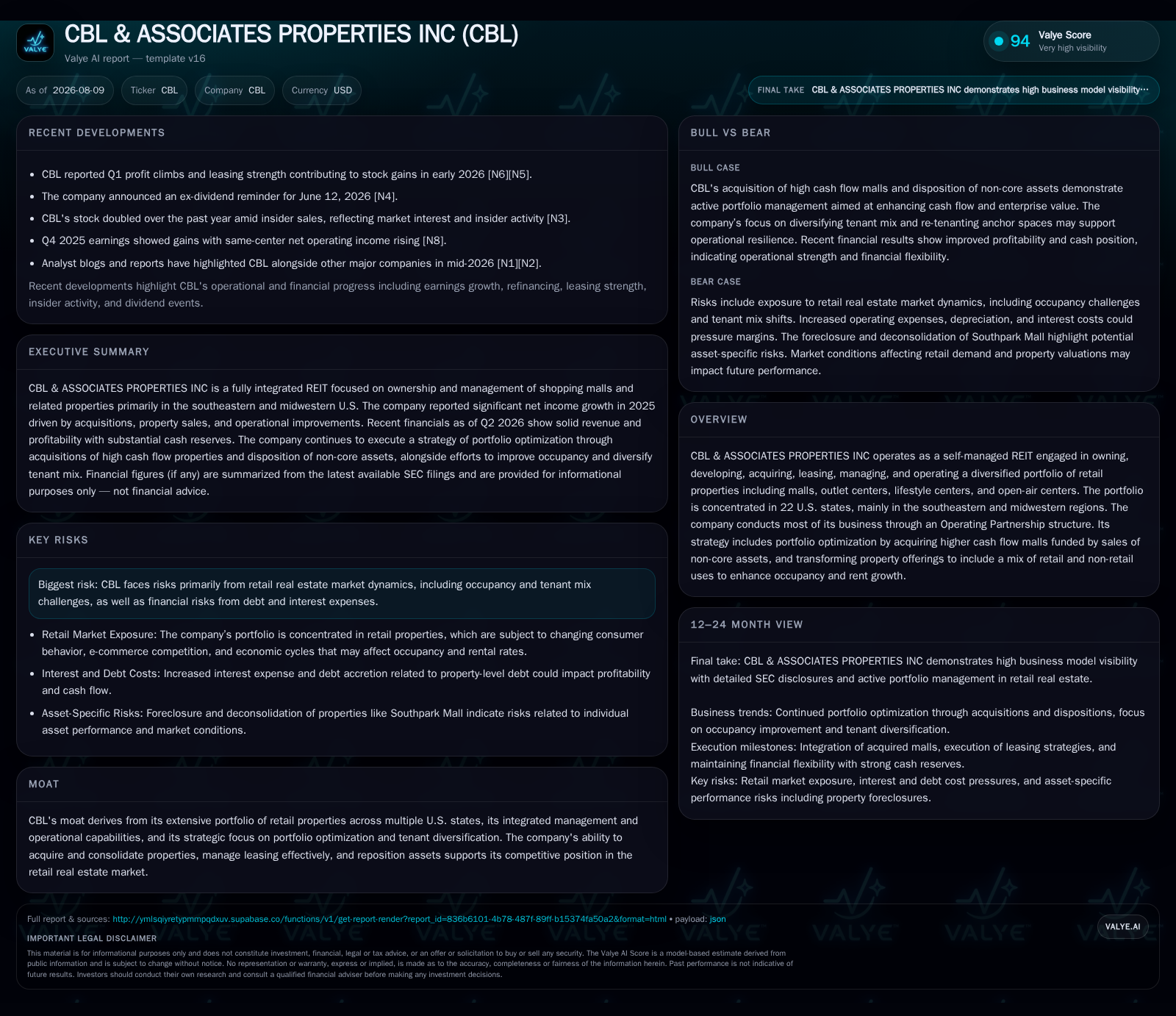
CBL & Associates Properties reported second-quarter 2026 results reinforcing its strategic shift toward optimizing a retail portfolio concentrated in the southeastern and midwestern US. Execution centers on acquiring higher-cash-flow malls funded by non-core asset sales, alongside tenant mix diversification including non-retail uses to stabilize occupancy and drive net operating income (NOI) growth. The company manages leverage prudently with continued debt reduction initiatives, though its substantial net debt remains a key watchpoint. Industry-wide retail pressures and evolving consumer behaviors underscore the importance of CBL’s operational adjustments as it seeks to compete with peers like Simon Property Group and PREIT.
Recent Operating Update: Q2 2026 Reinforces Strategic Portfolio Actions
CBL & Associates Properties' second-quarter 2026 filing confirms steady advancement of its long-stated portfolio optimization strategy. Management highlights continued efforts to enhance occupancy and rental income by integrating newly acquired enclosed malls into its portfolio while divesting certain open-air centers deemed non-core [S2]. The acquisition of four malls in July 2025—Ashland Town Center (KY), Mesa Mall (CO), Paddock Mall (FL), and Southgate Mall (MT)—demonstrates CBL's tactical redeployment of capital from less productive assets into properties with stronger cash flow potential [S1]. This rebalancing is critical to counteracting pressures from changing consumer shopping preferences that increasingly challenge traditional mall formats.
The company’s Operating Partnership functions as the vehicle consolidating most property-level operations and financials. The partnership’s pro rata share accounting provides a clearer lens on actual property economic performance inclusive of both consolidated and unconsolidated assets—a framework that supports analysis of net operating income (NOI) trends across the diversified portfolio [S1]
Business Model: Leased Retail Space Monetization during Transformation
As a self-managed REIT specializing in retail real estate—including malls, outlet centers, lifestyle centers, and open-air centers—CBL generates revenue predominantly through leasing agreements with retailers paying rent based on square footage leased [S1]. Rental contracts typically feature base rents augmented by percentage rents linked to tenant sales volume or escalations tied to inflation or lease anniversaries. Tenant mix diversification is a major theme for CBL as it strategically re-positions spaces formerly anchored by traditional department stores—now declining nationwide—to include a blend of services, dining venues, entertainment options, and other experiential or non-retail tenants aimed at driving foot traffic and stabilizing rents
This adaptive leasing approach addresses a broader industry dynamic wherein pure retail tenancy has contracted due to e-commerce growth challenging brick-and-mortar sales. Effective re-tenanting not only sustains occupancy but can enhance average rent per square foot if the new mix better matches evolving consumer demands. Capital expenditures focused on redevelopment find their justification in long-term NOI uplifts from improved tenancy density or higher-yield uses.
CBL's extensive footprint across 22 states positions it well against regional market swings but also requires nuanced local leasing strategies reflecting demographics and competitive retail environments. The company's operational control via its integrated management platform facilitates unified leasing efforts but also exposes it to the typical operational cost challenges intrinsic to mall ownership such as maintenance overheads and property taxes.
Industry Structure and Competitive Positioning
Retail REITs operate within a value chain spanning property development or acquisition, leasing negotiations with retail tenants often including anchor stores that drive traffic, day-to-day property management, and eventual disposition or redevelopment initiatives. CBL plays an owner/operator role between these ends, balancing capital deployment with leasing effectiveness.
Peers like Simon Property Group dominate with a national footprint emphasizing premium malls often anchored by leading fashion brands or membership clubs. Others like PREIT adopt a more focused regional approach emphasizing asset repositioning for enhanced tenant experience. CBL situates itself as a diversified portfolio owner mixing malls with lifestyle centers—offering exposure across various customer demographics—which helps mitigate single-property risks but necessitates vigilant active management.
Given broad retail market headwinds including store closures triggered by retail bankruptcies or shifting consumer behavior favoring e-commerce platforms, competitive success hinges on efficient vacancy management, forward-thinking tenant diversification strategies that incorporate experiential offerings beyond traditional retailing, disciplined capital allocation toward higher-yield properties or redevelopment projects, and effective cost controls.
Growth Drivers: Portfolio Optimization and Tenant Experience Transformation
CBL’s acquisition activity targets malls capable of delivering higher net operating income relative to disposed assets—a move supported by proceeds from divesting some open-air centers not aligned with strategic priorities [S1]. This capital recycling enhances yield profiles while preserving flexibility for selective redevelopments.
Tenant diversification programs replacing traditional anchors with service-oriented uses or entertainment improve resilience to sector disruptions while boosting foot traffic metrics essential for inline tenants' performance—thus enabling upward pressure on rents [S1]. Improving occupancy rates through targeted leasing campaigns directly uplifts funds from operations (FFO) which underpins dividend capacity.
Additional growth stems from ongoing rent escalations embedded within lease contracts alongside improved lease renewal rates reflecting tenant satisfaction amid mixed tenancy offerings. Geographic concentration principally in southeastern and midwestern U.S., regions with steady population growth trends compared to some coastal metro areas facing saturation or demographic stagnation also supports stability.
Finally, operational efficiencies gained via integrated property management reduce overhead as scale advantages compound across multiple locations managed under one Operating Partnership structure.
Risks and Watchpoints: Retail Disruption Meets Financial Leverage Considerations
Despite progress, CBL bears material risks endemic to retail REITs navigating disruptive market forces. Declining occupancy risk stems notably from anchor tenant bankruptcies or failures induced by broader retail insolvency trends impacting malls nationally. Pressures on rental rates could erode cash flows if new leases fail to achieve prior levels amid oversupply or weak demand locales.
Further complicating matters are refinancing concerns highlighted by the significant net debt level nearing $1.88 billion as of June 30, 2026 [F1]. Interest rate fluctuations could increase borrowing costs despite past efforts extending maturity schedules or lowering coupon terms [S1]. Debt service coverage ratios must be monitored closely alongside potential impairment charges on underperforming assets that would reduce net asset values.
Market competition not only arises from peer REITs operating more modern mixed-use developments attracting consumers but also from digital commerce requiring physical retailers increasingly adapt their real estate footprints—failure here could impair tenant retention metrics.
Regulatory landscape changes affecting zoning or allowable use mixes may constrain redevelopment flexibility especially when converting anchor spaces into alternative uses; local governments’ stance on such conversions can delay anticipated NOI improvements.
What To Watch Next: Execution Milestones And Operating Indicators
Investors should track earnings updates revealing same-center NOI growth trends driven by occupancy gains post-acquisition integrations particularly at the four malls acquired last year [S3]. Lease renewal rates at key anchors provide forward visibility on rent stability and security of cash flows.
Capital deployment toward redevelopment projects targeting former anchor vacancies signals commitment to value creation; progress reports here will reveal ability to generate NOI uplift justifying upfront expenditure. Monitoring changes in tenant mix composition informs how effectively diversification strategy mitigates pure retail trade risks.
Balance sheet developments including any new financing transactions impacting leverage profile will be critical given current net debt size relative to cash availability [F1]. Maintaining prudent financial ratios while supporting growth investments is essential.
Finally regulatory developments influencing ability to repurpose space or operate mixed-use facilities could materially affect future profitability constituents.
Financial Profile Discussion
CBL maintains approximately $101 million in cash equivalents as of June 30, 2026 providing liquidity buffers for ongoing operations or investment opportunities [F1]. However, total debt reported stood at about $1.98 billion two years earlier at mid-2024 fiscal snapshot implying net leverage around $1.88 billion when adjusting for cash [F1]. While newer filings do not detail further current debt adjustments explicitly [S2][S3], previous disclosures emphasized intentional debt reduction efforts combined with extension of maturity schedules aiming to reduce refinancing risk levels.
This sizeable leverage necessitates careful monitoring since elevated interest expenses—already seen rising over recent years—can constrain net income growth despite operational improvements [S1]. Funds from operations (FFO) remain key for sustainable dividend payouts enabling the company’s REIT status benefits alongside maintaining credit profile integrity.
Overall the financial profile supports ongoing transformation initiatives but depends heavily upon continued success improving occupancy metrics plus prudent capital structure management responsive to fluctuating market interest rates.
This analysis synthesizes CBL & Associates Properties’ latest operating disclosures anchored on Q2 2026 filings complemented by understanding industry structural dynamics shaping retail REIT performance today. It underscores balancing aggressive portfolio repositioning actions against persistent sector-wide headwinds while highlighting specific KPIs central to monitoring execution success over coming quarters.
This memorandum does not constitute investment advice but aims to provide informed industry-focused insight grounded strictly in public SEC filings and established real estate REIT sector knowledge.
Disclaimer: This is research-only, informational analysis and not investment advice. It may include AI-generated interpretation and general industry context. Always verify important details using primary sources.

Comments