
Capitol Federal Financial Advances Commercial Loan Growth While Sustaining Strong Asset Quality
Recent quarterly results highlight Capitol Federal Financial’s strategic shift to commercial lending with disciplined credit quality and active capital management.
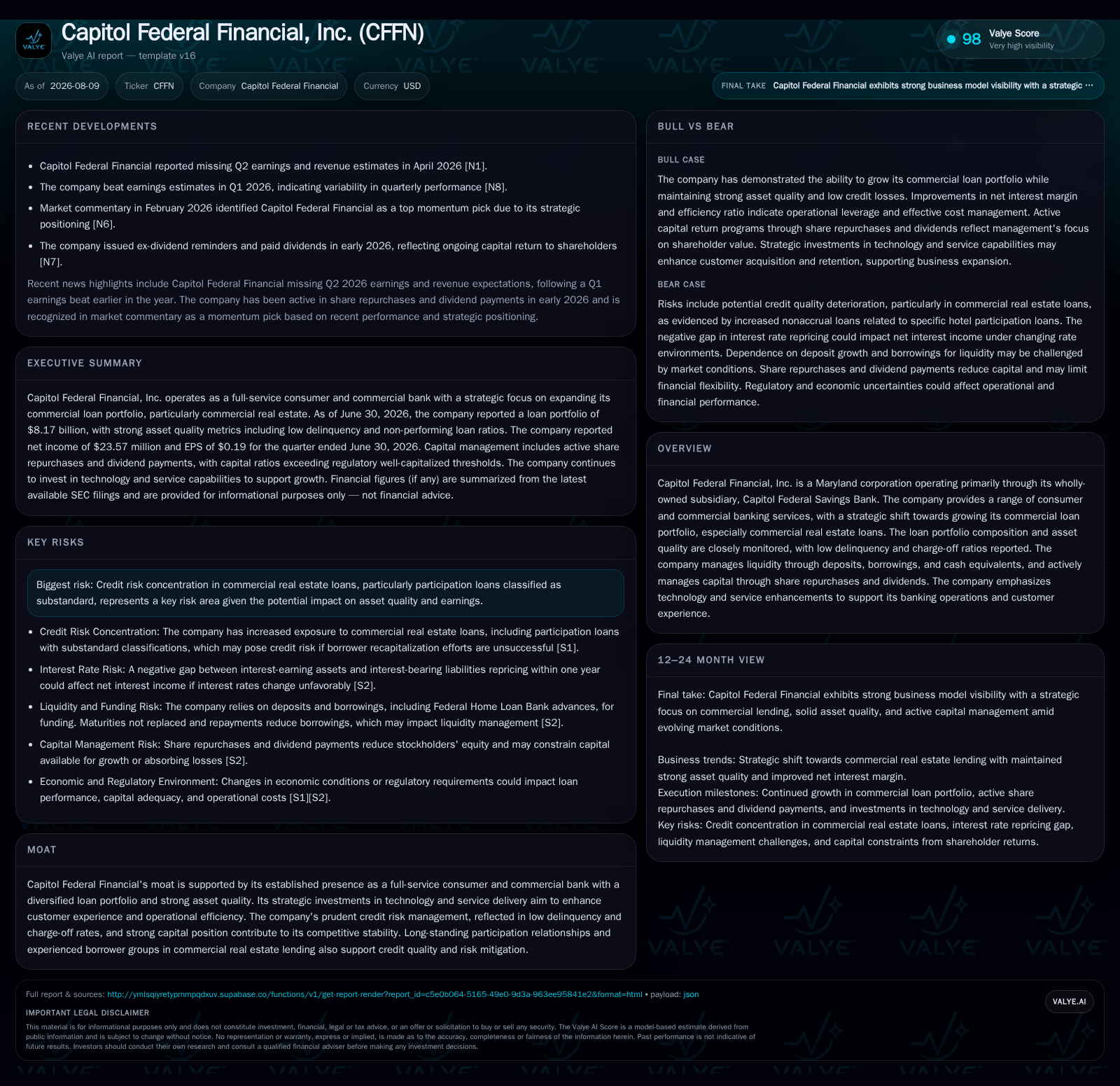
Capitol Federal Financial (CFFN), operating primarily through Capitol Federal Savings Bank, continues its transition from a retail-focused thrift to a full-service regional bank emphasizing commercial real estate lending. The loan portfolio increased modestly, driven by a $357 million rise in higher-yielding commercial loans offsetting declines in one-to-four-family loans. Asset quality remains robust with low delinquency and charge-off ratios despite some substandard participation loans. Liquidity and capital are managed conservatively, supporting ongoing stock repurchases and quarterly dividends within regulatory constraints. Technology and service investments align with long-term growth and customer retention goals.
Recent Operating Update
Capitol Federal Financial’s latest quarterly report [S2] revealed continued momentum in its strategic transformation towards a more commercially focused banking franchise. As of June 30, 2026, the loan portfolio grew modestly by $54.8 million year-to-date compared to September 2025, reaching $8.17 billion [S10]. This increase masks an important composition shift: commercial loans expanded sharply by $357 million, mainly through commercial real estate (CRE) lending, while one-to-four-family residential mortgages shrank by approximately $302 million as the company redirected cash inflows towards higher-yielding commercial book segments.
The importance of this shift lies in profitability dynamics—commercial loans typically yield more than traditional residential mortgages but require enhanced underwriting discipline given their complexity and credit risk nuances prevalent in CRE markets. Reflective of this prudent stance, the weighted average Debt Service Coverage Ratio (DSCR) for new commercial loan originations and participations stood at a healthy 2.22x during the nine months ended June 2026 [S10], comfortably above typical minimum underwriting thresholds in regional banking.
Bank asset quality remains solid with loan delinquency ratios maintaining very low levels; specifically, loans delinquent between 30-89 days accounted for only 0.17% of total loans, while those delinquent over 90 days or in foreclosure were 0.13% [S10]. Notably, some uptick in substandard classification arose from two CRE participation loans linked to a single borrowing relationship [S1]. Despite this concentration risk factor—a recognized sector hazard—the overall loan loss experience remains minimal, with net charge-offs totaling just $304 thousand across the current nine-month period [S10]. This disciplined credit culture is central to Capitol Federal's moat as it expands higher risk but more lucrative commercial exposures.
Liquidity kept pace with balance sheet dynamics: deposits increased by roughly $259 million since September 2025 predominately through retail non-maturity accounts alongside an 18% surge in commercial non-interest-bearing deposits [S9]. Meanwhile, total borrowings contracted approximately $314.5 million due mainly to principal repayments of amortizing Federal Home Loan Bank (FHLB) advances and matured borrowings that were not replaced [S9]. Management estimates liquidity availability at approximately $4.22 billion at quarter-end reflecting unpledged collateral, securities holdings, deposit capacity, and cash equivalents totaling approximately $136 million [F1], supporting operational flexibility in funding strategy.
Business Model
Operating primarily through Capitol Federal Savings Bank—the federally chartered thrift subsidiary—Capitol Federal Financial operates as a regional bank serving both consumer and commercial clients. The firm earns most revenue from net interest income generated by loan originations funded largely through customer deposits augmented by secured wholesale borrowings mainly via FHLB advances.
The monetization engine hinges on managing the spread between interest earned on assets (loans and securities) against interest paid on deposits and borrowings—captured as net interest margin (NIM) [S10]. By cultivating a larger share of higher yielding commercial real estate loans while concurrently reducing lower margin one-to-four-family mortgages, CFFN has improved its NIM from approximately 1.92% prior-year nine-month periods to roughly 2.25% year-to-date June 2026—a notable expansion facilitated both by volume mix effects and reduced funding costs related to certificates of deposit and borrowings
Fee income complements core lending revenue via deposit services and ancillary offerings though represents a smaller fraction given the institution's strong lending focus relative to wealth management peers.
Capital management entails balancing regulatory capital ratios exceeding well-capitalized thresholds alongside shareholder value initiatives including dividends and buybacks [S9]. Share repurchases are opportunistic within regulatory guardrails ensuring sustained capital buffers that support ongoing loan growth objectives.
Investment into technology infrastructure underpins strategic goals aiming at improving operational efficiency, enhancing digital service delivery, and supporting product innovation critical for customer acquisition and retention in a competitive regional banking landscape [S10][S1]. Layered cybersecurity defenses aligned with industry frameworks provide risk mitigation essential for preserving trust and compliance.
Industry Structure and Competitive Position
Capitol Federal Financial situates itself among regional banks that traditionally rely on local-market deposit gathering coupled with tailored lending solutions including consumer mortgages and SME financing but increasingly emphasize commercial real estate lending to enhance earnings variability through portfolio diversification.
Peers such as Regions Financial Corporation and KeyCorp embody similar multi-product offerings with broader geographic footprints whereas institutions like Zions Bancorporation provide useful comparators particularly regarding CRE credit exposure dynamics.
CFFN’s smaller size compared to large national banks places premium importance on disciplined underwriting standards evidenced by strong asset quality metrics—loan delinquency ratios significantly below industry averages—and conservative loan-loss provisioning anchored in detailed DSGR/LTV monitoring.
Technological investments seek parity with best-in-class competitors such as First Republic Bank whose customer experience innovations set high bar standards; this enhances Capitol Federal’s ability to efficiently serve both consumer and nuanced commercial client segments while controlling expense ratios.
Growth Drivers
Key growth drivers center around expanding the CRE-commercial loan portfolio where historically underserved local market niches remain accessible due to longstanding borrower relationships reinforced through participation structures that diversify credit risk yet preserve origination margins [S10]. Enhanced DSCR metrics near or above 2x signal relative borrower capacity internally emphasized for sustained asset quality.
Deposit base expansion particularly targeting commercial non-interest bearing accounts enhances low-cost funding opportunities critical for net interest margin preservation amid rising rate environments [S9]
Technology enablement supports product innovation including digital account platforms improving acquisition/retention economics alongside operational efficiency gains manifested in improving efficiency ratio trends from nearly 59% down toward low-50%s YTD [S10]
Stable economic conditions within core service regions underpin demand visibility for mortgage refinancing tapering supports reallocation towards CRE demand tied often to investment-grade properties evidenced through controlled LTVs around mid-60%s.
Capital allocation prioritizes dividend continuity alongside opportunistic buybacks calibrated against evolving regulatory status providing balanced shareholder returns without impairing internal capital adequacy margins.
Risks / Watchpoints / Constraints
Credit concentration risk tied to participation-based CRE loans classified as substandard warrants close monitoring given their disproportionate impact on earnings volatility if deterioration unfolds beyond conservative underwriting assumptions [S1][S10]. Although current DSCRs remain favorable, market cycles impacting property valuations or tenant demand could exert pressure.
Interest rate risk continues as a structural concern given large proportion of variable-rate deposits versus fixed-rate long-term loans necessitating vigilant asset-liability management especially considering recent borrowing amortizations reducing liability repricing flexibility.[S9]
Liquidity risks can arise if deposit outflows accelerate beyond forecast horizons necessitating contingent access reliance on FHLB lines or discount windows albeit collateral requirements impose borrowing constraints limiting emergency usage [S1]
Regulatory constraints particularly limitations on dividend distributions from regulated savings bank subsidiaries create capital flow frictions influencing parent company cash availability for wider corporate purposes including stock repurchases [S2]
Operational risks associated with technology upgrades include potential implementation failures or cybersecurity breaches despite robust multi-layered protections underscoring enterprise risk programs.[S1]
Competitive pressures from fintech disruptors continue eroding traditional product pricing power demanding ongoing innovation investment sustaining expense growth albeit partially offset through efficiency improvements.
What To Watch Next
Upcoming milestones include quarterly earnings releases detailing loan portfolio mix shifts confirming growth trajectory sustainability especially within CRE sectors accompanied by updated asset quality statistics highlighting delinquency trends or emerging charge-offs.[N3]
Monitoring FRB approvals on stock buyback program renewals will elucidate capital return capacity potentially altering shareholder reward profiles beyond steady dividends [S8]
Execution progress on technology initiatives impacting digital platform usage rates or customer satisfaction scores will signal operational effectiveness gains critical for competitive standing.
Deposit growth rates particularly within targeted commercial client segments remain key volume indicators verifying success of relationship acquisition strategies supporting liability cost control efforts [F1][S9]
Regulatory dialogue outcomes concerning capital adequacy recalibrations or dividend restrictions can materially influence internal capital deployment policy hence affecting longer-term growth investment appetite.
Financial Profile Discussion
At June 30, 2026, Capitol Federal maintained approximately $136 million in cash and equivalents providing immediate liquidity buffers amid its diversified funding profile which includes over $6.8 billion in deposits supported also by roughly $1.64 billion in term borrowings primarily executed through amortizing FHLB advances demonstrating disciplined maturity staggering mitigating rollover risks [S9][F1]
Improved net interest margin reported at approximately 2.25% reflects successful lean into commercially oriented loan yields complemented by favorable deposit cost trajectories partially offsetting elevated expense ratios borne from strategic technology investment [S10]
Efficiency ratio improvement evidences leveraging revenue enhancements despite inflationary pressures affecting non-interest expenses mainly attributed to personnel costs inherent in talent acquisition necessary for advancing corporate initiatives [S10]
This analysis synthesizes SEC filings including the latest quarterly Form 10-Q dated August 7, 2026 [S2], recent event filings [S3], annual disclosures [S1], companyfacts XBRL data as of June 30, 2026 [F1], alongside sector contextualization reflective of regional banking norms emphasizing asset quality maintenance amid strategic portfolio transitions without providing investment advice.
Disclaimer: This is research-only, informational analysis and not investment advice. It may include AI-generated interpretation and general industry context. Always verify important details using primary sources.

Comments