
Franchise Performance and Digital Expansion Define Krispy Kreme's Strategic Trajectory
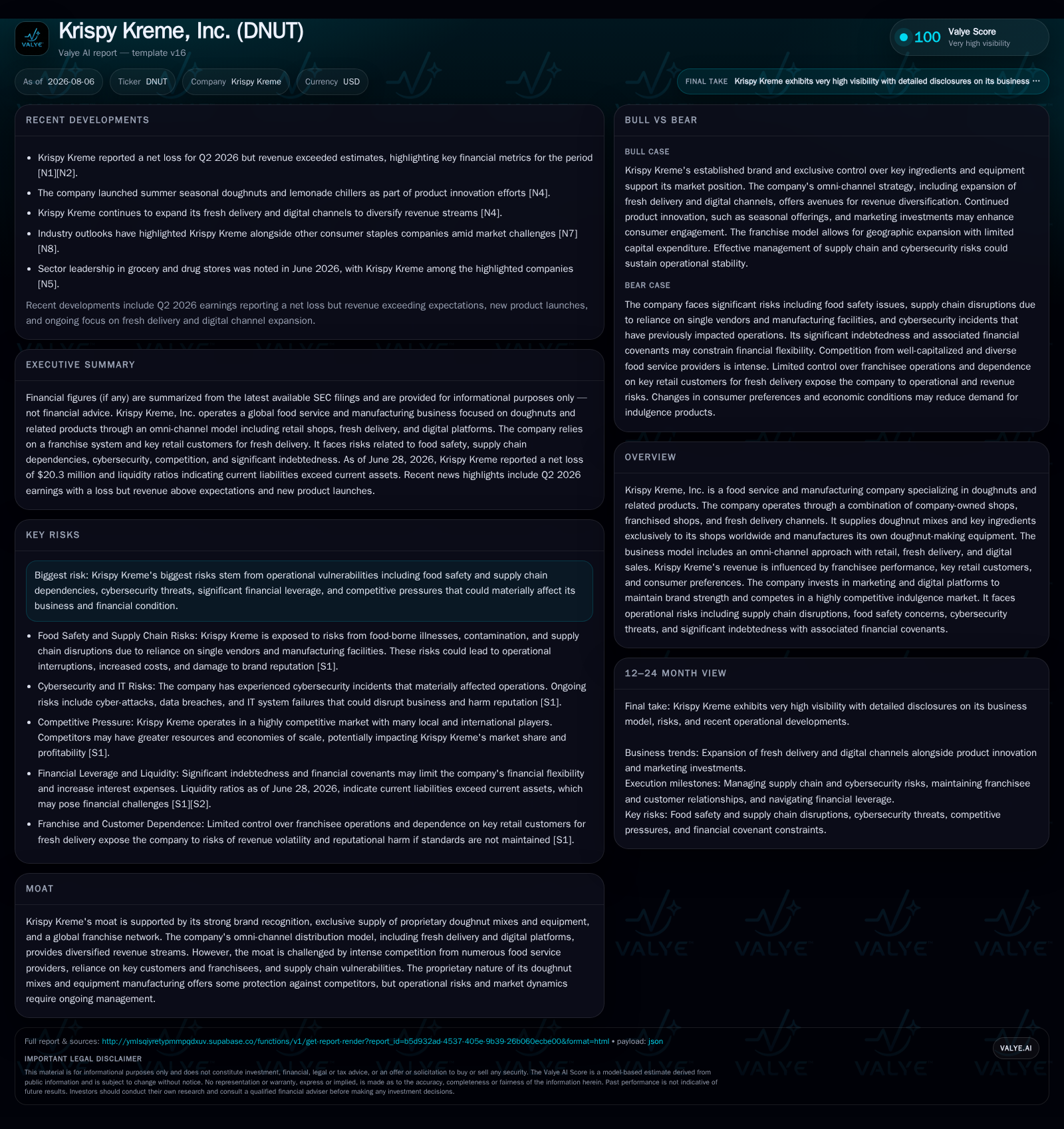
Krispy Kreme’s Q2 2026 results underscore the interplay of franchise network health, expanding digital and fresh delivery channels, and operational challenges shaping its growth outlook amid notable leverage.
Krispy Kreme’s second-quarter 2026 filing reveals a mixed operational landscape where modest improvements in franchisee same-store sales and digital penetration coexist with pressure on retail volumes and operating margins. The company’s proprietary doughnut mixes and in-house equipment manufacturing underpin its competitive position, while expansion in fresh delivery channels supports revenue diversification. High financial leverage and persistent supply chain complexities remain headwinds, highlighting the need for balanced execution on franchise expansion and omni-channel growth initiatives to sustain momentum.
Impact of Q2 Operating Metrics on Revenue Mix and Franchise Dynamics
The most recent quarterly filing (Q2 2026) details a nuanced operating environment for Krispy Kreme [S2]. Franchise-operated stores demonstrated modest positive same-store sales growth supported by steady royalty income, emphasizing the stabilizing effect of a robust franchise network on recurring revenues. However, company-owned retail shops exhibited some volume softness negatively affecting total retail sales volume—an important consideration given these stores typically bear higher operating leverage. Collectively, this dynamic contributed to margin compression within the quarter as operating costs were less effectively absorbed amidst uneven demand
Further complexity arises from strategic refranchising executed earlier in the year—specifically the Western U.S. joint venture restructuring—which reduced direct store ownership exposure but incentivized royalty-based income concentration. While this model mitigates some operating expense burdens inherent in company-operated units, it simultaneously increases dependency on franchisee performance; underperformance at the franchise level would cascade into royalty revenue volatility [S1][S2]. The balance between owned and franchised outlets remains critical as it influences both near-term cash flows and long-run growth trajectories.
Proprietary Recipe Production and Equipment Supply as Competitive Moat
A key pillar supporting Krispy Kreme’s market position is its proprietary doughnut mixes coupled with internally manufactured doughnut-making equipment. This vertical integration provides control over product quality consistency across all distribution points—franchised or owned—which fortifies brand equity critical in an indulgence-focused retail category. Proprietary recipes create switching costs for franchisees who rely on exclusive supply agreements, reinforcing network cohesion.
Moreover, manufacturing equipment in-house not only embeds the brand technologically but also enables incremental revenue streams through equipment sales or leases to franchise partners [S1]. This proprietary advantage signals some moat durability; however, it requires continuous innovation investment to prevent erosion given the competitive intensity from other specialty food retailers and quick-service restaurants that compete aggressively on product variety and price
Multi-Channel Distribution: Balancing Retail, Fresh Delivery, and Digital Platforms
Krispy Kreme’s strategy emphasizes omni-channel growth integrating traditional brick-and-mortar stores (company-owned and franchised), fresh delivery partnerships with key retailers, and expanding digital sales platforms targeting consumer convenience preferences. The latest filings underscore fresh delivery's growing contribution to top-line diversification—a significant shift from reliance solely on point-of-sale transactions.
Digital penetration improvements reflect ongoing investment into user-friendly ordering infrastructure which facilitates higher order frequency and average ticket size via personalized promotions or subscription models. These channels help offset sluggish foot traffic trends observed in physical locations amid broader foodservice competition [S1][S2]. Nonetheless, successful scaling requires tight logistics coordination and supply chain management to ensure product freshness—a critical attribute influencing repeat purchasing behavior within indulgence categories like doughnuts
Peer Benchmarking Highlights Strategic Position in Specialty Food Retail
When positioned against peers such as Dunkin’ Brands—which enjoys a larger footprint of franchised versus company-operated stores—Krispy Kreme shows similar strategic moves toward leveraging its franchise royalty streams while trimming direct operating exposures. Compared with Panera Bread’s advanced omni-channel foodservice platform emphasizing digital engagement and delivery integration, Krispy Kreme is progressing along this trajectory albeit at a smaller scale.
In terms of digital ordering platforms—an area dominated by Domino’s Pizza’s high penetration levels—Krispy Kreme's initiatives appear aligned directionally but face scalability challenges given differences in product perishability and distribution complexity. This comparative context highlights relative strengths in brand heritage and proprietary products but flags opportunities for accelerated platform enhancement or partnerships to close gaps in digital consumer capture mechanisms [N3][S1].
Growth Catalysts: Franchise Expansion, Digital Penetration, and Market Innovation
Growth drivers frame around expanding the domestic and international franchise footprint through targeted openings and market development agreements. Supplementing this is a push toward deepening fresh delivery contracts that unlock new retail channels beyond traditional outlets—providing access to consumers via grocery or convenience store formats.
On the innovation front, aligning product offerings closer to emerging indulgence trends (e.g., premium flavors or limited-edition items) can drive incremental transaction frequency while broadening appeal to shifting dietary preferences without compromising core recipe integrity. Enhanced marketing spend supports brand awareness efforts critical for both recruitment of new franchisees and stimulation of consumer demand 9[S1][S2].
Risks from Operational Complexities, Security Threats, and Financial Leverage
Operationally Krispy Kreme faces risk vectors common to specialty food retailers heavily reliant on perishable goods: food safety incidents present material threats not only via regulatory fines but also brand reputation damage—a crucial intangible asset underpinning customer loyalty.
Supply chain durability is another pressure point particularly as ingredient sourcing disruptions could constrain production schedules across channels causing lost sales or margin dilution due to last-minute cost escalations. The growing reliance on technology-enabled platforms introduces cybersecurity risks which could interrupt digital order flows or expose sensitive customer data if defenses weaken.
Financially, the company operates under significant leverage burden with net debt approximating $772 million against limited liquidity ($22 million cash) resulting in a current ratio well below 1 (0.36 as of Q2 2026), indicating tight short-term financial flexibility [F1][S1][S2]
Near-Term Monitorables: Execution Trackers for Franchise Health and Channel Growth
Key performance indicators warranting close observation include sequential same-store sales trends differentiated by franchise vs company-operated units to confirm if recent improvements solidify or falter amidst competitive pressures. Renewal rates among franchised locations post-refranchising provide visibility into partnership stability which directly impacts recurring royalty revenues.
Digital sales penetration rates will indicate if investments translate into sustainable customer acquisition amid evolving consumer ordering behaviors [S2][N1]. Additionally, monitoring store-level operating margins helps assess if operational efficiencies offset cost inflation in both owned outlets and fresh delivery logistics
Financial Profile Discussion
Disclaimer: This is research-only, informational analysis and not investment advice. It may include AI-generated interpretation and general industry context. Always verify important details using primary sources.

Comments