
Bowhead Specialty’s Merger and Underwriting Discipline Strengthen Its Specialty P&C Position
Recent merger agreement with American Family and disciplined underwriting models position Bowhead Specialty Holdings for scalable growth in specialty commercial P&C insurance.
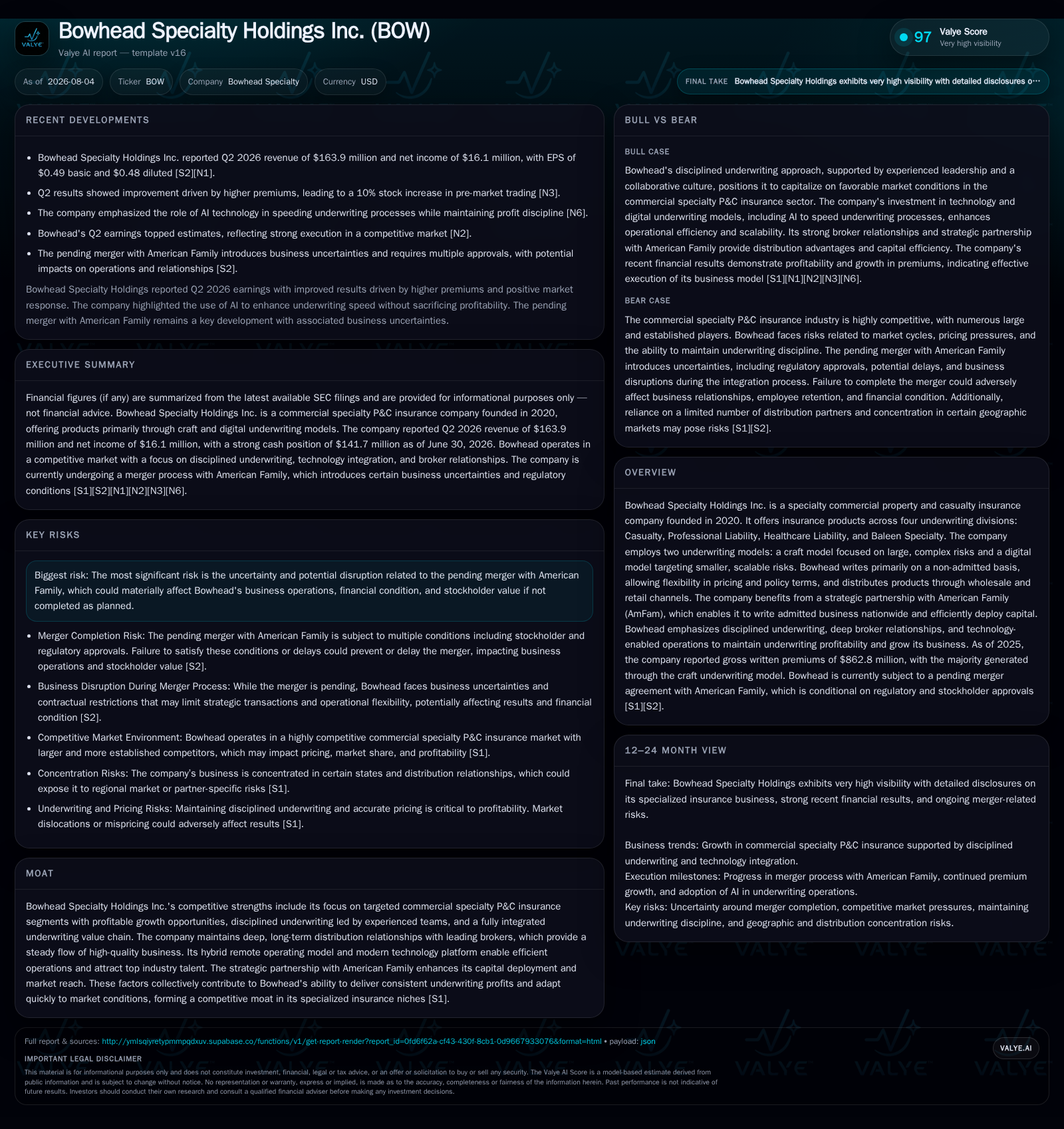
Bowhead Specialty Holdings (BOW) reported a solid Q2 2026 update highlighting disciplined underwriting across its craft and digital models and announced an agreement to merge with American Family Mutual Insurance Company, enhancing capital efficiency and market access. The company’s business model focuses on specialty commercial property and casualty insurance primarily written on a non-admitted basis through wholesale and retail broker channels, targeting casualty, professional liability, healthcare liability, and niche specialty risks. Its combined underwriting approach leverages experienced underwriters for complex risks while driving efficiency in smaller risks through technology-enabled digital platforms. Pending regulatory approvals for the merger present execution risk, but the transaction underscores Bowhead’s growing scale and strategic alignment within the specialty insurance sector. Financially, Bowhead retains a solid liquidity profile with manageable net debt, supporting its growth strategy in a cyclical market environment.
Recent Operating Update: Merger Agreement with American Family Highlights Strategic Capital Shift
In early August 2026, Bowhead Specialty Holdings Inc. entered into a definitive Agreement and Plan of Merger with American Family Mutual Insurance Company (AmFam) whereby Bowhead will become a wholly owned subsidiary of AmFam upon closing [S3]. This transaction is significant as it illustrates Bowhead’s strategic evolution from an independent specialty insurer to integration with an established admitted carrier that provides nationwide licensed paper access. Completion depends on customary conditions including shareholder approval from Bowhead stockholders, regulatory clearances from states like Wisconsin and Texas, antitrust review under Hart-Scott-Rodino guidelines, and absence of material adverse changes [S2]. The deal provides Bowhead capital deployment advantages expected to enhance scale without disrupting its specialized underwriting focus.
Business Model: Dual Craft and Digital Underwriting Driving Specialty Growth
Bowhead was founded in 2020 with backing from private equity GPC Partners Investments alongside AmFam as a strategic partner. It targets specialty commercial property & casualty insurance primarily in casualty, professional liability, healthcare liability, and its Baleen Specialty segment serving smaller or distressed niches [S1]. The company operates two distinct underwriting models:
- Craft Model: Focused on large, complex risks requiring deep technical expertise from tenured underwriters leveraging longstanding broker relationships to structure tailored policies.
- Digital (Express) Model: Emphasizes speed and scalability through standardized products supported by technology-driven workflows targeting small to mid-sized accounts without compromising underwriting rigor.
This bifurcated model enables Bowhead to efficiently scale across market cycles by balancing risk complexity with operational efficiency. Most policies are written on an excess & surplus (E&S) non-admitted basis allowing flexible pricing and policy form customization free from standard state rate restrictions—a critical advantage given the hardening market conditions affecting rate adequacy industry-wide [S1]
Distribution channels span wholesale brokers specializing in specialty lines complemented by retail agents linked to AmFam’s admitted footprint. The policy issuance occurs under AmFam paper via Bowhead's managing general agency subsidiary (BSUI), generating fees that recur as ceding income while reinsurance contracts backstop risk retained by Bowhead Insurance Company (BICI) wholly owned subsidiary [S1]. This partnership allows fluid capital deployment alongside breadth of market access.
Industry Structure & Competitive Positioning
The specialty P&C insurance sector serves hard-to-insure commercial risks often declined or avoided by standard admitted carriers due to complexity or size. Firms differentiate themselves via sophisticated underwriting expertise, deep broker networks for originating quality risks, flexible product forms typically offered through non-admitted E&S channels, and prudent risk selection amid social inflation headwinds increasing claims severity.
Peers such as The Hanover Insurance Group (THG) exhibit similar specialty focuses but often maintain larger scale admitted offerings. Markel Corporation also exemplifies niche excess & surplus specialists competing on technical underwriting muscle and capital strength.
Bowhead’s competitive moat stems from combining deep craft underwriting experience capable of handling high-severity specialty classes with a nimble digital platform for transactional volume gains. Its distribution ties through trusted wholesale brokers underpin consistent originations while the AmFam alliance expands admitted paper capabilities without capitulating the flexibility foundational to E&S products.
Growth Drivers: Hard Market Conditions & Technology Enablement
The broader P&C industry environment remains cyclical but currently favors specialty insurers like Bowhead due to ongoing hardening marked by rising premium rates prompted by inflationary cost pressures including social inflation impacting claims frequency and severity. This backdrop enhances rate adequacy prospects—a key driver of underwriting profitability—and creates opportunities to grow policy count while protecting margins.
Bowhead’s investment in proprietary technology tools such as the Bowhead Risk Analysis Tools (BRATs) helps streamline underwriting workflow by automating routine tasks allowing expert underwriters to focus on complex judgment calls faster. Coupled with data analytics refining risk selection precision, these investments support scalability of both craft and digital channels through more efficient quote-to-bind processes without compromising discipline crucial for controlling loss ratios [S1][S23]
Furthermore, expanding non-admitted E&S market demand due to stricter regulatory constraints on admitted insurers continues creating openings for Bowhead’s flexible policy forms. Strategic capital partnerships like the pending American Family merger augment growth capital enabling opportunistic expansion or product diversification aligned with differential risk appetites.
Risks & Challenges: Execution Uncertainty & Underwriting Sensitivities
The transaction with AmFam introduces several execution-related risks including uncertain timing due to dependency on multiple stockholder votes and regulatory approvals which may delay or scuttle completion; this merger-related uncertainty may distract management attention from ongoing operations potentially affecting near-term performance [S2][S3].
Operationally, reliance on key broker relationships exposes Bowhead to concentration risk if those channels shift priorities or contractual terms change unfavorably. The company's exposure to social inflation remains a latent risk whereby loss severity trends unexpectedly worsen beyond current reserving assumptions undermining combined ratios despite prudent underwriting efforts.
Loss reserve adequacy represents another watchpoint given inherent uncertainty in estimating ultimate claim costs within complex segments; historical reserve releases were limited largely because Bowhead commenced operations recently without legacy claims burden predating 2020 providing some comfort though future reserve development must be monitored closely [S1]. Regulatory developments including solvency modernization initiatives may impose heightened capital standards or operational reporting burdens potentially restricting flexibility.
What To Watch Next
Key near-term milestones include:
- Stockholder vote outcomes on the proposed merger crucial for closing timeline realization.
- Regulatory clearances especially from state insurance departments (Wisconsin/Texas) that could impose conditions or delay.
- Quarterly financial reporting post-merger announcement shedding light on any operational impacts related to transaction activities.
- Trends in premium growth rates across both craft-specialty large risks versus digital small-risk segments as indicators of balanced portfolio expansion.
- Combined ratio movement reflecting sufficiency of rate actions against inflationary cost pressures.
- Technology platform enhancements driving quote turnaround metrics indicative of scaling progress.
Financial Profile Discussion
As of June 30, 2026, Bowhead held approximately $142 million in cash and equivalents against total debt near $147 million resulting in net debt around $4.8 million — signaling low leverage supportive of ongoing growth initiatives without excessive refinancing strain [F1]. This liquidity position underpins the company’s ability to fund claims payments promptly while investing in underwriting talent acquisition and technology build-out essential for competitive positioning.
The company’s senior notes carry fixed interest obligations (7.75% coupon due 2030), supplemented by an undrawn revolving credit facility providing additional financial flexibility subject to customary covenants restricting excessive leverage or dividend payouts that align with a capital preservation mindset across cycles [S4][S5][S6]
Reported net income for full-year 2025 stood at approximately $54 million on about $552 million revenue reflecting emerging scale yet disciplined expense management consistent with sustainable underwriting profits rather than aggressive top-line chase alone [F1]. These metrics will be critical reference points as the merged entity’s financials evolve post-integration with AmFam’s admittance capacity potentially lowering capital costs further.
Conclusion
Bowhead Specialty Holdings continues advancing its focused dual-model specialty P&C insurance strategy augmented by robust technology enablement while leveraging one of its largest shareholders—AmFam—for enhanced admitted scale platform access via the pending merger agreement announced mid-2026. This combination addresses core industry challenges including cyclical pricing pressures intensified by social inflation-driven claims increasing severity but balances it with strong contractual distribution relationships rooted primarily in wholesale brokerage networks accustomed to navigating complex insurance needs.
Execution risks remain tied chiefly to regulatory approvals and stockholder consent yet successful closing promises accelerated growth potential. Monitoring loss ratio trends relative to premium pricing actions alongside maintaining operational excellence through technological innovation will be essential performance markers following this pivotal corporate transition.
This analysis is based solely on publicly available filings and news sources without offering investment advice.
Disclaimer: This is research-only, informational analysis and not investment advice. It may include AI-generated interpretation and general industry context. Always verify important details using primary sources.

Comments