
Broadridge Financial Solutions Advances SaaS Trade Processing and Investor Communication Amid Regulatory Shifts
Broadridge's latest quarterly report highlights growth in its Global Technology and Operations segment, supported by resilient SaaS revenues and investor communication services adapting to evolving regulations.
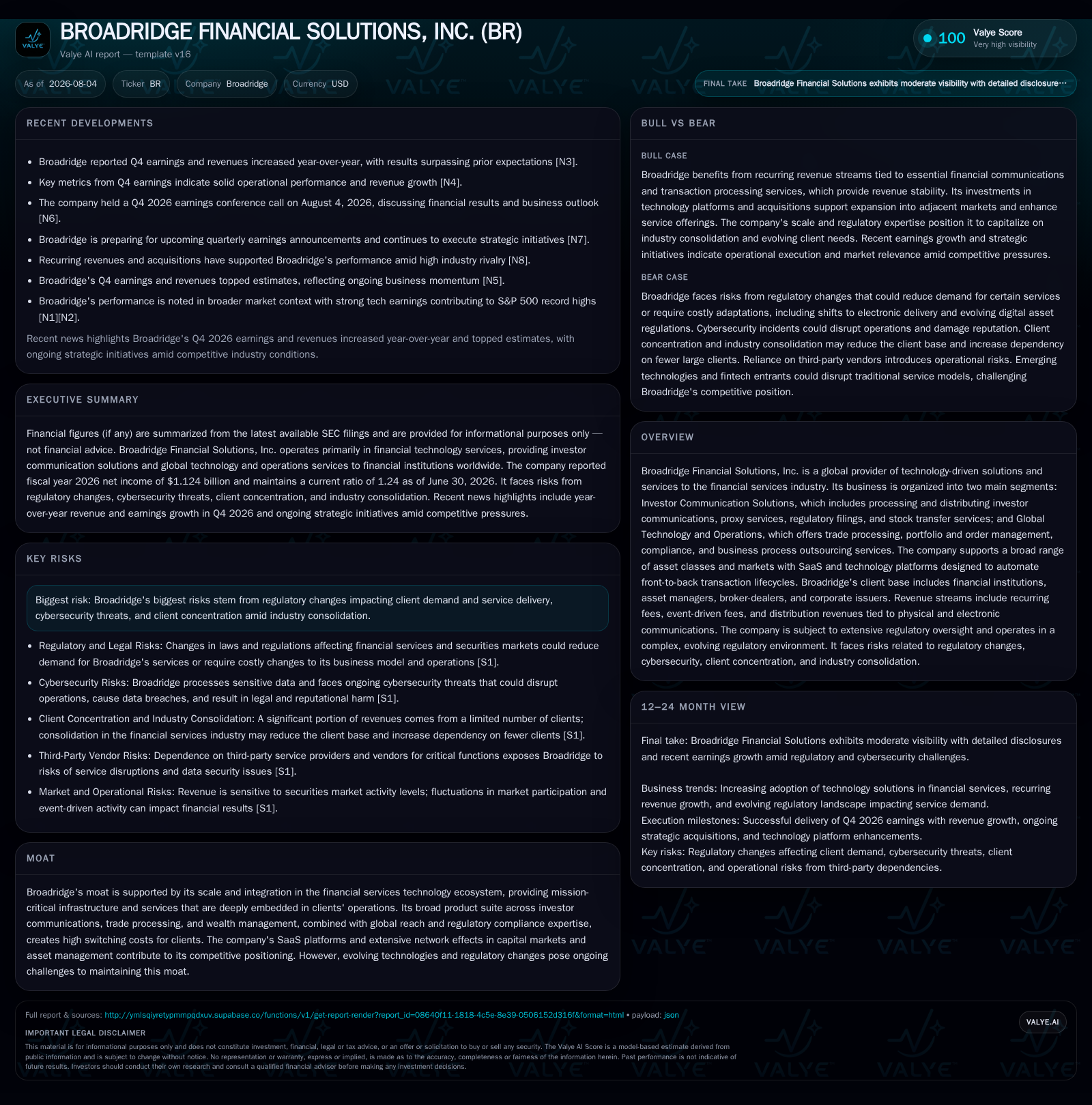
In its most recent quarter ending March 31, 2026, Broadridge Financial Solutions exhibited sustained momentum in its technology-driven financial services offerings. The firm’s Global Technology and Operations segment continues to generate recurring revenues primarily from SaaS trade processing solutions that serve capital markets, wealth management, and investment clients. Meanwhile, the Investor Communication Solutions segment faces moderate headwinds from regulatory proposals favoring electronic delivery over physical mailings, impacting distribution revenue streams. Broadridge’s competitive positioning remains anchored by scale, integration in financial ecosystems, and high switching costs despite ongoing regulatory and technological challenges. Key risks include evolving regulations on securities communications and digital assets, cybersecurity threats, and client concentration as industry consolidation persists.
Recent Operating Highlights
Broadridge Financial Solutions’ latest quarterly filing for the period ending March 31, 2026 reveals continued progression in its two primary business segments: Global Technology and Operations (GTO) and Investor Communication Solutions (ICS). The GTO segment maintained robust recurring revenue streams through its SaaS-based trade processing platforms that automate critical front-to-back transaction lifecycles across equity, fixed income, derivatives, mutual funds, foreign exchange, and other asset classes [S2]. Revenue recognition reflects monthly stand-ready obligations with fees billed as services are delivered over time. This recurring revenue model supports predictable cash flow visibility critical for capital allocation decisions.
On the ICS front, Broadridge offers governance solutions encompassing proxy services, shareholder meeting facilitation including virtual meetings, vote processing/tabulation services as well as data-driven regulatory communications for asset managers across jurisdictions [S1]. However, the segment faces a structural challenge from evolving regulatory frameworks such as the SEC’s proposed Regulation E-Delivery which would shift default communications from paper toward electronic delivery. While digital communications volume is expected to rise partially offsetting declines in physical mailings, Broadridge acknowledges potential decreases in distribution revenues and restructuring risks for physical logistics operations [S1]. This regulatory-induced mix shift pressures the sustainability of certain revenue streams within ICS.
Business Model Nuances
Broadridge monetizes through a blend of recurring subscription or usage-based fees primarily from GTO’s SaaS infrastructure supporting global capital markets firms along with event-driven fees tied to special corporate actions or proxy events processed within ICS [S2], [S10]. Additionally, distribution revenues linked to physical or electronic delivery services form part of ICS income but face secular decline drivers given digitization trends [S21]. This revenue composition creates partial top-line volatility tied to regulatory cycles and market transaction volumes but is stabilized by long-term contracts with high client retention.
Client categories served include banks and broker-dealers conducting trade processing activities; asset managers leveraging fiduciary, portfolio management, compliance software; retirement plan administrators accessing automated mutual fund trades; corporate issuers utilizing shareholder engagement tools; alongside wealth advisors depending on client onboarding and account management systems [S1], [S9]. This diversified customer base impacts the firm's average revenue per client metric while providing exposure to multiple growth vectors within financial services technology.
While contract terms vary—ranging from fee-for-service models for ICS event processing to subscriptions for GTO platforms—the company maintains high switching costs owing to the complexity of integrating its workflow automation into clients’ compliance regimens and operational infrastructures. This entrenched positioning bolsters retention rates amid competitive pressures from both specialist fintech startups and larger integrated service providers like SS&C Technologies and FIS/Fiserv analogues.
Industry Structure & Competitive Position
The financial technology services sector demands mission-critical reliability backed by regulatory compliance expertise. Broadridge operates upstream as an intermediary technology enabler bridging institutional clients with investors and regulators through seamless transaction processing and communications. Compared with peers focused narrowly on either trade management software (e.g., SS&C) or investor communication alone (historically DST Systems), Broadridge’s integrated platform approach supports cross-selling synergies that are increasingly valued amid industry consolidation.
Competition centers on scale of infrastructure capable of handling growing volumes (e.g., adoption of T+1 settlement cycles), technological adaptability (cloud-native SaaS architectures), data analytics capabilities augmenting decision-making insights for clients, security robustness against cyber threats, and cost efficiency. Broadridge’s multi-jurisdictional footprint also confers advantages navigating fragmented global regulatory regimes affecting digital assets or proxy voting protocols.
Margins can be sensitive to investments in platform modernization or acquisition integration yet benefit from mutualized cost structures inherent in shared-service SaaS deployments. Operational excellence measured by platform uptime, rapid client onboarding processes, low compliance incident rates, alongside net promoter scores drives competitive differentiation.
Growth Drivers
Broadridge’s growth thesis leverages multiple secular trends: increasing regulatory complexity fueling demand for automated compliance tools; accelerating shift from manual to SaaS-enabled financial operations to reduce error-prone workflows; global expansion of capital markets driving higher trading volumes requiring scalable trade-processing backbones; rising volumes of investor communication driven by shareholder activism and ESG reporting mandates; plus broader outsourcing trends pushing non-core middle- and back-office functions toward third-party vendors.
Its Wealth Management solutions aimed at brokers and advisors tap into long-term structural growth amidst demographic wealth accumulation. Meanwhile expansion into digital asset-related platforms represents a nascent opportunity contingent on clarifying regulatory environments around tokenized securities [S1]. Enhancements in data-driven fund solutions that provide analytics on product distribution further deepen customer value proposition.
Risks & Constraints
The foremost risk emanates from regulatory changes altering how communications are delivered to shareholders or how digital assets are classified — outcomes which could materially reduce Broadridge’s traditional fee pools or necessitate costly business-model pivots [S1]. Cybersecurity threats constitute ongoing operational vulnerabilities given the confidential nature of client transactions.
Client concentration risk intensifies as mergers within financial services produce fewer but larger counterparties who hold greater negotiating leverage possibly compressing pricing power or pushing for scope reductions [S1]. Additionally, rapid technological advances require continuous investment to fend off competition from innovative fintech startups specialized in niche verticals potentially eroding portions of Broadridge’s market share.
Operational risks related to platform reliability emphasize needs for consistent uptime; any system failures during critical proxy seasons or settlement cycles could cause reputational damage. Pricing pressure persists as clients seek cost reductions amidst rising fee scrutiny especially post-consolidation.
What To Watch Next
Key milestones include Broadridge's ability to grow recurring revenues within GTO amidst expanding asset-class coverage and new modular product rollouts. Monitoring quarterly transaction volume growth rates will signal market adoption strength while tracking event-driven revenue fluctuations will indicate sensitivity to market conditions.
On ICS side, updating progress against anticipated impacts from E-Delivery regulation adoption is crucial given potential revenue mix shifts. Client retention metrics alongside cross-sell success into adjacent business lines will reflect execution effectiveness. Watch for commentary on digital asset solution commercialization amid evolving legislation that might open new revenue avenues or require product adaptation.
Earnings calls following the August 4 extension filing may also reveal outlooks on capital allocation strategies like share repurchases or acquisitions balancing growth initiatives versus debt servicing constraints [N3], [N5], [N8].
Financial Profile Discussion
As of June 30, 2026, Broadridge held $402.9 million in cash and equivalents against current liabilities totaling approximately $1.41 billion resulting in a current ratio near 1.24 — indicative of reasonable short-term liquidity [F1], [S2]. Capital expenditures primarily involve continuing investments in software development ($42 million in nine months) alongside selective acquisitions supporting product breadth extension rather than broad capex-heavy expansions [S2], [F1]. Deferred consideration on acquisitions introduces integration execution risk but aligns with strategy to consolidate tech capabilities rapidly [S26].
This analysis synthesizes recent SEC disclosures alongside contextual industry dynamics without constituting investment advice.
Disclaimer: This is research-only, informational analysis and not investment advice. It may include AI-generated interpretation and general industry context. Always verify important details using primary sources.

Comments