
Dorchester Minerals Expands Williston Basin Footprint Amid Volatile Commodity Prices
DMLP's latest quarter demonstrates asset growth through strategic acquisitions, while commodity price fluctuations continue to shape cash flow stability.
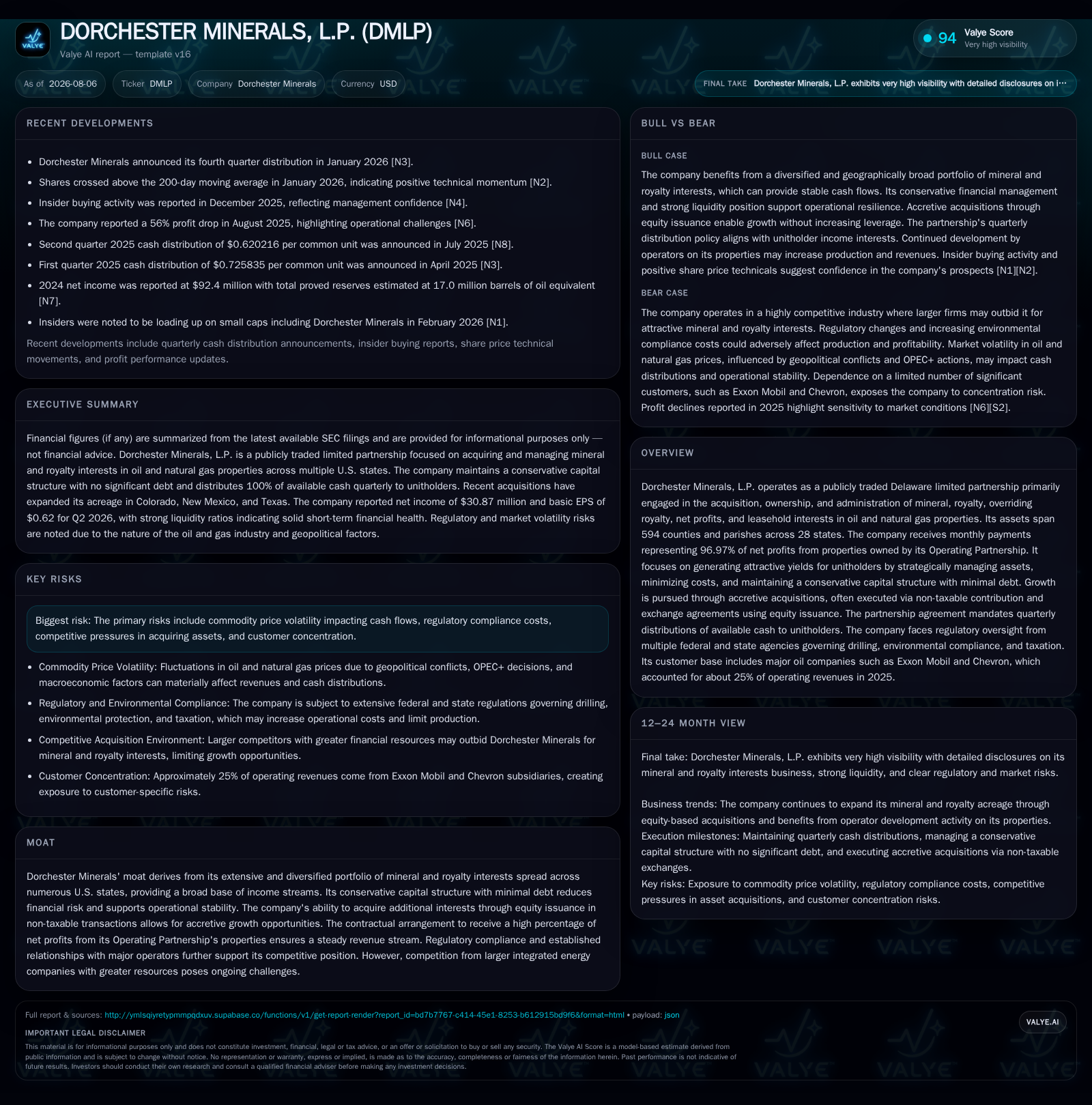
Dorchester Minerals, L.P. reported operational resilience in its August 2026 quarterly filing, marked by a significant acquisition of approximately 3,100 net royalty acres in the Williston Basin via a non-taxable contribution and exchange. The partnership maintains a highly diversified portfolio across 28 states and focuses on steady cash distributions primarily funded from net profits interests (NPIs) and royalty properties. Commodity price volatility and operator drilling activity remain major determinants of revenue and distributions. Dorchester's conservative capital structure—highlighted by minimal debt and substantial liquidity—supports ongoing acquisition-led growth while managing exposure to external risks such as regulatory changes and geopolitical uncertainty.
Recent Operating Update
In its most recent quarterly report filed August 6, 2026, Dorchester Minerals, L.P. announced the closing of a noteworthy acquisition totaling approximately 3,100 net royalty acres located in five counties within the prolific Williston Basin in North Dakota [S2][S3][S4]. This transaction was executed as a non-taxable contribution and exchange whereby contributing entities received 835,958 common units in the Partnership. Such structuring preserves tax efficiency while expanding the mineral footprint in a basin that remains attractive due to ongoing development activity despite overall industry headwinds.
This addition complements Dorchester’s existing footprint that spans over 594 counties across 28 states emphasizing geographic diversification that mitigates single-basin concentration risk. The partnership receives monthly payments equaling roughly 96.97% of net profits generated by its Operating Partnership from various properties subject to Net Profits Interests (NPIs), which form a major component of its revenues alongside royalty interests tied directly to production volumes and realized commodity prices [S1]
Commodity price volatility continued to impact operational results during the first half of 2026 as global political events—including conflicts involving the United States, Israel, Iran, and disruptions near critical chokepoints like the Strait of Hormuz—have created pronounced fluctuations in oil prices [S2]. Furthermore, shifts such as the UAE exiting OPEC+ add an additional layer of unpredictability potentially impacting drilling activity levels by operators on Dorchester’s underlying assets.
Business Model
Dorchester Minerals operates primarily as an upstream asset owner specializing in non-operating mineral interests, royalty interests, overriding royalty interests, and net profits interests (NPIs). Its business model is distinct from exploration or production companies; it generates revenue through contractual rights to portions of production proceeds realized by third-party operators drilling and completing wells on these properties.
The flat structure emphasizing royalties and NPIs inherently transfers operational control risks to working interest owners while providing Dorchester with high margins due to minimal direct operating costs. Revenue is mechanistically dependent on several factors: number of producing wells generating output under the company’s acreage; volumes produced; realized commodity prices; lease bonus payments from unleased acreage leases; and any deductions under NPI agreements primarily consisting of operating costs borne by operators.
Growth hinges on strategic accretive expansion through acquisitions that are often consummated via equity issuance in non-taxable contribution-exchange transactions to avoid cash outflows that could otherwise pressure distributions [S1][S5]. The Partnership agreement mandates quarterly distribution of available cash to unitholders, targeting attractive yield generation with preservation of capital structure conservatism by limiting debt exposure substantially below material thresholds
Industry Structure and Competitive Position
Dorchester sits firmly within the oil and gas mineral and royalty interest industry segment characterized by ownership of fractional property rights without direct operational involvement. This upstream niche contrasts sharply with producing or integrated firms active along the full energy value chain but nonetheless is critical for securing stable passive cash flows linked to hydrocarbon production.
Peer comparisons include other publicly traded mineral interest partnerships like Permian Resources Trust or Sabine Royalty Trust; integrated energy majors such as ExxonMobil hold substantial acreage but differ given their upstream operating roles; independent mineral rights firms focus regionally on basins like Permian or Bakken compared to Dorchester’s broader geographic diversification.
Competitive pressure arises mostly around acquisition opportunities where larger players with deeper pockets may dominate bidding processes for coveted producing properties or highly prospective mineral rights. Regulatory environment complexity — involving federal/state compliance for production reporting, environmental standards, royalties administration — favors entities with robust administrative capabilities such as Dorchester’s Operating Partnership.
Growth Drivers
Key growth vectors include:
- Continued operator drilling activities in established basins (e.g., Permian, Bakken) that increase production volumes attributable to Dorchester’s interests.
- Acquisitions executed through non-taxable contributions broaden net royalty acres under management; recent deals indicate ongoing expansion especially in resilient basins like Williston [S3][S4].
- Leasing activity generates variable lease bonus income providing supplemental cash inflows; extensions on existing leases can lock in future payments at attractive per-acre pricing demonstrated recently in Texas leases at $15k/acre plus royalties [S1].
- Favorable commodity price environments enhance revenue per barrel or Mcf produced though this remains cyclical with external geopolitical and economic influences.
- Improvements in drilling technology or enhanced recovery methods applied by producers can incrementally increase output on existing acreage without new land acquisition.
Risks and Constraints
Dorchester's financial health is closely tied to several exogenous risks:
- Commodity Price Volatility: Fluctuations driven by OPEC+ actions, geopolitical crises (notably ongoing conflicts disrupting key transit routes), macroeconomic uncertainties all create unpredictable earnings variability impacting quarterly distributions [S2].
- Limited Operational Control: As a passive participant holding royalty/NPIs rather than operating interests, Dorchester cannot directly influence drilling decisions or production levels which depend entirely on operator budgets and strategies.
- Leasing Dependence: Revenues from leasing bonuses depend on market conditions that affect third-party leasing willingness; unfavorable price or demand environments reduce lease activity.
- Regulatory Environment: Ongoing government regulation expansions impose compliance costs and can indirectly affect production economics making some projects uneconomic impacting royalties.[S1][S10]
- Competitive Pressures: Larger integrated E&P companies with broader resource pools may outbid Dorchester for assets, challenging future acquisitive growth efforts [S12].
What To Watch Next
Key upcoming milestones and indicators include:
- Monitoring production trends from newly acquired acreage in the Williston Basin for signs of sustained operator investment sustaining volume growth.
- Observing quarterly cash distribution per unit announcements as proximate signals reflecting realized commodity prices impact plus asset performance [S6][S8][N/A but implied from filings].
- Tracking further acquisitions structured via contribution-exchange agreements which signal ongoing asset portfolio expansion while managing dilution.
- Evaluating regulatory developments particularly any legislations affecting royalties calculation basis or environmental compliance costs.
- Watching operator capex plans for core producing basins that underpin drilling tempo influencing underlying NPIs revenue trajectories.
Financial Profile Discussion
Dorchester maintains a notably conservative balance sheet as evidenced by its lack of meaningful indebtedness prohibited under its partnership agreement save nominal trade payables [S5]. At quarter-end June 30, 2026, it reported $72.5 million in cash and equivalents against current liabilities of just $7.2 million yielding an exceptionally strong current ratio of approximately 13.85 [F1]. This liquidity profile supports ongoing opportunistic acquisitions without resorting to leverage enhancing financial stability amid commodity cycles.
Acquisitions conducted predominantly via equity issuance limit immediate cash outflows yet introduce ownership dilution which management appears balanced against yield accretion based on acquisition economics disclosed in filings [S3][S7]. Lease bonuses also provide supplementary steady-state cash flow; recently noted $4 million including extensions denotes active leasehold monetization capabilities.[S1]
In summary, Dorchester's financial discipline ensures resilience against oil price swings while offering flexibility for measured acquisitive growth within its broad geographic footprint.
This analysis synthesizes recent SEC disclosures alongside industry-contextual framing reflecting Dorchester Minerals’ position as a leading publicly traded mineral and royalty LP specializing in passive upstream asset ownership across multiple U.S. basins. The partnership's growth depends critically on continued operator investment trends combined with disciplined capital management amid persistent macrovolatility impacting energy markets.
Disclaimer: This is research-only, informational analysis and not investment advice. It may include AI-generated interpretation and general industry context. Always verify important details using primary sources.

Comments