
Genpact's Transition to AI-Enabled Enterprise Solutions Elevates Growth Trajectory
Genpact's latest quarterly report highlights accelerating revenue and margin expansion driven by its advanced technology segment amid broader digital transformation trends.
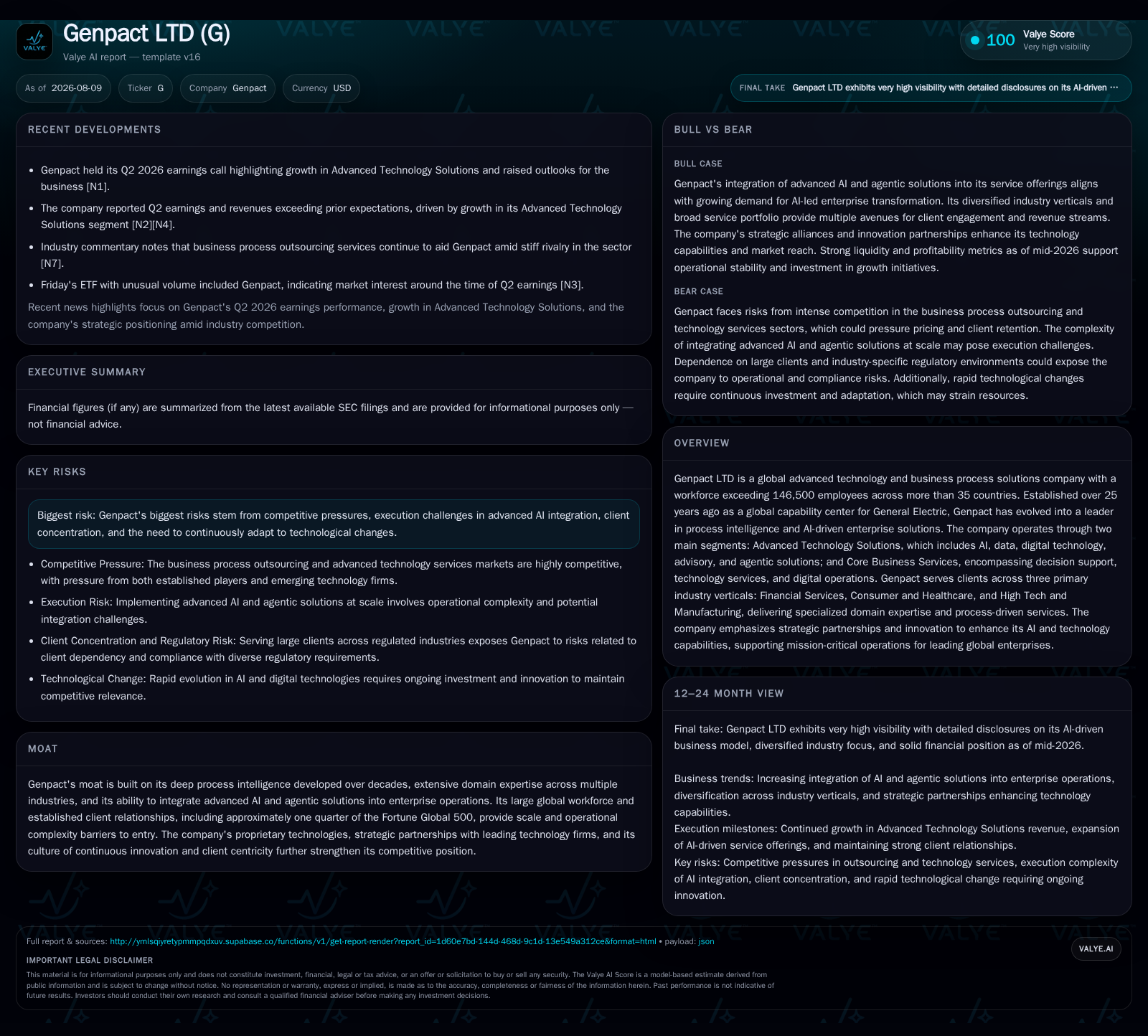
In its Q2 2026 filings, Genpact demonstrated notable growth in its Advanced Technology Solutions (ATS) segment, which now accounts for nearly a quarter of net revenues. This reflects the company's successful integration of AI-driven and agentic solutions that complement its core business process outsourcing services. Leveraging large-scale domain expertise and operational complexity across diverse industry verticals, Genpact strengthens client retention and pricing power. However, execution risks relating to AI adoption and client concentration remain important considerations going forward. The company's financial position remains solid with manageable leverage and strong free cash flow generation.
Q2 Results Reflect Acceleration in Advanced Technology Revenue
Genpact's Q2 2026 filing [S2] reveals a clear inflection in its business profile marked by accelerated revenue growth within its Advanced Technology Solutions (ATS) segment. ATS now constitutes approximately 23.7% of total net revenues, reflecting robust demand for AI-driven automation and data-centric services that complement the company’s traditional business process outsourcing (BPO) foundation. This shift is supported by an operating margin uptick in the quarter, indicative of improved pricing power and operating leverage stemming from higher-margin technology-enabled services. This evolution signals that Genpact is effectively capitalizing on enterprise digital transformation priorities through a structurally superior product mix rather than relying solely on commodity BPO volume growth [S2], [N1], [N2].
Embedding AI and Agentic Solutions Strengthens Process Intelligence Moat
Genpact’s strategic transition builds on over two decades of deep process intelligence honed initially as GE’s global capability center [S1]. Its agentic solutions—AI systems that learn from and interact alongside human operators—represent a differentiated approach within enterprise operations enabling continuous learning and automation. Such capabilities extend beyond typical robotic process automation by integrating sophisticated generative AI models tailored to complex industry-specific workflows. This enhances client switching costs due to significant domain expertise embedded in software and operational processes that competitors find difficult to replicate quickly. Hence, Genpact’s moat derives from marrying advanced data engineering with operational scale and domain knowledge to deliver last-mile process execution excellence [S1], [S2].
Establishing Competitive Position via Scale and Domain Expertise Across Key Verticals
Service delivery at scale is another pillar supporting Genpact’s market position. With over 146,500 employees distributed across more than 35 countries [S1], the company effectively manages operational complexity—an advantage relative to many peers focused solely on digital or IT consulting segments. Genpact targets three primary industry verticals: Financial Services; Consumer & Healthcare; and High Tech & Manufacturing, each requiring nuanced regulatory understanding and unique process transformation strategies. This multi-vertical breadth diversifies revenue sources while deepening client centricity given specific domain knowledge crucial to high-stakes business functions such as compliance or supply chain optimization. Competitors like Cognizant or Infosys share presence here but Genpact’s emphasis on agentic process intelligence combined with scale differentiates its value proposition [S1], [S3].
Contract Structure and Client Retention Underpin Revenue Visibility
Revenue durability stems from a contract structure combining long-term multi-year service agreements with both fixed fees and usage-based components [S1]. While exact renewal rates are undisclosed, the stable contract backlog coupled with approximately one quarter of revenues coming from Fortune Global 500 clients suggests low churn risk undergirded by critical operational dependencies at these firms [S1], [S2]. This mix aligns incentives between Genpact and clients fostering ongoing collaboration on automation initiatives—a dynamic enabling both volume growth through expanded scope and margin expansion via premium technology services adoption. Client concentration remains a watchpoint given the sizable top-client exposure but is mitigated by multi-industry diversification [S1].
Growth Catalysts: Enterprise Demand for Digital Transformation and Automation
The broader industry tailwinds fueling Genpact’s ATS momentum include escalating enterprise investments in AI-led transformation, cloud migration, advanced analytics, and generative AI integration [N9], [S1]. Increasingly complex knowledge processes are prime candidates for outsourcing to providers who simultaneously act as technology partners offering modernization roadmaps alongside traditional shared services models. Strategic partnerships with leading cloud platforms and workflow vendors augment credibility and accelerate deployment cycles—a necessity given fast innovation cycles in AI technologies today. These secular shifts support expanding addressable markets well beyond legacy BPO scopes [S1].
Risks From Technology Integration Complexity and Client Concentration
Despite strengths, several risks warrant scrutiny. Intense pricing competition persists from both traditional BPO players optimizing labor arbitrage as well as emerging pure-play digital automation providers with lighter cost structures [S1]. Integrating complex generative AI into client environments involves execution challenges including ensuring solution reliability, data privacy safeguards, and change management among end-users. Additionally, reliance on third-party cloud providers introduces cybersecurity vulnerabilities that may trigger client remediation costs or regulatory liabilities if breached [S1]. Labor cost inflation across global delivery centers could pressure margins absent sufficient automation gains. Finally, high client concentration implies risk case if any major account materially reduces spend or does not renew multi-year contracts on favorable terms [S1], [S2]. Currency fluctuations add further margin volatility.
Key Near-Term Milestones: Renewals, Automation Adoption, Margin Expansion
To validate the sustainability of recent growth trends, key near-term indicators include monitoring contract renewal success particularly among top-tier clients; incremental uptake rates of proprietary AI modules embedded into client operations measurable through utilization metrics; and continued operating margin improvement reflecting premium service mix scaling efficiently [N1], [S2]. Given the rapid evolution of technology capabilities required for agentic solutions, progress against product development timelines alongside hiring/retention metrics for technical talent also merit observation as proxies for innovation momentum.
Financial Profile Discussion: Leverage, Cash Flow, Margin Sustainability
At Q2-end June 30, 2026, Genpact reported cash and equivalents of approximately $517 million against total debt near $1.18 billion, yielding net debt around $663 million consistent with manageable leverage ratios relative to EBITDA covenant thresholds outlined in prior filings [F1], [S2]. The company maintains a healthy current ratio close to 2.0 reflecting ample liquidity buffers versus short-term obligations ([F1]). Operating margins expansion this quarter evidences pricing power durability amid mix-shift towards ATS offerings that command higher premiums than commoditized BPO tasks ([S2]). Free cash flow is positive albeit impacted by working capital investment for accounts receivable growth as the company optimizes scaling operations ([S2]).
This analysis synthesizes recent SEC filings and company disclosures without providing investment advice or forecasts. It aims to present a nuanced understanding of Genpact’s evolving business model amid shifting industry dynamics related to BPO digitization and AI adoption.
Disclaimer: This is research-only, informational analysis and not investment advice. It may include AI-generated interpretation and general industry context. Always verify important details using primary sources.

Comments