
Global Partners LP’s Integrated Logistics and Retail Network Supports Resilient Fuel Distribution
The latest quarter underscores Global Partners LP's strengths in wholesale logistics and retail fuels amid commodity price volatility and regulatory pressures.
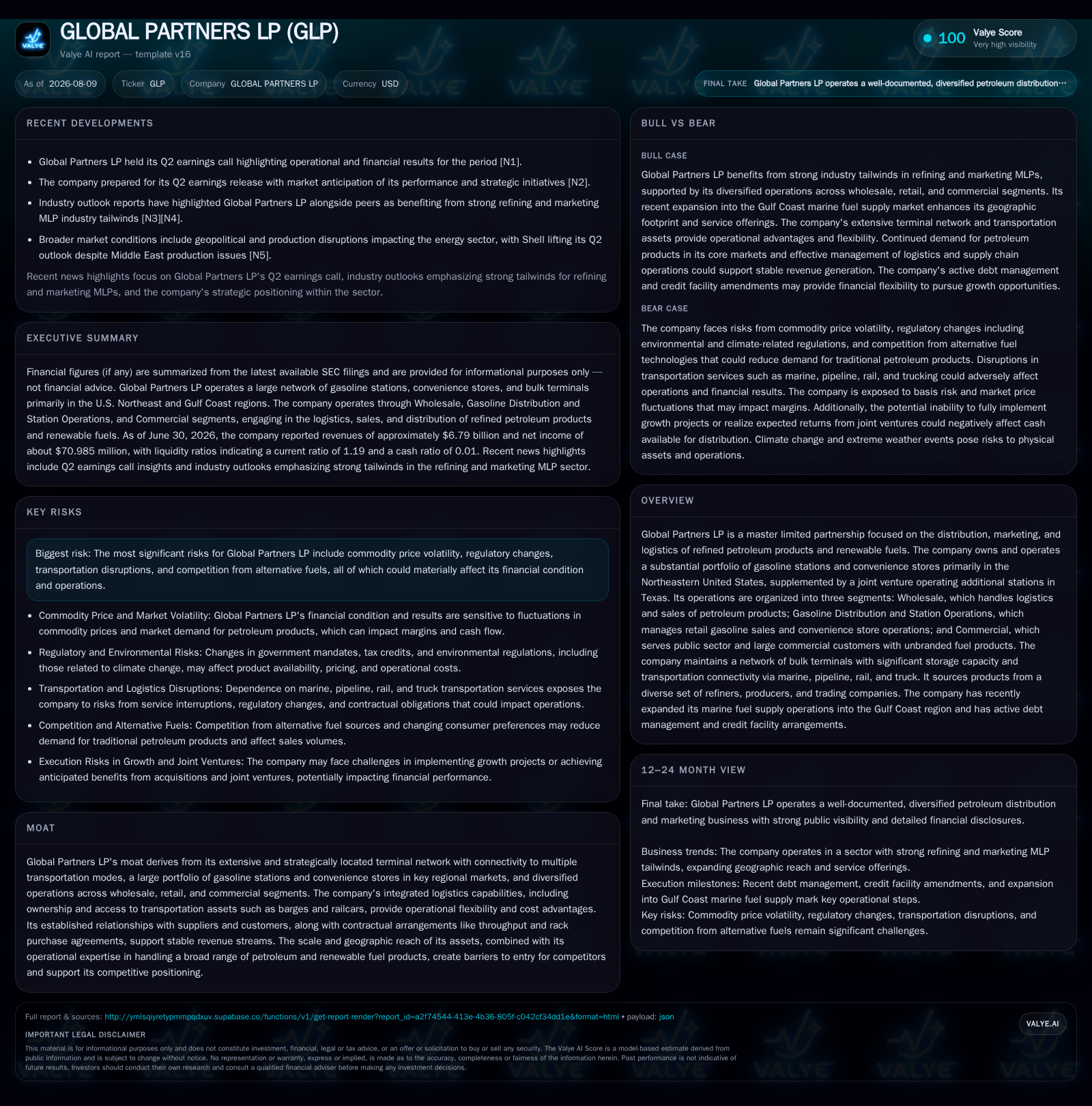
Global Partners LP, a master limited partnership specializing in refined petroleum products and renewable fuels distribution, reported stable operations in Q2 2026 with its integrated logistics network and diversified retail footprint underpinning resilience. The company’s Wholesale segment, which accounts for the majority of sales, continues to leverage its expansive terminal capacity and multi-modal transportation assets, while the Gasoline Distribution and Station Operations segment sustains retail presence primarily across the Northeastern U.S. Growth drivers include terminal expansions and penetration of renewable fuels, although risks from commodity price fluctuations and evolving regulatory landscapes persist. Financially, the partnership maintains a current ratio of 1.19 with liquidity supported by substantial current assets relative to liabilities.
Recent Operating Update
Global Partners LP's second quarter 2026 filings reveal a stable operational footing amid ongoing energy market volatility. The partnership issued financial results on August 7, highlighting continued execution across its Wholesale logistics operations and retail gasoline station portfolio [S2], [S3]. Despite fluctuating commodity prices—a perennial challenge for midstream/downstream petroleum distributors—Global Partners maintained performance consistency supported by its asset base.
The recent earnings release emphasized non-GAAP measures reconciled against GAAP, reflecting management’s focus on distributable cash flow metrics pertinent to MLP structures rather than purely accounting earnings [S3]. No material disruptions or strategic divestitures were disclosed this quarter.
Business Model Overview
Global Partners operates as a master limited partnership focused on the distribution, marketing, and logistics of refined petroleum products—including gasoline, diesel, propane—and renewable fuels. Its revenue streams derive primarily from three segments: Wholesale, Gasoline Distribution and Station Operations (GDSO), and Commercial sales.
The Wholesale segment dominates revenue (approximately 68%), focusing on logistical activities such as selling, gathering, blending, storing, and transporting refined products via an integrated network of terminals connected through pipelines, rail lines, barges, and trucks [S24]. This segment sells fuel both branded and unbranded to commercial distributors who typically take delivery at bulk terminals or inland storage facilities owned or controlled by Global Partners
The GDSO segment encompasses retail gasoline station operations—including approximately 1,524 stations mainly concentrated in Northeastern states—with various ownership models: company-operated sites (290), commissioned agents (328), lessee dealers (164), and contract dealers (742). This segment also generates revenue through convenience store merchandise sales, prepared foods at stores, car washes, lottery commissions, rental income from leased sites, and co-branding fees [S24]. Convenience store sales serve to bolster margin potential beyond fuel volume alone—a critical factor given shrinking fuel demand trends in the broader market.
The Commercial segment caters to public sector entities and large commercial customers with unbranded fuel offerings constituting roughly 6% of sales. This diversification helps mitigate concentration risk tied solely to retail consumers.
The company holds a strategic portfolio of bulk terminals—54 as of end-2025—with collective storage capacity around 22.3 million barrels [S22]. These facilities offer connectivity to marine ports, pipelines, rail infrastructure, and road transport networks enabling agile product sourcing from multiple refineries or producers across geographic corridors spanning from Maine down through Florida into the Gulf States
Additionally, Global Partners complements its terminal holdings with leased transportation assets including a fleet of approximately 48 general-purpose railcars governed under lease agreements extending through at least 2027 [S22]. Such control over transportation improves cost management flexibility amid volatile freight rates and seasonal supply-demand fluctuations
Global Partners sources products via spot contracts or long-term purchase agreements at rack pricing—wholesale prices set at distribution terminals—with part of revenue inflows linked directly to throughput volumes under throughput agreements ensuring baseline demand at terminals.
This vertically integrated model provides operational advantages through margin capture opportunities in logistics optimization while supporting retail sales cross-subsidy strategies.
Industry Structure and Competitive Position
Operating primarily within the refined petroleum products distribution and retail sector situates Global Partners in a capital-intensive industry characterized by exposure to commodity price fluctuations and stringent environmental regulations. Its primary competitors include other MLPs like CrossAmerica Partners that also combine wholesale distribution with station operations; integrated refiners such as Phillips 66 or Valero offering downstream logistics; plus regional chains concentrating on convenience retailing.
Global Partners’ moat hinges on three pillars: an extensive terminal network with multimodal connectivity; scale in gasoline station ownership concentrated in dense Northeastern markets; and diversification across wholesale logistics plus retail segments reducing reliance on any single channel or customer type. Barrier-to-entry factors stem from required capital intensiveness of terminals (~22 million barrels stored) coupled with specialized handling capabilities for both conventional fuels and renewable blends requiring blending licenses or storage segregation [N1], [S24].
The company's ability to lease or operate proprietary transportation equipment enhances supply chain resilience relative to competitors limited to third-party carriers.
Further differentiation arises from its expanding renewable fuel penetration which aligns with evolving regulatory incentives for low-carbon fuels despite mandate uncertainties that pose longer-term risks.
Growth Drivers
Strategic capital investments underpin growth prospects for Global Partners. Notably, recent terminal expansions include extending marine fuel supply operations into the Gulf Coast region beginning late 2025—specifically at Port Houston plus adjacent hubs like Freeport—via throughput agreements complemented by barge time charters enhancing reach into industrial shipping lanes [S14]. This expansion opens access to faster growing downstream markets outside their traditional Northeast base.
Incremental growth also benefits from expansion or acquisition of retail gasoline station portfolios especially those integrating convenience merchandising capable of driving same-store sales growth. Enhancements in shop offerings improve customer retention metrics amid changing consumer habits.
Increasing renewables adoption contributes revenue diversification. While ethanol blending remains subject to federal/state mandates impacting availability/pricing dynamics negatively or positively over time, diligent management aims to optimize sourcing costs versus margin contribution from renewable identification numbers (RINs) credits embedded within fuel sales totals [S1], [S24].
Public sector fuel contracts within the Commercial segment provide steady demand less sensitive to market cycles than retail consumer fuels while offering opportunities for scale through contract renewals.
Globally rising transportation fuel demand in underserved regional markets combined with favorable government incentives for renewable fuels form further tailwinds.
Risks and Watchpoints
Commodity price volatility remains paramount among industry headwinds impacting margin per gallon sold due to timing differences between inventory valuation adjustments at wholesale terminals versus downstream sale prices. Sharp price swings can erode distributable cash flow if not effectively hedged or passed through rapidly.
Regulatory risks include tightening emissions standards capable of increasing compliance costs notably around sulfur content rules or blending requirements that could necessitate costly terminal upgrades or add complexity limiting product versatility.
Competition grows from alternative fuels—including electric vehicles—potentially compressing gasoline volumes sold over medium term horizons particularly in urban areas where charging infrastructure gains ground.
Operational risks arise from potential transportation disruptions affecting pipelines worn infrastructure or port congestion hindering timely product delivery reliant on multi-modal logistics coordination [S1], [N7]. Severe weather such as hurricanes impacting coastal terminals represents episodic disruption points.
Credit risks exist around wholesale customers given exposure to commercial counterparties’ financial health tied sometimes indirectly to cyclical economic conditions.
Capital intensity demands continuous investment cycles requiring access to cost-effective financing options without straining leverage ratios excessively amid fluctuating cash flows tied partly to market factors outside Global Partners’ control.
Lastly governance complexities inherent in MLP structures—with limited unitholder voting rights concentrated around general partner affiliates—may influence strategic decision-making priorities less aligned with minority investor interests.
What To Watch Next
Key forthcoming milestones include execution progress on Gulf Coast terminal expansions during late 2026 along with any announcements involving additional acquisition activity targeting complementary regional retail sites or wholesale logistics assets enhancing scale.
Monitoring quarterly fuel volume trends both wholesale gallons distributed via terminals plus retail station gallons sold will reveal underlying demand momentum beyond just pricing effects.
Tracking same-store sales growth metrics from convenience store operations will provide insight into merchandise contribution improvements crucial for sustained profitability given flat-to-declining gasoline demand structurally over time.
The evolution of renewable fuel mix percentages in total gallons handled also warrants attention as it reflects adaptability amid transitioning energy policy environments affecting supply availability / pricing.
Finally liquidity maintenance including revolving credit facility utilization levels alongside senior note maturity profiles will indicate financial flexibility managing market downturns or facilitating opportunistic investments.
Financial Profile Discussion
As of June 30, 2026, Global Partners reported current assets totaling approximately $1.43 billion against current liabilities around $1.20 billion resulting in a current ratio of about 1.19—a modestly comfortable liquidity position suggesting adequate short-term working capital coverage amidst inventory-heavy operations requiring substantial cash tied up in product holdings [F1]
Capital expenditures focus significantly on terminal expansions/upgrades alongside digitalization efforts within station operations aimed at driving margin efficiency improvements reflected partially through operating expense per gallon distributed metrics absent explicit figures yet indicating ongoing cost management initiatives embedded within segment disclosures [S24], [N1].
In sum, Global Partners maintains a balanced financial profile aligning liquidity preservation with strategic investment endeavors supporting sustained competitive positioning within an evolving industry scenario characterized by rising regulatory scrutiny and shifting energy consumption patterns.
Disclaimer: This is research-only, informational analysis and not investment advice. It may include AI-generated interpretation and general industry context. Always verify important details using primary sources.

Comments