
Astrotech Advances Proprietary Mass Spectrometry Amid Capital Constraints
Astrotech Corporation’s latest quarter underscores technology progress and market segmentation through subsidiaries, tempered by financial challenges.
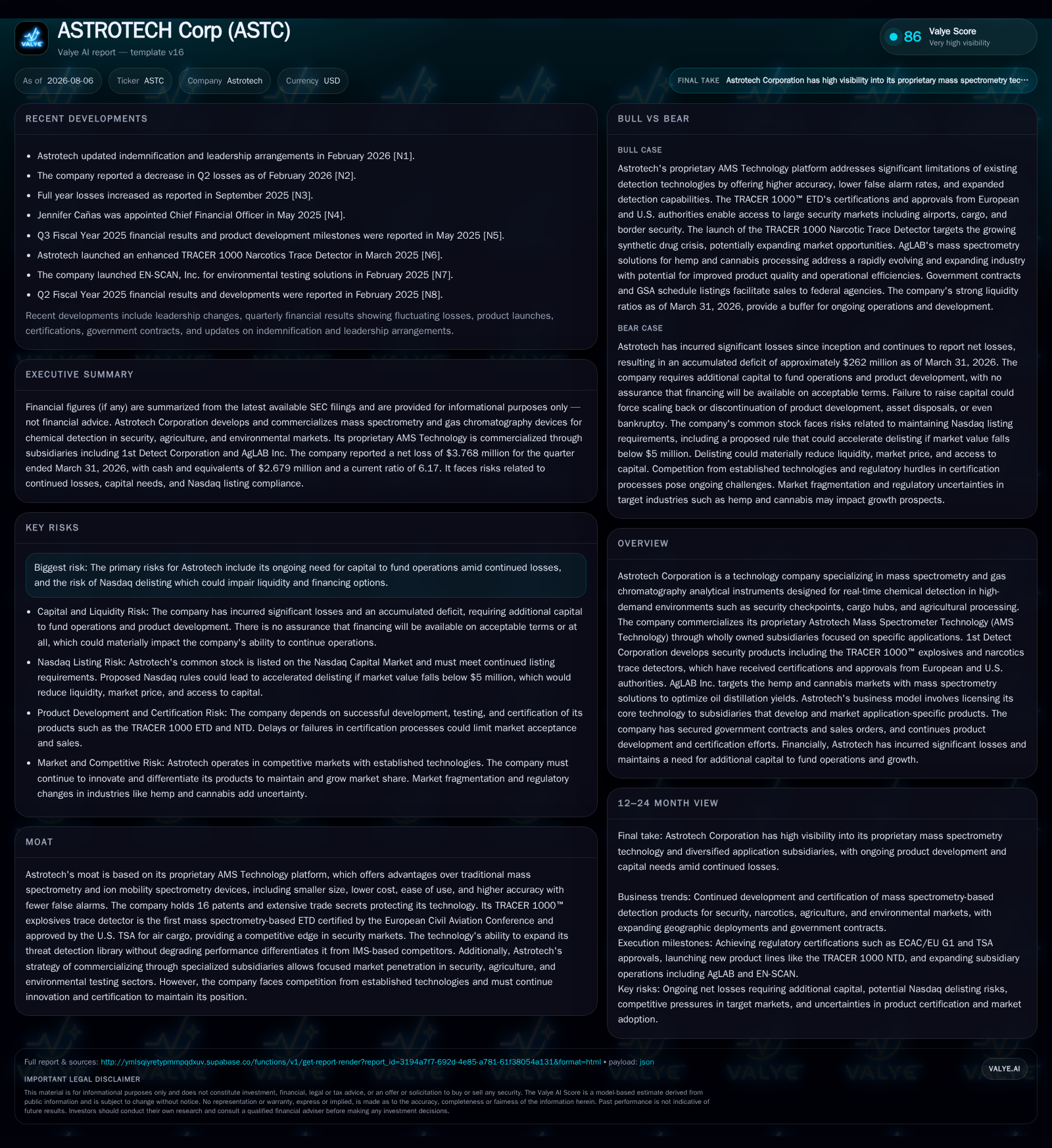
Astrotech Corporation continues to develop and commercialize its proprietary Astrotech Mass Spectrometer Technology (AMS Technology) via specialized subsidiaries targeting security and agricultural markets. Recent quarterly results reflect ongoing product deployment alongside stable consumables revenue, but also reveal sustained operating losses and liquidity pressures necessitating additional capital raises. The company’s differentiation lies in its ultra-portable, high-accuracy mass spectrometry platform with regulatory approvals supporting competitive positioning in explosives trace detection and cannabis/hemp analytics. Major risks revolve around the financial runway and Nasdaq compliance, while growth hinges on expanding certified product deployments, consumables adoption, and market penetration of specialized applications.
Recent Operating Update
Astrotech Corporation’s latest quarterly report for the period ending March 31, 2026 reinforces its dual strategy of advancing proprietary mass spectrometry technology while navigating considerable financial constraints. The company reported a modest total revenue decrease of approximately 5%, largely due to a fall in product sales and warranty services offset partially by growth in consumables revenue and grants tied to research activities [S4]. Gross margins declined materially from 48% to roughly 33%, attributed primarily to higher labor and warranty costs alongside accounting treatment shifts involving sale of obsolete consumable parts at standard cost rather than inventory write-offs—a factor that temporarily depresses reported margins [S4].
Alongside these operational dynamics, management has prudently moderated research and development expenditure by roughly $1.16 million over nine months as efforts pivot from pure R&D toward commercialization activities including enhanced sales initiatives [S8],[S10]. Despite cost discipline, the company’s operating loss remains substantial at $11.2 million year-to-date, consistent with its longer-term trajectory of recurring negative cash flow since inception [S4],[S6]. Liquidity remains constrained: cash on hand plus short-term investments totals about $6.6 million with positive working capital of $9.5 million as of Q3 end but against an accumulated deficit north of $262 million—highlighting continued reliance on capital markets or partnerships for survival beyond near-term horizons [S2],[F1]. Management has emphasized continuous monitoring of funding needs with anticipated material additional investment required prior to achieving positive operating cash flow [S2],[S6].
Another notable development is the announced engagement in a sale process for its wholly owned subsidiary 1st Detect Corporation—developer of the flagship TRACER 1000 explosive trace detector—opening questions about strategic portfolio optimization during financing challenges [S13]. This move may reflect a tactical shift to prioritize core technology licensing or reduce operational complexity amidst a difficult fundraising environment.
Business Model
Astrotech’s business model centers on its proprietary Astrotech Mass Spectrometer Technology (AMS Technology) platform, conceived as a smaller, more affordable alternative to traditional mass spectrometers with superior performance characteristics such as operation under ultra-high vacuum. This platform underpins multiple application-specific subsidiaries which license the IP exclusively from holding company Astrotech Technologies Inc. These entities develop tailored products targeting distinct verticals:
- 1st Detect Corporation: Security-focused explosives and narcotics trace detectors like TRACER 1000™, leveraging mass spectrometry's higher accuracy over incumbent ion mobility spectrometry (IMS) ETDs well-known for false positive issues.
- AgLAB Inc.: Agriculture sector players in hemp/cannabis testing utilizing the AgLAB 1000-D2™ system designed to optimize oil distillation yields through real-time chemical analysis.
- BreathTech: Breath analysis technologies aimed at detecting volatile organic compounds relevant for disease screening.
- Pro-Control: Industrial process control instruments integrating AMS Technology for enhancing manufacturing reaction yields.
- EN-SCAN: Environmental testing solutions featuring ruggedized field-ready GC-MS platforms for contamination monitoring [S2],[S26],[S28],.
Revenue streams derive primarily from product sales supplemented by consumables (recurrent purchase of reagents, parts), warranty service contracts, training programs, and occasional grant funding linked to R&D contracts [S4],. This mixture reflects typical analytical instrument industry models where installed base consumables serve as important margins stabilizers beyond one-time equipment sales.
Intellectual property protection is robust with sixteen granted patents plus extensive trade secrets underpinning AMS Technology exclusivity—a critical moat given competition from well-entrenched IMS-based solutions with narrower detection libraries limited primarily to key explosive compounds rather than hundreds supported under ASTC’s approach [S2]. Licensing coupled with focused subsidiary commercialization allows leveraging technology breadth across sectors without diluting management attention or innovation pipelines per segment.
Industry Structure and Competitive Position
The analytical instruments industry is highly R&D intensive with significant regulatory barriers dictating product adoption especially in security applications requiring certifications such as those from the TSA or European Civil Aviation Conference (ECAC). In this context, Astrotech has achieved a unique milestone: TRACER 1000 is reportedly the first mass spectrometry-based explosives trace detector certified by ECAC and approved by TSA for air cargo security—an endorsement conferring substantial credibility against IMS incumbents prone to frequent false alarms causing major operational disruption at checkpoints [S2],[S21].
Peers such as Thermo Fisher Scientific or Agilent Technologies offer broad chemical analysis platforms supporting mass spectrometry broadly but lack Astrotech’s hyper-focused application niche deployment model via dedicated subsidiaries. Smiths Detection represents competitors on the security screening front yet relies heavily on IMS technology still challenged by false positive rates absent comprehensive threat libraries that ASTC’s AMS Technology accommodates intrinsically.
Agriculture testing represents another emergent vertical where AgLAB competes within a fragmented but fast-growing hemp/cannabis market coping with variable consumer product quality and rigorous regulatory evolution post-2018 Farm Bill legalizations driving demand for quantitative analytical tools [S2],[S28],. Here AMLAB’s capability to deliver real-time distillation yield optimization via MVP processing offers substantive differentiation aiding yield improvement between 15%-30% in field trials thus addressing critical inefficiencies undermining processor economics.
Overall ASTC’s integrated IP-flexible licensing combined with targeted industry-certified devices builds defensible market positions albeit dependent on successful scaling of unit volumes translating into sustainable consumables demand—a key marginal profit lever,
Growth Drivers
Growth stems primarily from expanding use cases for real-time chemical detection across increasingly security-conscious government infrastructure installations worldwide—including airports, cargo hubs, border crossings—and emerging cannabis/hemp industry needs demanding precise on-site analysis technologies.
The key enablers include:
- Expansion of detection libraries facilitated by AMS Technology’s robustness allowing more threats without performance degradation unlike IMS rivals.
- Regulatory certifications like ECAC/EU G1 approval opening European markets critical for aviation security customers.
- Increasing operational adoption reflected in prospective sales scaling and consumables penetration forming locked-in recurring revenue.
- Advancements in instrument portability and automation simplifying user interaction catalyzing fleet deployment across diverse environments including remote locations requiring ruggedized devices.
- Cross-industry proliferation via AgLAB’s optimized solutions addressing large-scale agricultural process inefficiencies thereby broadening addressable markets.
Confirmation metrics will include increasing number of instruments sold through subsidiaries, consumables revenue growth reflective of established installed bases, certification milestones secondary to new deployment opportunities, and acceleration in customer adoption particularly among governmental security agencies able to replace legacy IMS units [S21],.
Risks and Watchpoints
ASTC faces multifaceted risks typical of capital-intensive high-tech analytical instrument firms:
- Capital Dependency: Persistent operating losses necessitate periodic equity or debt raises risking shareholder dilution or restrictive covenants respectively; current reserves (~$6.6M including short-term investments) cover about a year’s runway but substantial additional financing will be required absent rapid scaling or partnership breakthroughs [S2],[F1],[S6].
- Nasdaq Listing Risks: Ongoing financial strain could threaten compliance with Nasdaq continued listing criteria undermining stock liquidity and investor access further raising financing costs or barriers [S22].
- Market Fragmentation: Especially acute in cannabis/hemp testing markets where fierce R&D-led competition along with non-uniform product standards challenge differentiated positioning despite technology merits.
- Regulatory Uncertainties: Delays or failures in securing crucial certifications can stall commercial rollouts constraining revenue growth trajectories.
- Technology Threats: Emergence of competing detection advances could erode AMS Technology’s uniqueness especially if rivals mature ion mobility approaches or new analytical techniques improve their precision without commensurate cost penalties.
- Operational Execution: Successful scaling requires alignment across multiple subsidiaries managing specialized development cycles—not trivial given constrained resources.
Continuous monitoring of capital raising progress alongside milestone achievement related to certification expansions and consumables uptake will be vital indicators regarding ability to mitigate these risks.[S16],
What To Watch Next
Key upcoming indicators for evaluating ASTC include:
- Progress on potential sale or strategic restructuring concerning 1st Detect subsidiary impacting cash flow profile or strategic focus [S13].
- Updates on certification approvals especially related to expansion within EU or other international regulatory bodies enhancing addressable markets.
- Quarterly trends evidencing improvement or stabilization in gross margins potentially driven by scale benefits or cost optimizations.
- Consumables revenue trajectories supporting evidence of growing installed base adoption underpinning sustainable long-term profitability.
- Financing announcements including equity/debt raise plans indicating runway extensions necessary for business execution continuity.[S13],[S21],[S26]
Financial Profile Discussion
As of March 31, 2026, Astrotech Corp held approximately $2.7 million in cash alongside $3.9 million in short-term investments totaling $6.6 million in liquid assets with current assets of $11.3 million and current liabilities of $1.8 million, implying a current ratio near 6.17x—reflecting solid short-term liquidity [F1],[S2]. Despite this, the company reported a net loss of $11.2 million year-to-date and an accumulated deficit of approximately $262 million, underscoring persistent unprofitability rooted in aggressive R&D investments transitioning towards commercialization focus [S2],[S4].
Management emphasizes close liquidity oversight combined with reliance on external capital sourced mainly through equity issuances given challenging credit market conditions affecting mid-cap technology firms currently [S2]
Ultimately, ASTC appears strategically committed to bridging its considerable innovation pipeline towards scalable revenues while navigating known constraints typical for emerging technology developers within highly regulated analytical markets.[S2],[S6]
Disclaimer: This analysis is based exclusively on publicly available SEC filings up to May-July 2026 and related evidence cited herein. It is intended solely for informational purposes without any investment research view or advice.
Disclaimer: This is research-only, informational analysis and not investment advice. It may include AI-generated interpretation and general industry context. Always verify important details using primary sources.

Comments