
KKR Expands Fee-Paying AUM and Insurance Segment While Managing Leverage Covenants
KKR's latest quarter shows growth in asset management fees and insurance investment income amid stable leverage and covenant compliance.
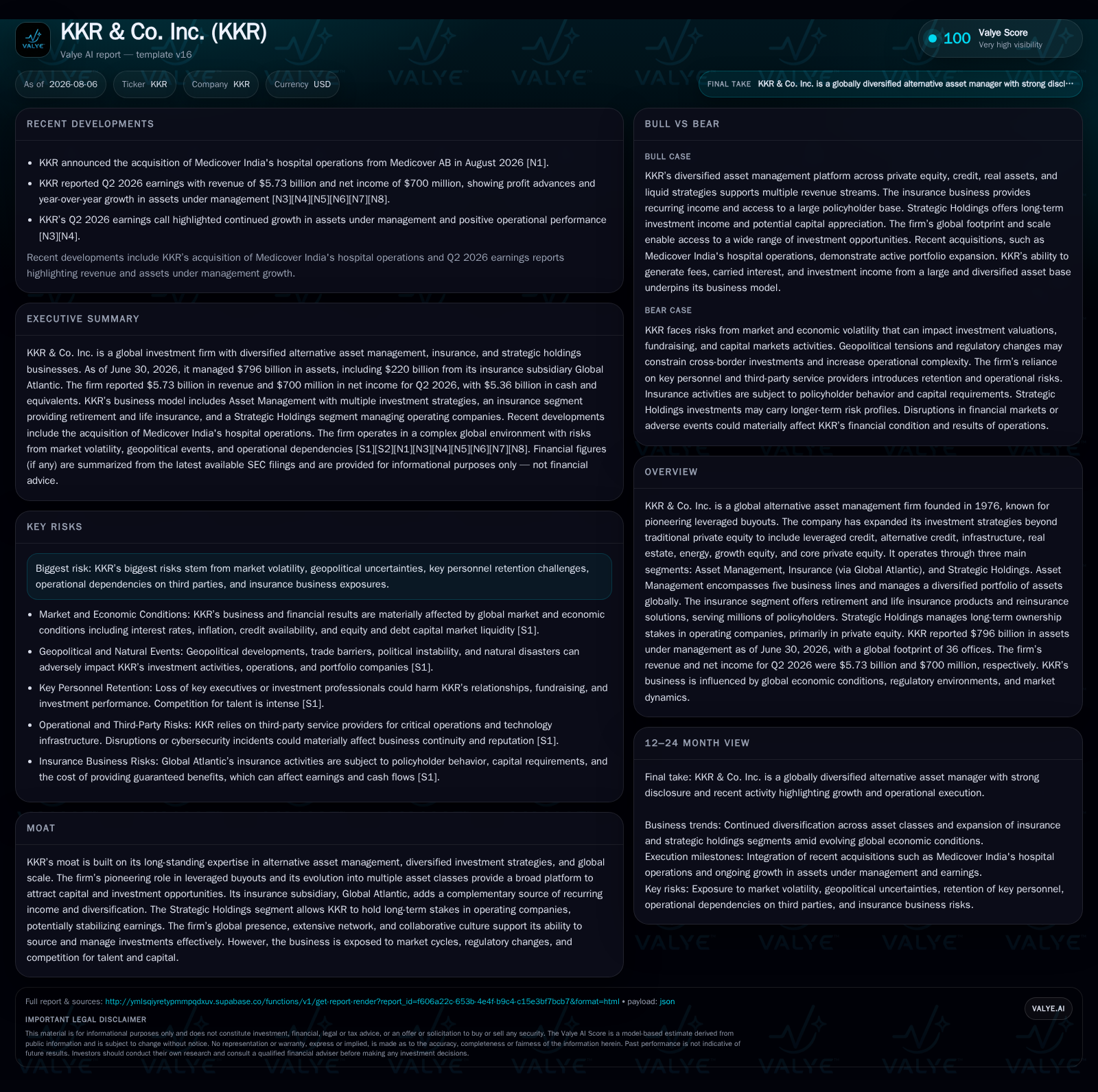
KKR & Co. Inc.'s Q2 2026 results reveal a continuing shift towards diversified alternative asset strategies complemented by its growing insurance business, Global Atlantic. Assets under management approached $796 billion with a significant mix from insurance-related capital. Management fees increased on higher fee-paying AUM, while the insurance segment benefited from favorable net investment income despite declining premiums. The firm maintains prudent leverage controls under recent credit agreements. Risks include sensitivity to market rates impacting investment valuations and policyholder behavior influencing insurance liabilities.
Recent Operating Update
KKR & Co. Inc. delivered its latest quarterly filing for Q2 2026 on August 6 [S2], confirming growth momentum across its diversified alternative asset management platform alongside steady performance in its insurance business. Total assets under management (AUM) expanded to $796 billion as of June 30, 2026, with approximately $220 billion attributable to the firm's insurance subsidiary Global Atlantic. This represents continued scale and diversification from the firm's legacy private equity roots toward multi-asset strategies including credit, real assets, infrastructure, and growth equity.
Operating revenues rose materially quarter-over-quarter driven by increases in both management fees and capital allocation-related income within Asset Management and Strategic Holdings segments. Management highlighted that fee-paying assets reached record levels supporting recurring fee streams characteristic of top-tier global asset managers [S2]. The insurance segment offset a decline in net premiums collected against rising net investment income owing to higher portfolio yields and AUM growth—a function of both new business inflows and robust market appreciation. Such investment yield improvements partially mitigated headwinds from lower premium volumes that potentially reflect competitive or demographic trends impacting policyholder behavior.
In terms of leverage and liquidity management, KKR announced entry into a Fourth Amended and Restated Credit Agreement effective July 30, 2026 [S3], establishing a $3 billion unsecured revolving credit facility with an option to increase availability by up to $750 million. Maintaining this disciplined leverage threshold reflects prudent risk management aligning with peer global alternative asset managers that blend balance sheet strength with operational agility.
Business Model Nuances
KKR operates through three interconnected segments: Asset Management, Insurance (Global Atlantic), and Strategic Holdings. Asset Management covers five principal lines including Private Equity (less than 25% of AUM presently), Real Assets, Credit & Liquid Strategies, Capital Markets, and Principal Activities [S1]. This multi-asset approach allows KKR to capture broad institutional investor interest amid a structural shift toward alternatives seeking yield enhancement beyond public markets.
Revenue is generated primarily via management fees calculated as a percentage of fee-paying AUM plus performance-based carried interest (performance fees) contingent on investment outperformance post hurdle rates. Capital allocation income arises when KKR deploys its own balance sheet alongside client capital in co-investments or principal activities generating additional returns but exposing the firm to market cycles directly.
The Insurance segment contributed sizeable recurring revenues derived from policyholder premiums (life, retirement annuities) and investment income earned on the float—the pool of funds held between receipt of premiums and payout of claims or benefits. Global Atlantic employs static and dynamic hedging strategies to mitigate interest rate, equity price volatility, and foreign exchange exposures associated with its insurance product guarantees [S1]. Investment gains supplement underwriting profit; however, premium volume fluctuations influence overall segment profitability.
Strategic Holdings reflects long-term ownership stakes primarily in private equity portfolio companies where KKR holds control or significant influence allowing value creation over extended horizons while smoothing earnings volatility typical in fee-based segments.
Industry Structure and Competitive Position
KKR sits among a select group of global alternative asset managers such as Blackstone, Apollo Global Management, and Carlyle Group distinguished by scale exceeding hundreds of billions in AUM across diverse asset classes. The firm's addition of an insurance platform via Global Atlantic differentiates it from pure-play private equity peers by introducing stable premium flows and investable float enhancing earnings diversification.
Competition is governed not only by size but by ability to source proprietary deals globally, deploy capital efficiently across cycles, retain top talent amid intense headhunting pressure, and manage regulatory complexities across jurisdictions for both investment vehicles and insurance operations. KKR maintains a global footprint with 36 offices facilitating extensive deal flow access that supports continued fundraising success critical for replenishing funds fueling carried interest realization.
Growth Drivers
Structural growth catalysts for KKR remain strong given ongoing institutional appetite for alternatives driven by low yield environments globally coupled with rising wealth segmentation requiring retirement solutions bolstering demand for annuity products embedded within Global Atlantic’s offerings. Expansion into credit strategies including leveraged credit CLOs capitalize on underserved debt capital markets niches where yield compression persists less than equities.
Technological advancements permitting improved portfolio monitoring enhance operational efficiencies underpinning scalable fee growth potential without proportionate expense increases. Capital markets activity within KKR’s platform offers synergies through underwriting revenues connected to debt placements – complementing asset management economics.
Acquisitions strategically augment capabilities as evidenced by recent integration activity expanding healthcare services exposure adding non-market-correlated revenue streams supporting longer-duration earnings stability [N11], [N14].
Risks and Watchpoints
Significant risk factors revolve around macroeconomic volatility that impacts portfolio valuations especially for illiquid private equity holdings vulnerable to pricing shocks influenced by interest rate rises or credit market disruptions [. Rates affect discounted cash flow analyses utilized to value Level III investments potentially leading to mark-to-market losses more volatile than public securities] [S1]. Policyholder behavior risks such as lapses or premium deferrals could adversely impact Global Atlantic’s liability profile undermining prior actuarial assumptions.
Regulatory scrutiny heightens particularly over insurance solvency standards potentially converging internationally demanding elevated capital buffers which may constrain growth or require costly capital injections [S19]. Furthermore operational risks emerge from reliance on third-party service providers alongside integration complexity inherent in acquisitions.
Capital structure integrity depends on maintaining covenant compliance amidst fluctuating EBITDA tied partly to realized carried interest timing; breaches could restrict strategic flexibility or precipitate costly refinancing events [S3], [S21]. Continuous competition for best-in-class talent raises expense risk while challenging retention critical for sustained fund performance.
What To Watch Next
Key milestones include monitoring quarterly fee-paying AUM trends as a proxy for fundraising success whose sustainability drives management fee revenue visibility. Progress in converting committed capital into invested assets signals deployment efficiency affecting performance fee accrual trajectories.
Insurance segment metrics such as new business sales volumes in annuities/preneed life products alongside combined ratio stability provide insight into underwriting discipline effectiveness justifying franchise value on recurring revenue streams. Updates on hedging program efficacy amid volatile interest rates warrant attention given their impact on reported earnings quality.
Upcoming refinancing or credit agreement amendments will reveal financial policy priorities amid uncertain macro conditions.
Portfolio exits demonstrating attractive multiples realize carry distributions underpinning investor returns potentially buoying share price sentiment aligned with intrinsic valuation adjustments from strategic holdings realizations.
Financial Profile Discussion
KKR’s financial position at mid-2026 remains robust supported by diversified cash flow sources from fee revenues, investment income including strategic stakes dividends, and insurance underwriting results [S2], [S23]. Liquidity is underpinned by access to a multi-year $3 billion senior unsecured revolving credit facility maturing in 2031 [S3].
Operating cash flows are complemented by investing activities reflecting selective acquisitions balanced against divestitures generating positive cash inflows ($3 billion net investing inflow over six months ended June 30) indicating disciplined capital deployment aligned with strategic objectives rather than volume chasing [S2]
Capital allocation remains prudent with ongoing share repurchases executed within board-authorized limits ($87 million remaining under current buyback plan as of July 24) while sustaining dividend distributions consistent with historical policies supporting shareholder returns without compromising growth funding capacity [S9]
Interest expense levels are manageable reflective of largely fixed-rate corporate debt mitigating immediate refinancing risks while hedging arrangements offset variable rate exposure associated with consolidated CLO obligations further insulating net income variability from rate swings [S1], [S2].
In summary, KKR maintains a strong financial foundation that supports its multifaceted business model focusing on resilience through diversification across asset classes paired with disciplined balance sheet stewardship suitable for navigating potential economic headwinds.
Disclaimer: This is research-only, informational analysis and not investment advice. It may include AI-generated interpretation and general industry context. Always verify important details using primary sources.

Comments