
Main Street Capital Navigates Modest Income Growth Amid Rising Expenses and Stable Credit Quality
Q2 2026 results reflect steady net investment income growth tempered by increased operating costs, with asset quality remaining stable in Main Street Capital’s lower middle market-focused portfolio.
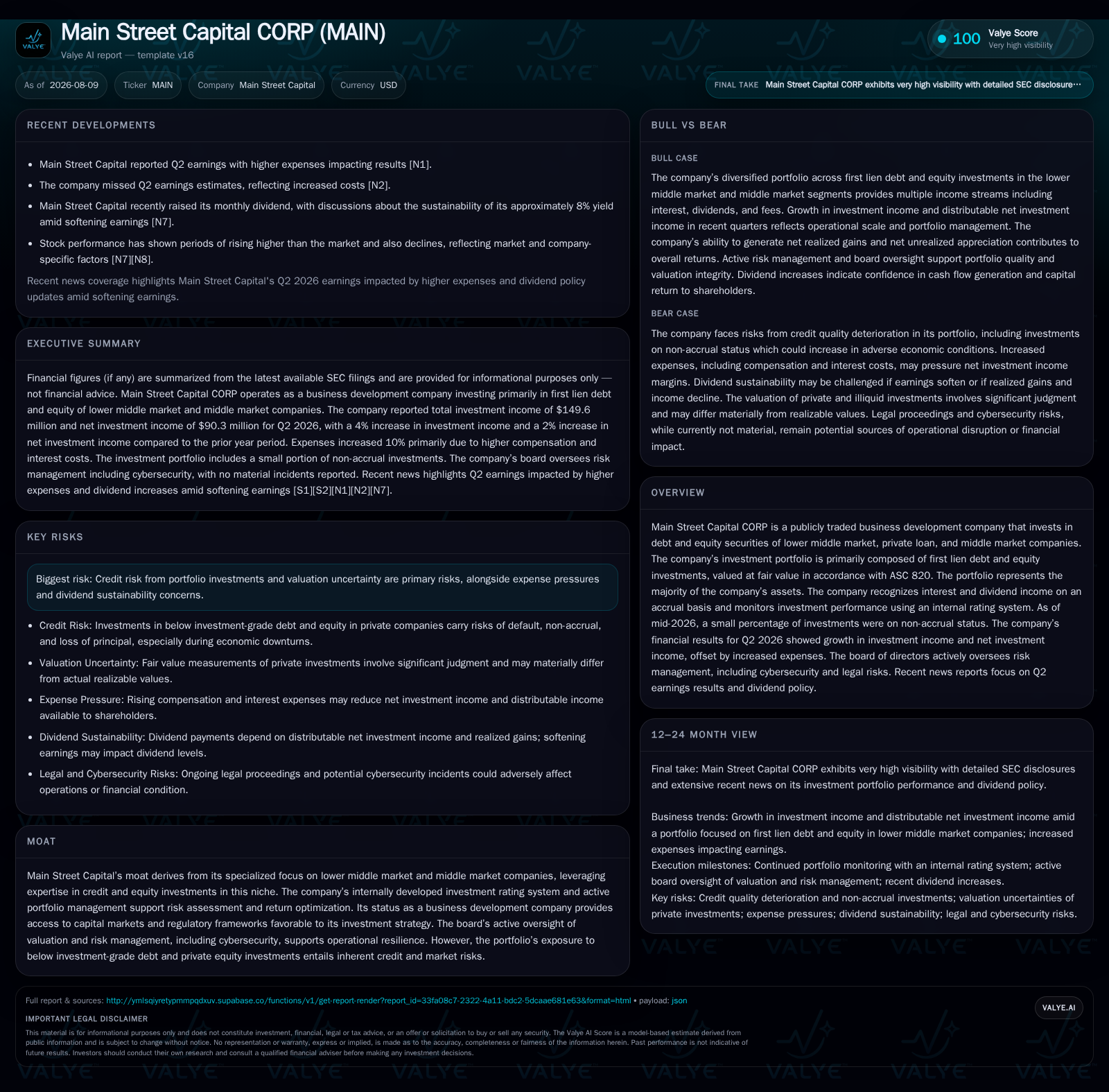
Main Street Capital Corporation (MAIN) reported a 2% year-over-year increase in net investment income to $90.3 million for Q2 2026, supported by rising total investment income despite a 10% increase in expenses. The portfolio’s non-accrual investments remained low at 1.1% of fair value, signaling stable credit conditions amid broader economic uncertainty. MAIN’s proprietary investment rating system continues to guide active portfolio risk management. While leverage supports returns, elevated expenses highlight margin pressures common in BDCs exposed to below-investment-grade credits. Key watchpoints include expense control, credit cycle sensitivity, and valuation volatility under ASC 820 fair value standards.
Recent Operating Update
Credit quality remained largely stable as investments classified on non-accrual status rose marginally to $65.2 million at fair value—about 1.1% of the total portfolio—compared to $56.3 million at year-end 2025 [S2]. On a cost basis, these non-accruals represented approximately 4% of invested capital, consistent with previous periods. MAIN’s internally developed investment rating system plays an integral role in ongoing risk monitoring by evaluating expected returns, debt collectability prospects, equity upside potential, competitive positioning, and economic outlook for each portfolio company [S2]. This approach supports proactive management aligned with the cyclical vulnerabilities inherent in small- and mid-sized enterprises.
Business Model Overview
Main Street Capital operates as a publicly traded business development company specializing in providing capital—primarily first lien debt alongside selective equity investments—to privately held lower middle market and middle market companies that often face limited access to traditional bank financing [S1]. Its revenue model centers on earning interest income from debt instruments combined with dividends or capital appreciation from equity stakes.
Revenue recognition follows accrual accounting based on contractual interest payments and dividend declarations within its portfolio companies [S1]. Given the illiquid nature of these private investments, valuations adhere strictly to ASC Topic 820 guidance on fair value measurement which assumes hypothetical transactions in principal markets involving knowledgeable independent participants [S1]. Consequently, unrealized gains or losses can cause meaningful earnings volatility but do not directly impact distributable cash flow unless realized.
Portfolio management emphasizes diversification across industries and credit profiles while leveraging debt prudently within regulatory limits to enhance shareholder returns [S1,F1]. Operating margins thus depend not only on portfolio company performance but also effective expense management.
Industry Context and Competitive Positioning
Within the U.S. BDC sector—a specialized financial niche providing private credit primarily to underserved middle market businesses—Main Street distinguishes itself through its dual focus on senior secured loans complemented by equity investments coupled with a proprietary credit rating system that refines risk assessment beyond standard industry metrics. This strategic blend allows participation in both yield generation and capital appreciation but entails exposure to sub-investment-grade credits sensitive to economic cycles.
The broader industry landscape includes peers such as Ares Capital Corporation and Golub Capital BDC; however, Main Street’s emphasis on rigorous internal risk grading enhances its ability to navigate credit cycles prudently while optimizing risk-adjusted returns. Maintaining robust risk controls remains critical given the cyclical pressures small- and mid-sized companies face amid evolving macroeconomic conditions [S2].
Growth Drivers
Growth prospects are anchored by persistent disintermediation trends where smaller companies increasingly seek alternatives outside traditional banks constrained by regulatory reforms and risk aversion post-financial crisis.
Main Street benefits from scalable access to capital via public equity markets relative to private credit funds reliant solely on institutional commitments. Its hybrid debt-equity approach offers upside potential beyond pure yield plays common among peers.
Additionally, rising interest rate environments typically enhance yields on floating-rate debt instruments within its portfolio—supporting incremental net investment income growth despite offsetting borrowing costs. Ongoing enhancements in underwriting rigor through its proprietary rating framework may further improve credit selection and loss mitigation over time.
Risks and Watchpoints
Key risks encompass potential deterioration in credit quality driven by increased defaults or bankruptcies among underlying borrowers—particularly vulnerable during economic downturns impacting small-to-mid-sized enterprises [S2]. Although current non-accrual levels remain low near 1%, any material rise would heighten earnings volatility.
Valuation challenges arise from applying ASC 820 fair value principles to illiquid investments lacking observable market inputs; this can introduce swings in unrealized gains or losses that affect reported equity though not immediate cash flows [S1]
Expense inflation evident in Q2 results poses margin pressure risks; sustained cost increases without proportional income growth could impair distributable net investment income critical for dividend coverage [N1,S2]
Leverage amplifies both returns and risks; maintaining balanced debt-to-equity ratios alongside prudent refinancing strategies is essential given over $2.5 billion in outstanding debt against relatively modest cash reserves near $58 million at quarter-end [F1]
Cybersecurity oversight remains robust under Board Audit Committee guidance with no recent material incidents reported; ongoing vigilance is necessary amid increasing digital threats facing financial intermediaries [S1]
Dividend sustainability depends fundamentally on stable portfolio performance amid economic cyclicality influencing borrower repayment capacity [N7]
What To Watch Next
Investors should monitor upcoming quarters for changes in non-accrual levels serving as early indicators of portfolio stress impacting income streams. Trends in realized versus unrealized gains will provide insight into valuation shifts affecting shareholder equity.
Expense trajectory reversal or stabilization would signal improved operational efficiency after recent headwinds. Shifts in new originations mix between first lien loans versus mezzanine or equity stakes will clarify evolving risk appetite.
Dividend declarations remain key signals of distributable net investment income health; deviations merit close scrutiny regarding cash flow adequacy.
Financial Profile Discussion
As of June 30, 2026, Main Street Capital held approximately $58.3 million in cash and equivalents alongside total debt nearing $2.54 billion resulting in net debt around $2.48 billion—a leverage profile typical for BDCs seeking enhanced yield through borrowed capital under regulatory constraints [F1]
Ongoing discipline around portfolio valuation per ASC 820 remains critical given its significant influence on reported asset values and shareholder equity metrics alongside capital allocation decisions informed by realized gain/loss patterns [S1]. Liquidity appears adequate for near-term obligations though consistent cash flow generation will be essential amid any economic volatility affecting borrower payment capacity.
Disclaimer: This report is for informational purposes only and does not constitute investment advice or research views.
Disclaimer: This is research-only, informational analysis and not investment advice. It may include AI-generated interpretation and general industry context. Always verify important details using primary sources.

Comments