
MainStreet Bancshares Advances Real Estate Lending Amid Stable Credit and Capital Fundamentals
MainStreet Bancshares reports steady credit quality and a new dividend announcement supporting its regional banking franchise focused on real estate lending to small and midsize businesses.
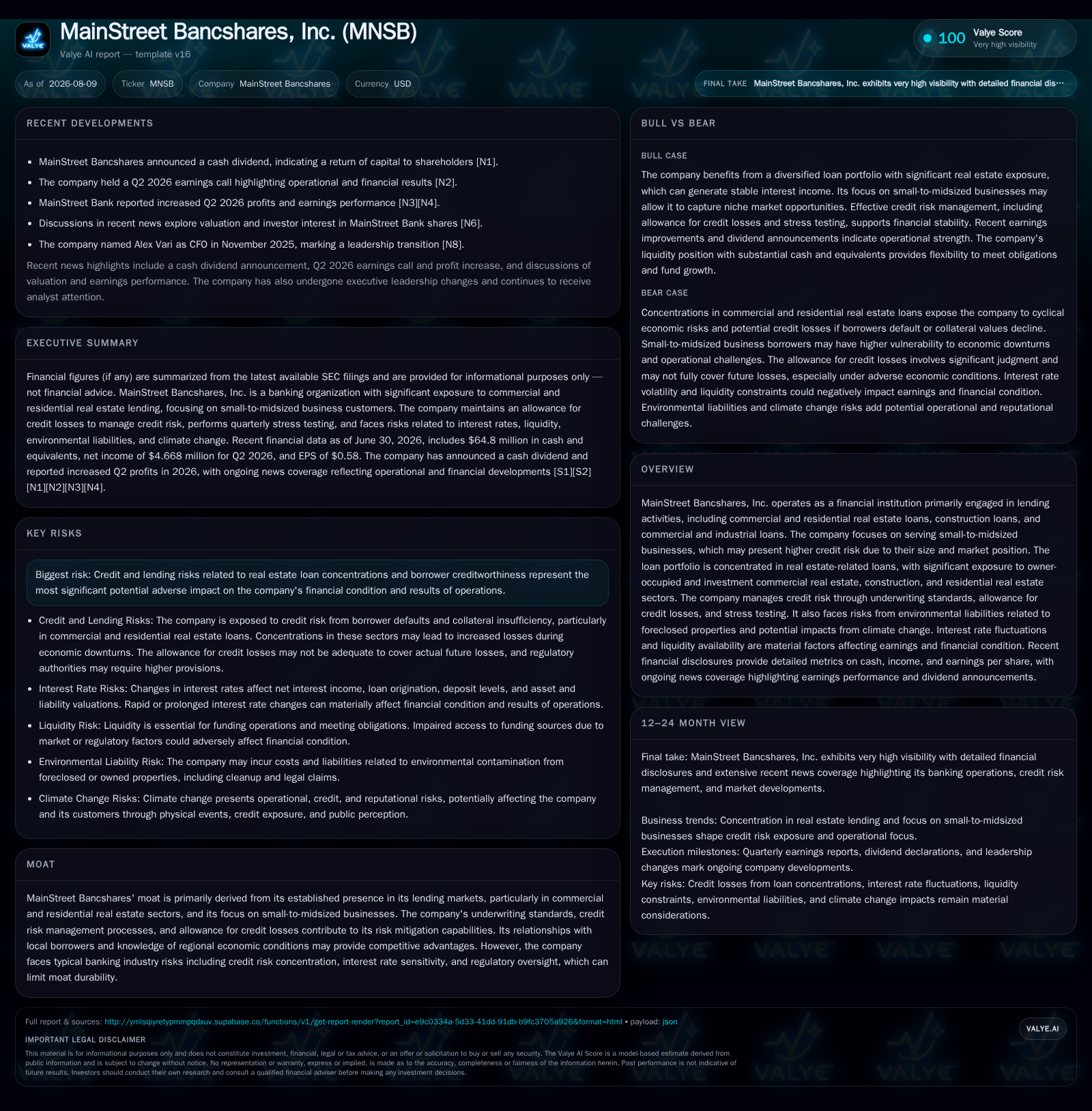
In its latest quarterly filing, MainStreet Bancshares, Inc. maintained disciplined credit risk management across a loan portfolio heavily concentrated in commercial and residential real estate loans while declaring a modest cash dividend. The bank's underwriting standards and allowance policies remain key to navigating the cyclical nature of real estate markets, particularly given exposure to construction loans and investment properties. With regulatory capital ratios consistent with Federal Reserve expectations and no material change in its liquidity profile, the company remains positioned to serve its regional borrower base in the Washington, D.C. metro area. Market sensitivity to interest rate shifts and concentration risk demand ongoing monitoring as real estate cycles evolve.
Latest Operating Update: Steady Asset Quality and Dividend Initiation
MainStreet Bancshares’ most recent quarterly report filed on August 7, 2026, reveals that its investment securities portfolio held-to-maturity experienced no allowance for credit losses during the period, signaling strong asset quality in this segment despite market uncertainties [S2]. The company also redeemed restricted investments in bank stock during Q2, indicative of portfolio rebalancing or regulatory compliance moves.
Concurrently, on July 21, 2026, the Board approved a $0.10 per share cash dividend payable in early August to shareholders of record as of August 4, underscoring management’s confidence in capital reserves and earnings sustainability within their regional banking operations [S3]. This dividend decision represents an important signal for investors regarding balance sheet strength given the volatile backdrop faced by lenders with concentrated real estate exposures.
Business Model: Focused Regional Lending Centered on Real Estate
MainStreet Bancshares chiefly operates through MainStreet Bank headquartered in Fairfax, Virginia with branch presence serving the Washington D.C. metro area—a region characterized by dynamic commercial activity intertwined with substantial small-to-medium business demand [S4]. The company monetizes primarily via net interest income from lending activities including commercial real estate (owner-occupied and investment types), residential mortgage loans, construction and land development financing, as well as commercial-and-industrial (C&I) loans to local businesses.
Revenue generation depends critically on optimizing net interest margin (NIM) by lending at rates above their cost of funds while managing funding from deposits and wholesale sources competently—the latter necessary due to persistent competition for stable core deposits [S1], [S4]. Fee income from account-related services provides secondary diversification though lending dominates profitability.
Strategically, the company’s underwriting emphasizes local market knowledge combined with prudent risk grading that governs allowance for loan losses provision—especially important given the loan book’s heavy real estate concentration which historically is sensitive to economic cycles impacting collateral values. This approach aligns with sector norms where regulatory stress testing simulates adverse scenarios ensuring capital buffers can absorb cyclical shocks rooted in real estate downturns or borrower distress [S1].
Industry Context: Intermediate Regional Bank with Real Estate Concentration
MainStreet Bancshares fits within the regional banking archetype: intermediary financial institutions focused on geographically localized lending/deposit gathering. Their peer context includes other community-oriented banks servicing small/midsize enterprises rather than large national banks. The concentration in commercial real estate (CRE) loans—both owner-occupied (24%) and non-owner occupied/investment (30%)—reflects typical regional bank specialization but engenders concentration risk relative to more diversified peers such as Zions Bancorporation or Umpqua Holdings [S1].
Construction loans (16% approx.) add another cyclical dimension owing to their sensitivity to economic swings affecting building activity. Residential loans (~24%) further tether portfolio risk profiles directly to housing market conditions.
Banks competing here must balance yield enhancement via CRE exposure against increasing regulatory scrutiny over concentrations perceived as systemic vulnerabilities after past financial crises.
Growth Drivers: Loan Portfolio Expansion & Community Development Focus
Growth for MainStreet Bancshares is tenant partly on expanding its loan portfolio by deepening penetration among small/midsize businesses seeking CRE financing solutions—with opportunities tied especially to owner-occupant borrowers who present different credit profiles than investors or speculative developers. Growth also hinges on broadening residential mortgage volumes leveraging favorable market segments within Washington area demographics.
Notably, establishing MainStreet Community Capital LLC as a community development entity certified by the Treasury’s CDFI Fund introduces avenues for accessing New Market Tax Credit allocations aimed at low-income communities—a strategic pivot enabling subsidy-enhanced lending investments while fulfilling social impact objectives which also garner regulatory goodwill [S4], [S10]. This initiative can diversify revenue streams while improving local footprint relevance.
Risks and Watchpoints: Concentration & Interest Rate Sensitivities Remain Key
Credit risk due to portfolio concentration in CRE loans—both owner-occupied and investment—is arguably MainStreet Bancshares’ largest structural vulnerability given cyclicality in collateral valuations exposed during downturns or localized economic stress events such as employment shocks within metropolitan regions they serve [S1]. Construction segment volatility further exacerbates this risk requiring vigilant underwriting discipline.
Environmental liabilities associated with foreclosed properties create contingent cost exposures absent in other loan classes—increased insurance costs or remediation requirements could weigh on operating expenses unexpectedly in adverse cycles.
Interest rate risk impacts arise both from net interest margin compression—if deposit costs rise faster than re-pricing ability of fixed-rate loans—and from behavioral changes reducing loan demand or escalating repayment stresses among borrowers facing higher financing costs.
Regulatory landscapes continuously evolve influencing reporting burdens, permissible activities especially around community development lending incentives, and capital requirements—all factors shaping future growth capacity or margin pressure. Monitoring macroeconomic indicators like local D.C. employment trends or national housing supply-demand balances offers predictive insights into upcoming credit performance shifts within their loan portfolios.
What To Watch Next: Credit Quality Metrics & Capital Deployment Decisions
Upcoming quarterly disclosures will be critical for tracking non-performing loan ratio trends particularly within construction and investment CRE segments providing signals whether recent underwriting approaches continue containing credit risk adequately. Similarly, updates on allowance for loan losses as percentage of total loans will indicate prudence level amidst changing economic outlooks.
Further Board declarations regarding dividends or share repurchases will elucidate management’s evolving capital return stance reflecting earnings sustainability insights.
How effectively MainStreet implements community development lending programs leveraging NMTC allocations through its CDE will bear watching for revenue diversification impacts plus reputational effects enhancing competitive differentiation locally.
Financial Profile Discussion
As of August 7, 2026, the company’s latest quarterly filing indicates no allowance for credit losses on held-to-maturity investment securities and reports redemption of restricted investments in bank stock, reflecting active portfolio management [S2]. Cash and equivalents were last reported at approximately $64.8 million as of mid-2019, with updated figures expected in forthcoming quarterly disclosures [F1]. Interest expense trends noted in the recent quarter complement narratives of disciplined asset-liability management focusing on sustaining net interest margins amid evolving funding costs [S2].
Overall, financial disclosures corroborate the business strategy emphasizing steady loan growth tempered by rigorous credit risk monitoring plus pragmatic capital return choices highlighted by new dividend payment initiation pointing toward board confidence without compromising balance sheet robustness.
Disclaimer: This is research-only, informational analysis and not investment advice. It may include AI-generated interpretation and general industry context. Always verify important details using primary sources.

Comments