
First Bancorp’s ALM Strategy Underpins Earnings Stability Amid Interest Rate Shifts
The regional bank executes disciplined asset/liability management and credit risk controls within its Maine-focused footprint, balancing growth and prudent risk.
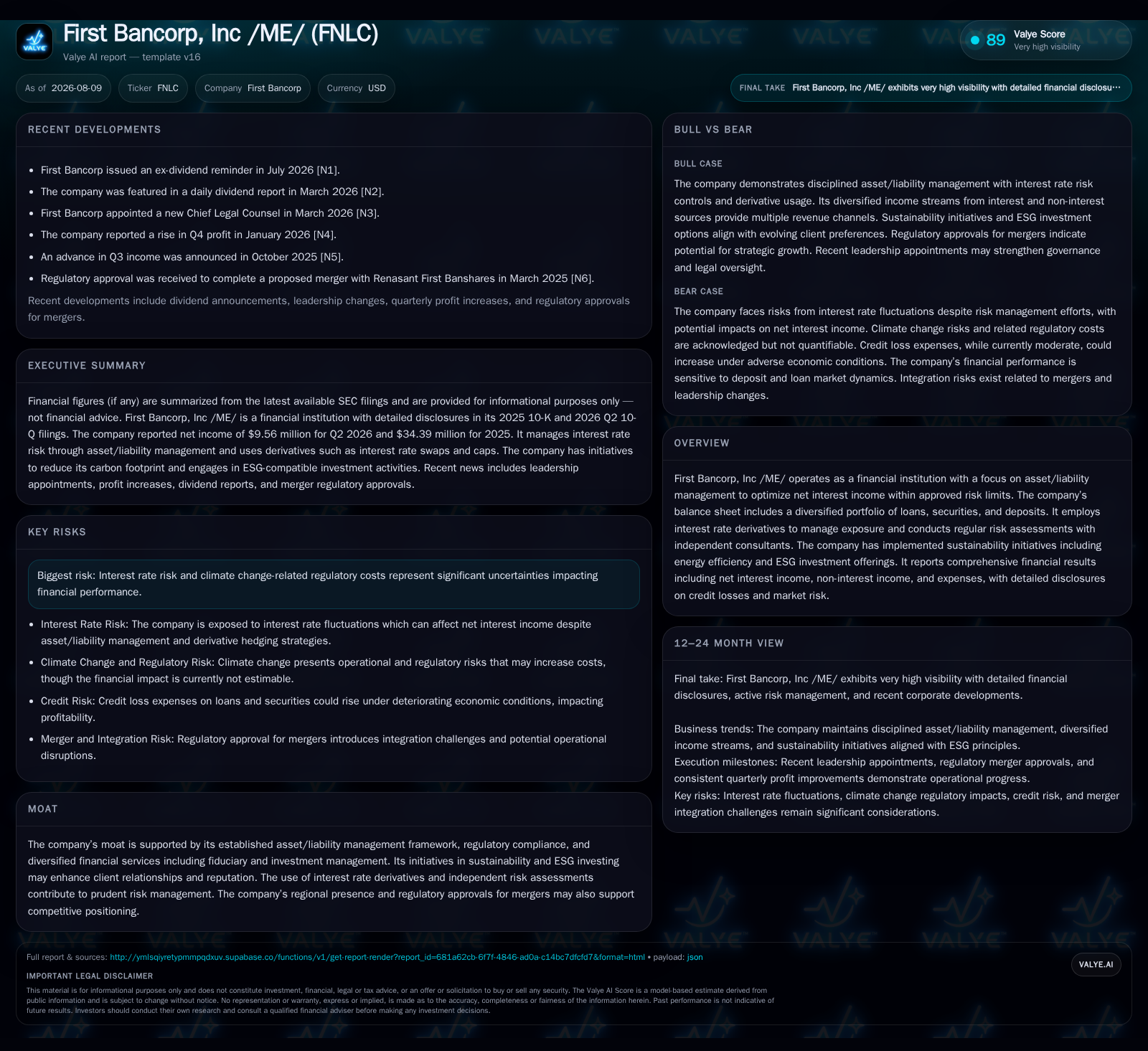
First Bancorp, Inc /ME/ reported steady operating performance in Q2 2026, driven by disciplined asset/liability management that strives to optimize net interest income amid a fluctuating interest rate environment. The company maintains a diverse loan portfolio concentrated on small businesses and individuals in eastern Maine, complemented by non-interest income from wealth management and mortgage services. Prudent credit loss provisioning and regulatory compliance support its risk profile, while emerging ESG initiatives may contribute to client retention. Key risks include interest rate volatility and climate-related regulatory costs, with growth supported by regional economic factors and product diversification.
Recent Operating Update: Stability Through Effective ALM
First Bancorp’s latest Q2 2026 filing confirms continued focus on optimizing net interest income through rigorous asset/liability management (ALM) practices. The bank’s Asset/Liability Committee (ALCO) employs static gap analysis combined with earnings simulation modeling to monitor interest rate risk exposure carefully. As of December 31, 2025, the one-year repricing gap stood at approximately -13.24% of total assets—comfortably within the Board-approved policy band of ±20%—indicating a modestly asset-sensitive position that aligns with management’s moderate exposure stance [S2,S1]. This balanced approach aims to preserve interest margins during volatile benchmark rates.
Interest rate derivatives are utilized for hedging purposes to mitigate earnings volatility linked to fluctuating rates. Modeling incorporates estimates of mortgage prepayment speeds based on coupon ranges and loan ages, reflecting realistic cash flow projections aligned with industry standards [S1]. Importantly, this disciplined ALM framework supports both earnings stability and capital preservation, key markers for sustaining long-term shareholder value.
Business Model: Regional Banking Centered on Net Interest Income with Fee Diversification
Operating through a national bank charter headquartered in Maine, First Bancorp serves primarily local individuals and small business customers across eighteen offices along Maine’s coastal corridor. Its predominant revenue source is net interest income—the spread between yields on loans/investments versus costs of deposits and borrowings—which naturally fluctuates with changes in earning asset volumes and prevailing interest rates [S1]. The diversified loan book encompasses commercial real estate (CRE), residential real estate (owner-occupied and non-owner-occupied), construction loans (both commercial and residential), home equity lines of credit, consumer loans secured or unsecured, agriculture loans, municipal loans, and term loans. The mix reflects localized lending priorities tailored to Maine’s economy [S22,S20].
Non-interest income complements core lending with fees from deposit accounts, debit card interchange revenue, mortgage loan sales and servicing gains, as well as investment management fees generated through First National Wealth Management. This fiduciary service division targets higher-net-worth clients seeking private banking alongside ESG-aligned investment options—a strategic foothold given rising sustainability awareness among retail investors [S1,S2]. Such fee diversification aids revenue resilience against episodic net interest margin compression.
The bank monetizes deposit gathering primarily via demand deposits, savings accounts, certificates of deposit (CDs), and money market instruments—the liability base underpinning its funding structure. Loan-to-deposit ratio dynamics are managed prudently to avoid overreliance on wholesale funding or short-term borrowings [S1,S2]. The regional footprint allows for strong community ties supporting customer retention while limiting competitive pressure from large national banks.
Industry Structure & Competitive Positioning
As a regional bank focused on eastern Maine's markets, First Bancorp occupies a niche emphasizing close customer relationships in retail banking and commercial lending which larger money center banks typically don’t prioritize. Its competitors can be segmented into similarly sized regional banks such as M&T Bank Corporation or KeyCorp operating in neighboring regions but also community banks deeply embedded locally. Credit unions present alternative financing choices but lack broad product offerings like fiduciary services.
The company’s moat rests on established ALM capabilities that help maintain margin stability despite macroeconomic interest rate fluctuations—a notable advantage given the rising volatility in monetary policy cycles broadly impacting US banking peers [S1]. Additionally, First Bancorp has embraced ESG principles more proactively than many smaller peers by installing energy-efficient infrastructure at branches and offering green bonds within its securities portfolio alongside climate-conscious wealth management solutions—a forward-looking differentiation that appeals to evolving client preferences
Regulatory compliance is thoroughly managed with capital levels aligned to Federal Reserve standards ensuring resilience under stress scenarios. The Bank exhibits sound risk governance frameworks encompassing credit underwriting discipline backed by comprehensive allowance for credit losses reflecting forward-looking economic indicators plus historical benchmark data customized to internal loan pools [S24].
Growth Drivers: Regional Demand & Product Diversification
Given Maine’s generally stable but modest economic growth profile centered around small business expansion, the company’s primary avenue for top-line revenue gains lies in loan portfolio expansion focused on owner-occupied commercial real estate lending complemented by residential mortgage production. Construction lending also represents growth potential linked to local housing market dynamics.
Simultaneously, non-interest income growth benefits from an expanding branch-based debit card user base generating interchange fees plus accelerating adoption of digital banking tools that enhance transactional engagement. The wealth management division poised to capture rising demand for ESG-investment vehicles can incrementally grow fee revenues alongside traditional advisory offerings.
Cross-selling products within existing client relationships leverages trusted community presence. Additionally, judicious M&A activity could expand geographic reach or add complementary service capabilities if aligned with strategic criteria—though no active deals were disclosed recently [S3].
Risks & Watchpoints: Interest Rate Volatility & Climate Regulation Costs
Key risks entrenched in First Bancorp stem from macro-level uncertainties around interest rate fluctuations that could compress net interest margins if ALM hedges fail to fully cushion dynamic repricing effects beyond modeled scenarios [S1,S2]. Prolonged periods of inverted yield curves or abrupt policy shifts could exacerbate this.
Another emerging area is the potential financial impact from climate-change related regulations raising operating costs—such as increased reporting requirements or capital earmarks for environmental exposures—which although deemed immaterial now may increase over time per disclosures [S1]. Lastly, technology disruption risks including cybersecurity threats pose industry-wide exposure requiring constant vigilance.
What to Watch Next
Investors should monitor subsequent quarterly filings for signs of net interest margin movement tied directly to ALM effectiveness amid evolving interest rate landscapes. Loan portfolio growth metrics segmented by category will clarify whether targeted regional economic opportunities are materializing sustainably.
Non-interest income trends driven by acquiring new wealth clients or scaling mortgage servicing fees represent another barometer for diversification success. Movements in provision for credit losses can signal early changes in credit cycle positioning ahead of delinquencies or charge-offs rising.
Additional updates regarding ESG initiatives’ client uptake or related regulatory cost disclosures will reveal the extent to which sustainability efforts translate into operational benefit or burden.
Financial Profile Discussion
In summary, First Bancorp demonstrates steady execution of a traditional regional bank model anchored by prudent ALM strategies safeguarding earnings amid cyclical uncertainties while diversifying toward fee-based businesses bolstered by nascent ESG positioning—all underscored by solid balance sheet metrics typical of the sector’s sound capitalization norms.
Disclaimer: This is research-only, informational analysis and not investment advice. It may include AI-generated interpretation and general industry context. Always verify important details using primary sources.

Comments