
InvenTrust Properties Strengthens Sun Belt Retail Portfolio While Managing Interest and Inflation Pressures
InvenTrust's Q2 2026 update reflects steady execution in its focused grocery-anchored retail REIT strategy amid macroeconomic headwinds.
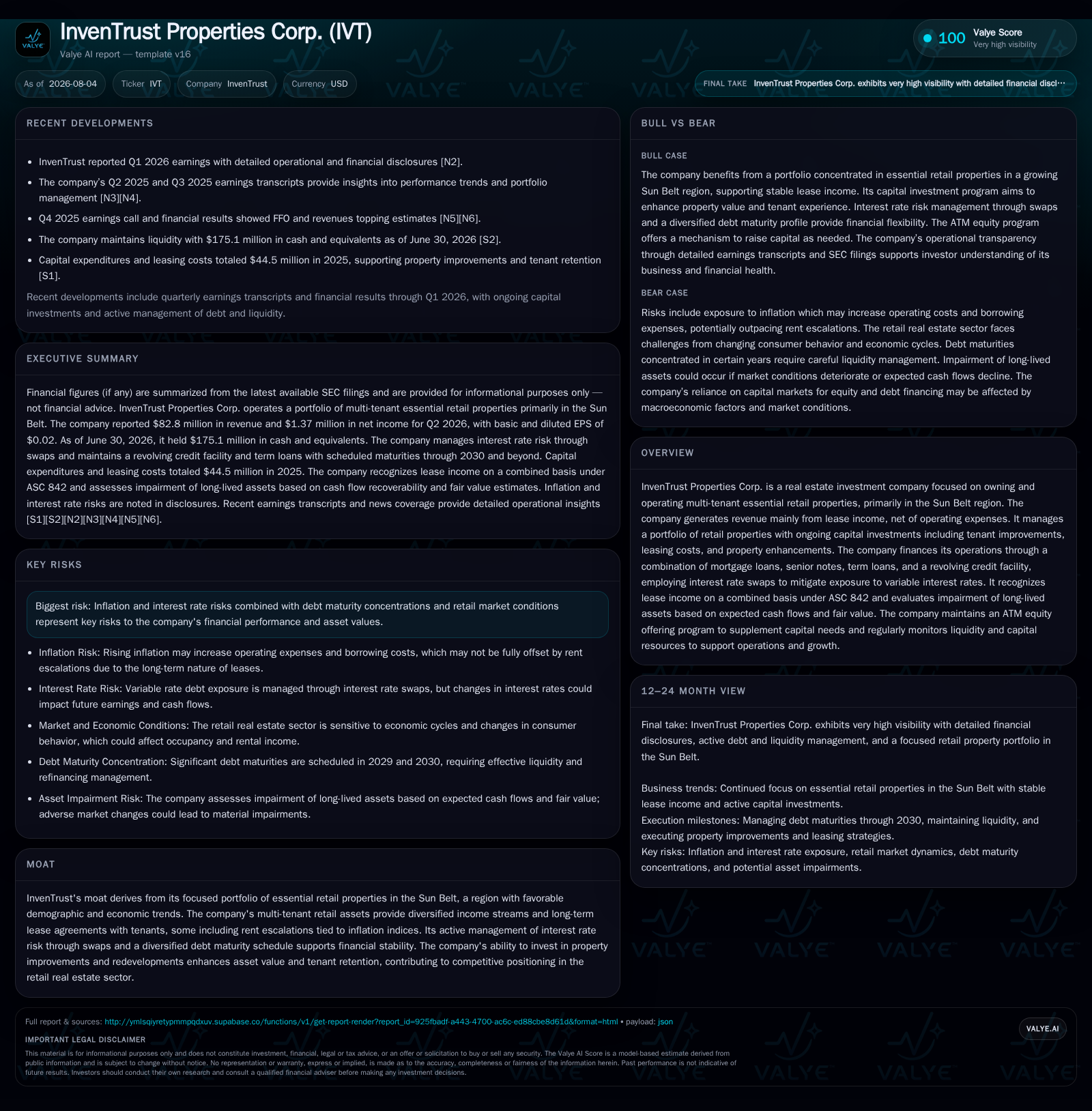
InvenTrust Properties Corp. (IVT) reported Q2 2026 results highlighting stable leased occupancy and ongoing capital deployment within its Sun Belt-focused portfolio of essential retail properties. The company continues to emphasize grocery-anchored multi-tenant centers, leveraging demographic growth trends in key markets. Despite a challenging financing environment marked by rising interest rates, InvenTrust manages risk via interest rate swaps and a staggered debt maturity profile. Growth drivers include rent escalations tied to inflation indices and selective property acquisitions, while risks stem from inflationary cost pressures and retail sector dynamics. Monitoring lease rollover and tenant retention metrics will be critical for validating operational resilience going forward.
Recent Operating Update
InvenTrust Properties Corp., a real estate investment trust focused on owning, leasing, and managing multi-tenant essential retail properties primarily across the Sun Belt region, released its Q2 2026 results on August 3. The company continues to report stable operational performance anchored by consistent leased occupancy levels and active leasing activity within its grocery-anchored neighborhood and community centers [S2]. No material changes in risk factors were disclosed compared to prior filings, reinforcing the steady-state nature of prevailing macroeconomic influences including inflation and interest rates [S2]. Notably, an investor presentation made public concurrently reinforced management's commitment to a disciplined capital structure and proactive asset management [S3].
Business Model Analysis
InvenTrust generates virtually all of its revenue through lease income derived from tenants operating essential retail businesses such as grocery stores within multi-tenant shopping centers. These leases are predominantly long-term contracts featuring rent escalations tied to inflation indices or contractual step-ups that insulate cash flows against moderate inflationary pressures [S1]. The company invests selectively in tenant improvements and redevelopment initiatives—classified as capital expenditures—to maintain competitive property positioning and optimize tenant retention, thereby sustaining occupancy levels that drive Net Operating Income (NOI) growth.
Revenue mechanics center on maintaining high leased occupancy of rentable square footage coupled with rental rate increases embedded in lease agreements. Revenue is sensitive to fluctuations in lease rollover schedules; successful renewals at market or above-market rents underpin Funds From Operations (FFO), a key non-GAAP profitability indicator that reconciles net income with non-cash adjustments typical in real estate accounting frameworks [S1]. The Sun Belt geographical focus taps into markets exhibiting above-average population growth, employment expansion, and household income gains—factors that foster sustained demand for necessity-based retail formats.
Financially, the company employs a blended capital structure composed of mortgage loans secured by specific assets, unsecured senior notes with staggered maturities, term loans with fixed rates achieved through interest rate swaps, and a revolving credit facility providing liquidity flexibility [S1]. This diversified debt mix enables mitigation of refinancing risk concentrations while interest rate swaps are deployed tactically to convert variable-rate exposure into fixed-rate equivalents until swap maturities expire later this year or early next year.
Industry Structure and Competitive Position
Retail REITs specializing in grocery-anchored centers like InvenTrust occupy a defensible position within commercial real estate due to the essential nature of their tenants' services which historically yield lower vacancy risk relative to discretionary retail formats facing e-commerce disruption. Key competitors include peers such as Regency Centers, Kimco Realty, and Federal Realty Investment Trust who operate similar portfolios albeit often with broader geographical diversification beyond the Sun Belt.
InvenTrust distinguishes itself through concentrated exposure to dynamic Sun Belt markets experiencing demographic tailwinds that support both underlying demand for physical retail space and pricing power through rent escalations indexed to inflation or consumer price measures. This regional specialization creates both an opportunity—via localized demand—and a concentration risk which can amplify exposure should those regional economies soften.
Lease structures typically feature base rents augmented by common area maintenance charges allocated to tenants (operating expense recoveries), ensuring operating costs are partly passed through rather than absorbed entirely by the landlord. Tenant mix strategies skew heavily toward necessity retailers which bolster occupancy even during economic downturns but require constant engagement to manage lease expirations effectively.
Growth Drivers
The fundamental growth drivers for InvenTrust derive first from ongoing population growth in target Sun Belt cities. These demographic expansions increase household formation rates and aggregate consumer spending potential—a positive for retail center foot traffic and tenant sales performance. Consequently, this underpins landlords’ ability to lift rental rates upon lease renewals or new leases.
Secondarily, rent escalations embedded within leases tied directly or indirectly to inflation provide a semi-protected pathway for nominal rental revenue growth despite rising input costs or competitive pressures. Active asset management involving redevelopment projects or targeted tenant improvement expenditures further enhances property appeal thus supporting occupancy stability or improvements.
Thirdly, capital recycling through acquisitions of high-quality grocery-anchored centers in faster-growing markets paired with dispositions of non-core assets allows concentration enhancement while potentially improving portfolio yield metrics [S1]. The company's demonstrated acquisition activity in mid-to-late 2025 reinforces this strategy with purchases anchored by recognized grocers like Trader Joe's or Whole Foods across expanding metro areas fostering cash flow accretion potential over time
Risks and Watchpoints
Key risks that could constrain InvenTrust’s execution include elevated inflation translating into higher operating expenses such as utilities or maintenance costs that may not be fully recaptured via rent escalations if tenant sales falter. Inflation can also put pressure on general administrative costs thereby compressing margins absent offsetting revenue increases.
Tenant retention amid changing consumer shopping behaviors presents ongoing uncertainty as shifts toward e-commerce can impact physical store requirements even among essential retailers. While grocery anchors demonstrate relative resilience compared to discretionary retailers, monitoring lease renewal spreads and drop-off rates remains vital.
Geographic concentration in the Sun Belt also elevates exposure to localized economic shocks such as regulatory changes affecting property taxation or zoning that could influence investment returns adversely. Additionally, liquidity constraints under adverse capital market conditions could hamper timely access to equity or debt capital needed for redevelopment initiatives or opportunistic acquisitions.
What To Watch Next
Upcoming quarterly disclosures should be monitored closely for net leased occupancy trends—both absolute percentage levels and quarter-over-quarter directional changes—as these will indicate tenant retention effectiveness amidst macroeconomic pressures. Changes in average rental rates per square foot upon lease renewals will reveal pricing power sustainability underpinning NOI growth trajectories.
Lease rollover percentages scheduled over the next 12–24 months deserve scrutiny; high rollover volumes concentrated near maturity dates could stress leasing teams and potentially reduce cash flow visibility if renewals occur below market expectations. Likewise, capital expenditure amounts deployed toward tenant improvements versus redevelopment projects may signal strategic priorities influencing future NOI expansion.
On the financial front, attention should be given to availability under revolving credit facilities indicating liquidity flexibility alongside any updates regarding refinancing status of maturing swaps or term loans approaching expiration dates late this year or early next year. Core FFO figures relative to prior periods will help assess profit quality adjusted for non-cash items typical in real estate accounting.
Financial Profile Discussion
Capital allocation balances reinvestment into existing assets through tenant improvements and redevelopment against external growth via acquisitions funded partially through equity issuance programs such as At-The-Market (ATM) offerings that supplement traditional financing routes indicating prudent financial stewardship focused on sustainable income growth coupled with manageable leverage levels [S3]
This analysis presents an evidence-backed overview of InvenTrust Properties Corp.’s core business fundamentals as disclosed in its latest SEC filings as of Q2 2026 without offering investment advice.
Disclaimer: This is research-only, informational analysis and not investment advice. It may include AI-generated interpretation and general industry context. Always verify important details using primary sources.

Comments