
Centerspace Executes Strategic Portfolio Optimization and Operational Enhancements in Key Growth Markets
Focused redevelopment and targeted asset sales signal Centerspace’s commitment to strengthening its balance sheet and portfolio quality amid strategic review.
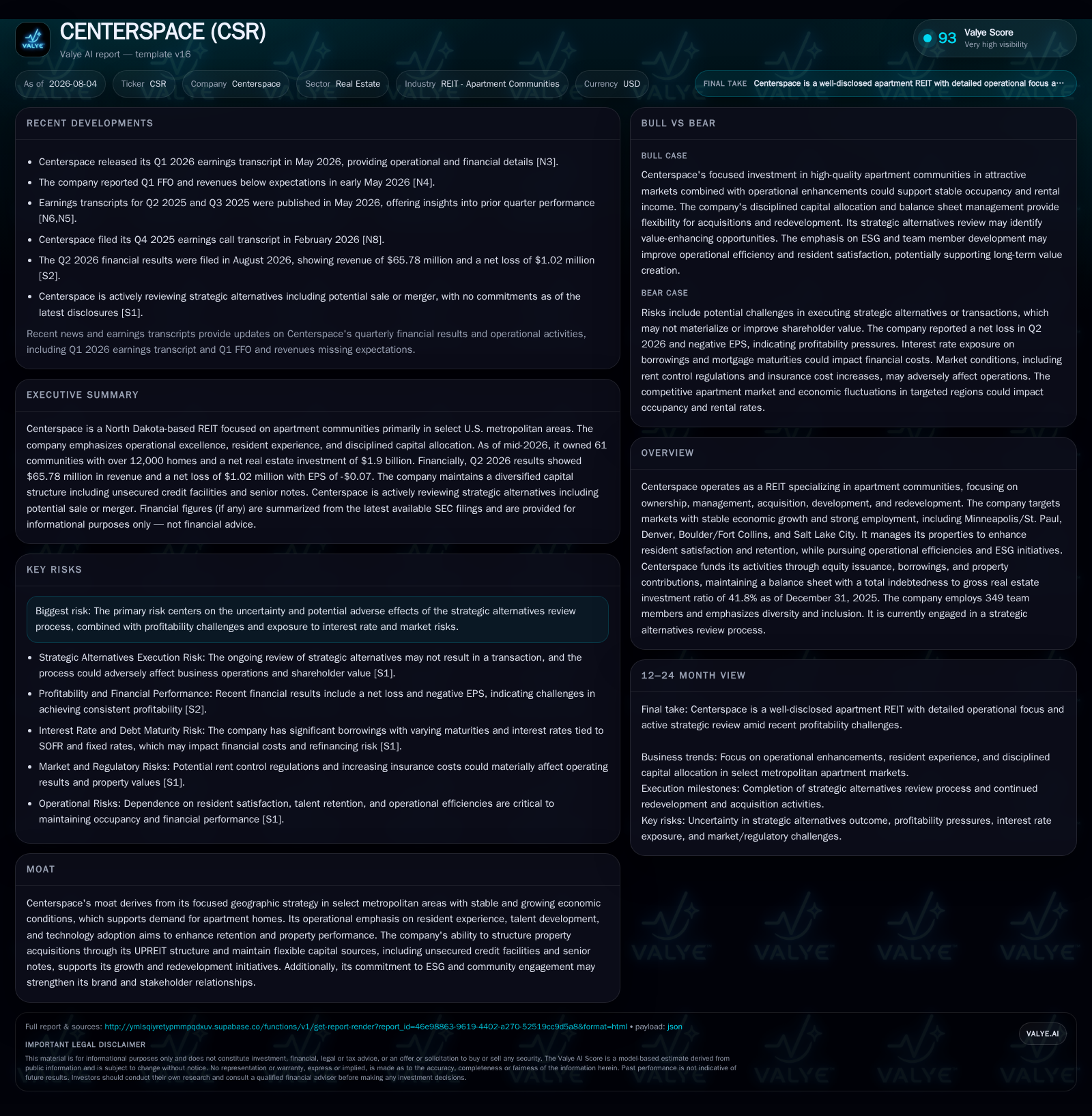
Centerspace reported solid operational results in Q2 2026, underscored by ongoing initiatives enhancing resident experience and property performance across its portfolio focused on stable, growth-oriented metropolitan areas. The company is actively pursuing a strategic alternatives review, accompanied by a $240-245 million asset sale program targeting less accretive markets to optimize its portfolio composition. Its UPREIT structure facilitates tax-efficient acquisitions and capital management, while debt levels remain elevated near $1.02 billion as of mid-2026 against a backdrop of structured covenants and a maturing debt profile. Growth drivers include redevelopment execution in denser urban clusters with sustained employment expansion, yet risks loom from interest rate pressures, refinancing uncertainty, and execution of strategic alternatives.
Recent Operating Update: Strategic Alternatives Progress and Portfolio Actions
Centerspace's Q2 2026 filings reaffirm its active commitment to reshaping its portfolio through a strategic alternatives review initiated in late 2025 [S1]. The review contemplates diverse options including potential sale or merger transactions alongside continued independent operation. Concurrently, Centerspace announced a targeted asset sales program aiming to divest approximately $240-245 million worth of properties concentrated notably in Bismarck, Rapid City, and Denver markets with anticipated closings in H2 2026 [S5][S6]. These moves seek to enhance portfolio quality by exiting less accretive geographies while bolstering balance sheet flexibility during this transformative phase.
The company emphasizes operational improvements focused on resident experience enhancements and redevelopment projects designed to align community offerings with evolving market demands. This dual approach targets improved tenant retention—critical given the short-duration apartment leases that expose revenue streams to rapid market fluctuations—and enhanced net operating income (NOI) through increased rental premiums post-modernization [S2][S1]. While no material changes occurred to risk factors compared to prior disclosures, the ongoing strategic review itself poses execution risks impacting managerial focus and stakeholder confidence [S2][S1].
Business Model: Apartment Communities Anchored on Growth Markets
Centerspace operates as an UPREIT REIT specializing in ownership, management, acquisition, development, and redevelopment of apartment communities primarily located in metropolitan areas exhibiting stable employment growth and quality-of-life attractions—specifically Minneapolis/St. Paul, Denver, Boulder/Fort Collins, and Salt Lake City [S1]. This geographic concentration leverages strong economic fundamentals underpinning sustained rental demand.
Revenue generation is predominantly through monthly rents from residential tenants under typically short-term leases (~12 months or less), allowing for periodic rent resets aligned with inflationary or market-driven adjustments but also introducing re-leasing risk should market conditions deteriorate [S1]. Tenant retention directly impacts occupancy rates—a key operating KPI—making resident satisfaction programs central to sustaining cash flow stability.
The company's business model strategically incorporates redevelopment projects aiming at repositioning older assets to command higher rents matching current tenant preferences [S1][S26]. These projects require significant capital expenditures balanced against expected accretive benefits via increased NOI over time. Operational efficiencies are sought through scaling property management platforms augmented by technology investment aimed at service quality upgrades and cost containment
Capital formation employs multiple channels including common share issuances under an At-the-Market (ATM) offering program (with up to $500 million capacity), unsecured senior debt instruments issued via private placements, revolving credit facilities with expansion options (accordion features), and equity/unit issuance in exchange for contributed real estate via its UPREIT structure—offering tax efficiency advantages in acquiring new assets without immediate taxable gain recognition [S7][S27][S1]
Industry Structure and Competitive Position
Within the apartment REIT segment characterized by steady rental income streams offsetting cyclical homeownership trends and housing affordability challenges, Centerspace's focused metro area approach differentiates it from peers pursuing broader geographic diversification (e.g., Camden Property Trust or AvalonBay Communities). Concentrating on markets with sound employment trajectories enables more predictable occupancy levels despite macroeconomic variability.
However, this concentration introduces regional exposure risks relative to diversified peers like Mid-America Apartment Communities who spread asset bases broadly across multiple states. Competitive dynamics center on tenant retention strategies employing amenity upgrades, responsive leasing terms, pricing discipline reflective of local supply-demand balances, and operational excellence.
Centerspace competes not only with other institutional apartment REITs but also local multifamily operators whose nimbleness or lower cost structures can pressure margins. Thus continual investment in community modernization alongside technology-driven management capabilities is vital to maintaining competitive rent levels while controlling expenses.
Growth Drivers
Growth hinges on leveraging population influxes into target MSAs supported by strong job creation trends that favor rental housing demand. The enduring affordability challenges within these metros reinforce demand for high-quality rental communities over homeownership alternatives.
Redevelopment pipelines provide avenues for organic NOI growth as properties are upgraded or rebranded to capture higher market rents. Technology adoption that enhances resident interactions—from leasing processes to maintenance requests—improves tenant satisfaction metrics thus reducing turnover rates.
Capital availability facilitated by diversified financing tools—including unsecured senior notes at historically low fixed rates locked years ahead plus expandable credit lines—underpins acquisition activity as well as redevelopment spending necessary for sustained growth.
ESG commitments increasingly shape brand reputation among tenants valuing sustainability measures and community engagement initiatives. Internally focused human capital programs aim at retaining experienced teams essential for operational consistency across dispersed apartment communities [S26].
Risks and Watchpoints
Key risks revolve around the uncertainties inherent in the strategic alternatives process which may cause distraction or delay critical investment decisions. Failure to consummate any structural transactions could adversely affect shareholder value or corporate flexibility.
Interest rate exposure remains a chief concern given substantial debt outstanding near $1.02 billion as of June 2026 juxtaposed against modest cash balances (~$8.56 million) requiring vigilant liquidity management ahead of maturities [F1]. Rising rates could increase borrowing costs upon refinancing or constrain access if credit markets tighten further.
Tenant default rates or declining occupancy triggered by economic slowdown would directly impair rental revenue streams given short lease durations prompting immediate repricing sensitivity. Regional concentration exposes Centerspace disproportionately if localized employment shocks occur relative to more diversified operators.
Redevelopment efforts carry cost overrun potential alongside risks of prolonged downtime during renovations impacting cash flows temporarily before projected rent gains materialize.
Finally, regulatory risks including prospective rent control measures could limit pricing power in affected jurisdictions necessitating active monitoring although current target metros have relatively favorable regulatory environments compared with coastal peers.
What to Watch Next
Milestones include progress on the announced asset sales anticipated closing in second half of 2026 which will reveal management’s ability to execute portfolio optimization plans timely without disrupting core operations.
Tracking occupancy rate trends post-redevelopment completions will shed light on effectiveness of property enhancements on tenant demand resilience amidst inflationary pressures.
Capital deployment activities reported quarterly—such as property acquisitions funded via the UPREIT unit mechanism or debt issuances—will indicate appetite for growth balanced against deleveraging objectives expressed by management.
Liquidity management updates including any draws on revolving credit lines or equity issuance under ATM programs should be monitored as signals of financial flexibility amid evolving market conditions.
Management commentary related to the strategic alternatives review progress remains a key qualitative marker affecting investor sentiment regarding long-term corporate direction.
Financial Profile Discussion
As of June 30, 2026, Centerspace carries total debt approximating $1.02 billion net of cash equivalents totaling about $8.56 million reflecting moderate net leverage consistent with a capital-intensive REIT business model reliant on debt-supported acquisitions and redevelopments [F1]
Debt facilities include unsecured senior notes issued under private shelf agreements offering maturity dates staggered through early 2030s at fixed interest rates mostly between ~2.5%–3.8%, complemented by revolver availability expandable up to $400 million providing short-term liquidity [S7][S19][S27]. These instruments incorporate financial covenants encompassing leverage ratios and secured debt limits intended to preserve credit quality but constrain aggressive borrowings.
Capital allocation prioritizes reinvestment into acquisitions or redevelopments targeting high-return opportunities while balancing shareholder distribution requirements mandated under REIT tax rules mandating payout of most taxable income annually [S26]
Centerspace maintains an ATM equity offering program facility valued up to $500 million facilitating opportunistic common share sales when market conditions align with funding needs though no issuances occurred during FY2025 suggesting cautious capital stewardship [S27]
Disclaimer: This is research-only, informational analysis and not investment advice. It may include AI-generated interpretation and general industry context. Always verify important details using primary sources.

Comments