
SITE Centers Corp. Faces Disposition Execution and Financing Constraints Amid Wind-Down
The retail REIT is navigating a portfolio disposition and wind-up strategy while managing liquidity, tenant risks, and lack of credit facilities.
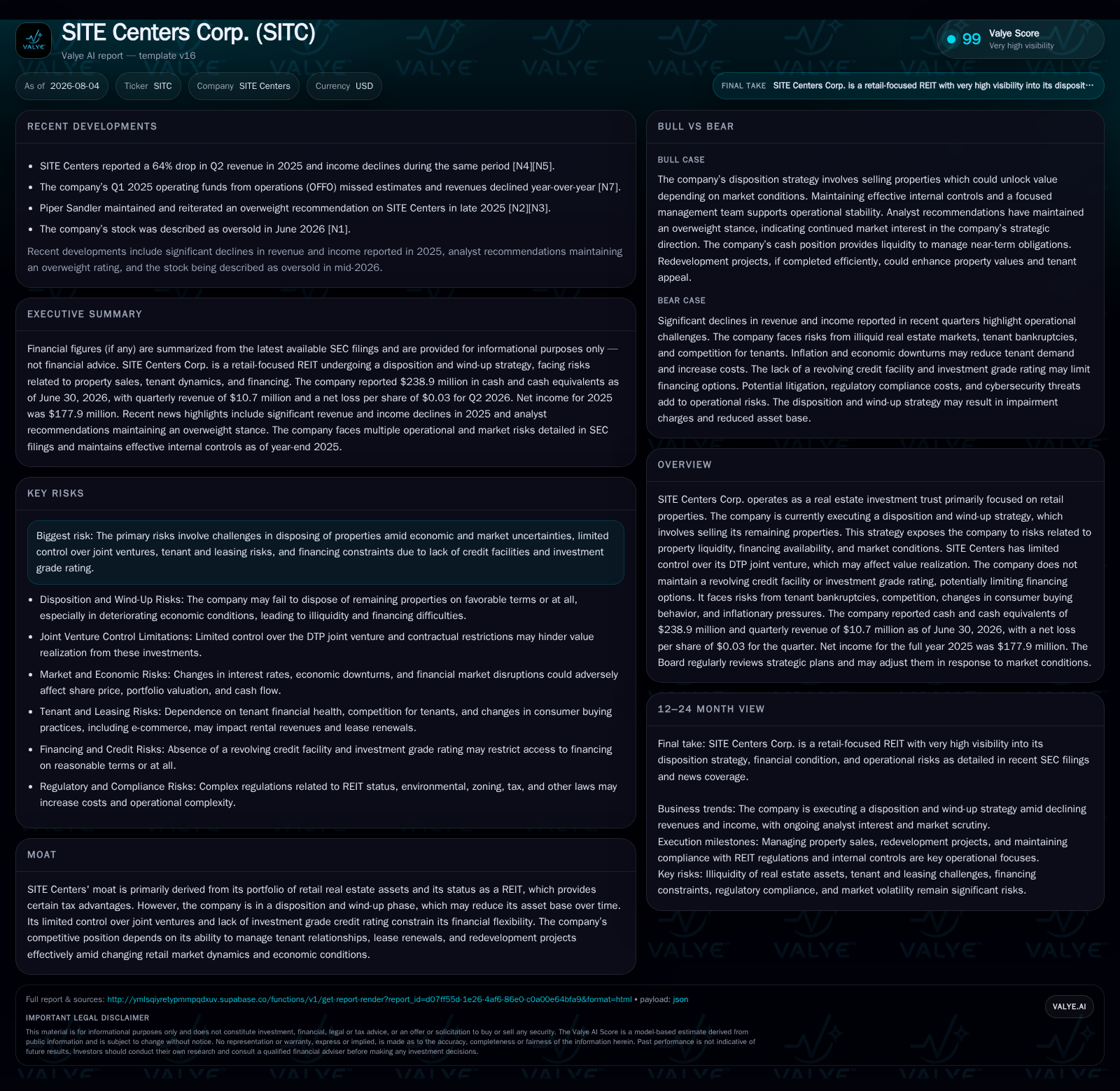
SITE Centers Corp., a retail-focused real estate investment trust, is actively engaged in selling its remaining property holdings as part of a strategic wind-down. Recent quarterly filings reveal ongoing challenges related to property liquidity, financing limitations due to absence of an investment grade rating and revolving credit facility, and exposure to tenant bankruptcies amid evolving retail market dynamics. With reported cash of $239 million as of mid-2026, the company’s ability to complete dispositions on favorable terms and manage operational expenses under inflationary pressures will be key to preserving value during this transition.
Recent Operating Update
SITE Centers Corp.'s latest quarterly 10-Q filing dated August 3, 2026, confirms that the company remains focused on executing its disposition and wind-up strategy by divesting its remaining retail properties [S2]. The company reported quarterly revenue of approximately $10.7 million for the period ended June 30, 2026, coupled with a small net loss per share of $0.03 [S2]. Operating results reflect the ongoing pressures associated with managing a shrinking asset base alongside leasing challenges inherent in retail-focused REITs.
Liquidity position shows cash and cash equivalents of $238.9 million as of quarter-end [F1], which provides some runway but underscores the importance of asset sales generating proceeds to cover operational costs and satisfy liabilities.
Joint ventures remain an uncertain area; specifically, SITE Centers expresses limited control over its DTP joint venture holdings [S1][S2], which can complicate efforts to fully monetize those assets within the disposition timeline.
Business Model Overview
As a retail-focused real estate investment trust (REIT), SITE Centers primarily owns shopping centers leased out to a broad tenant base composed of national chains, regional retailers, and local businesses [S1]. Revenue is generated largely through contractual fixed-lease payments supplemented by variable rents tied to tenant sales breakpoints and reimbursements for common area maintenance and property taxes [S20].
Lease contracts typically range from short-term renewal arrangements up to fifteen years, with revenue recognition spread on a straight-line basis over non-cancelable lease terms [S20]. Success depends heavily on maintaining high occupancy rates, achieving lease renewals at favorable rents or escalations, mitigating tenant defaults or bankruptcies, and managing tenant mix to attract steady foot traffic.
SITE Centers’ current strategy shifts away from acquisition or redevelopment growth toward winding down operations via asset sales. This changes revenue mechanics from recurring rental income toward one-off gains or losses on real estate dispositions. However, these assets can be highly illiquid. Meaningful valuation gaps can arise between book value and achievable sale prices during volatile market demand.
Industry Structure and Competitive Positioning
Retail REITs operate in a sector sensitive to cyclical economic factors such as consumer discretionary spending levels and shifts toward e-commerce that reduce demand for physical retail space. Leasing velocity slows during downturns as tenants seek rent relief or close locations. Inflation increases operating expenses (property taxes, maintenance costs) that can threaten tenant profitability especially if landlords cannot push through commensurate rent increases.
SITE Centers’ competitive profile is hampered further by reduced scale following the October 2024 spin-off of convenience retail properties into Curbline Properties Corp., which removed approximately half its gross leasable area [S16]. The spin-off narrowed SITE’s portfolio mostly to traditional shopping centers where growth is tougher given headwinds facing brick-and-mortar retailers.
Moreover, limited control over joint venture entities restricts direct operational agility in those assets—these arrangements dilute control over leasing decisions and timing of sales [S1]. Consequently, the company's positioning reflects greater vulnerability amid industry challenges rather than resilience through expansion or diversification.
Growth Drivers Analysis
With active disposition underway rather than portfolio growth focus, SITE Centers’ primary near-term growth catalysts lie in:
- Disposition Execution: Successful sales at attractive prices will realize value trapped in assets since recurring NOI generation declines during wind-down phases.
- Lease Renewals & Tenant Retention: Securing high lease renewal rates—at least on par or better than prior agreements—helps sustain rental revenue levels despite declining asset count.
- Redevelopment Optimization: Select redevelopments could enhance property values before sale but carry risk of delays or cost overruns especially given reduced operational scale [S1].
- Managing Tenant Risk: Maintaining tenant mix stability limits downside from bankruptcies; however, changing retail formats continue pressuring traditional leasing models.
- Liquidity Stewardship: Balancing operational cash burn with disposition proceeds controls financial flexibility in absence of external borrowing capacity.
Monitoring metrics like occupancy percentage stabilization above sector distressed benchmarks (~85-90%) or successful transaction closings would provide tangible data points confirming progress against headwinds.
Risks and Growth Constraints
Key risks weigh heavily due to strategy shift:
- Disposition Illiquidity: Real estate assets are inherently illiquid; timing sales depends on receptive capital markets which may falter amid rising interest rates or economic weakness causing valuation declines [S1][S2].
- Tenant Bankruptcies & Defaults: Retail sector remains vulnerable; bankruptcies reduce cash flow visibility leading to write-offs affecting earnings reliability.
- Competitive Pressures: Other retail landlords compete intensively for tenants; superior locations or amenities elsewhere can pull demand away diminishing leverage over renewal rents.
- Disruptions from E-Commerce & Behavioral Shifts: Long-term secular shift reduces physical retail footprint needs altering property desirability profiles.
- Inflationary Pressures: Rising operating costs compress margins unless offset by higher rents; constrained tenant profitability may impair payment reliability further suppressing NOI.
- Limited Control Over Joint Ventures: Contractual restrictions limit ability to accelerate sale timing or reposition joint venture holdings efficiently [S2].
- Operational Downscaling Effects: Shrinking size risks losing key personnel or expertise undermining property management quality impeding leasing activity [S1][S2].
What To Watch Next
Critical upcoming developments include:
- Quarterly updates on property disposition volumes completed versus target schedules;
- Lease renewal rate trends reported explicitly in future filings indicating tenant stability;
- Changes in net operating income (NOI) reflecting rent escalations or concessions granted;
- Disclosure about joint venture realizations clarifying valuation implications;
- Management commentary addressing inflation impact mitigation strategies;
- Market conditions impacting buyer demand for retail real estate affecting pricing negotiations;
- Monitoring dividend policy adjustments that affect REIT qualification status given operational contraction.
Financial Profile Discussion
SITE Centers reported cash and equivalents totaling $238.9 million as of June 30, 2026 [F1]. Total debt and net debt figures from companyfacts date back to 2012 and are not indicative of the current balance sheet [F1]. The absence of revolving credit lines means liquidity primarily depends on cash reserves plus disposition proceeds without fallback external credit facilities [S2].
Operating income streams have contracted consistent with asset reductions [S2]. Quarterly results showing small losses illustrate transitional costs exceeding rental income during the managed wind-down phase
Capital allocation currently prioritizes liability repayments along with disciplined expense management while maintaining mandatory REIT distributions. Thus financial flexibility remains a critical watchpoint connected closely with successful disposition execution pace.
This article is an independent analysis focused on company fundamentals within the context of the retail REIT industry environment. It does not constitute investment advice or research views.
Disclaimer: This is research-only, informational analysis and not investment advice. It may include AI-generated interpretation and general industry context. Always verify important details using primary sources.

Comments