
Capital Southwest Corp Advances Middle-Market BDC Strategy with Growing Portfolio and Diverse Capital Sources
A combination of increased investment activity, strong net investment income growth, and diversified financing supports Capital Southwest's stable BDC operations.
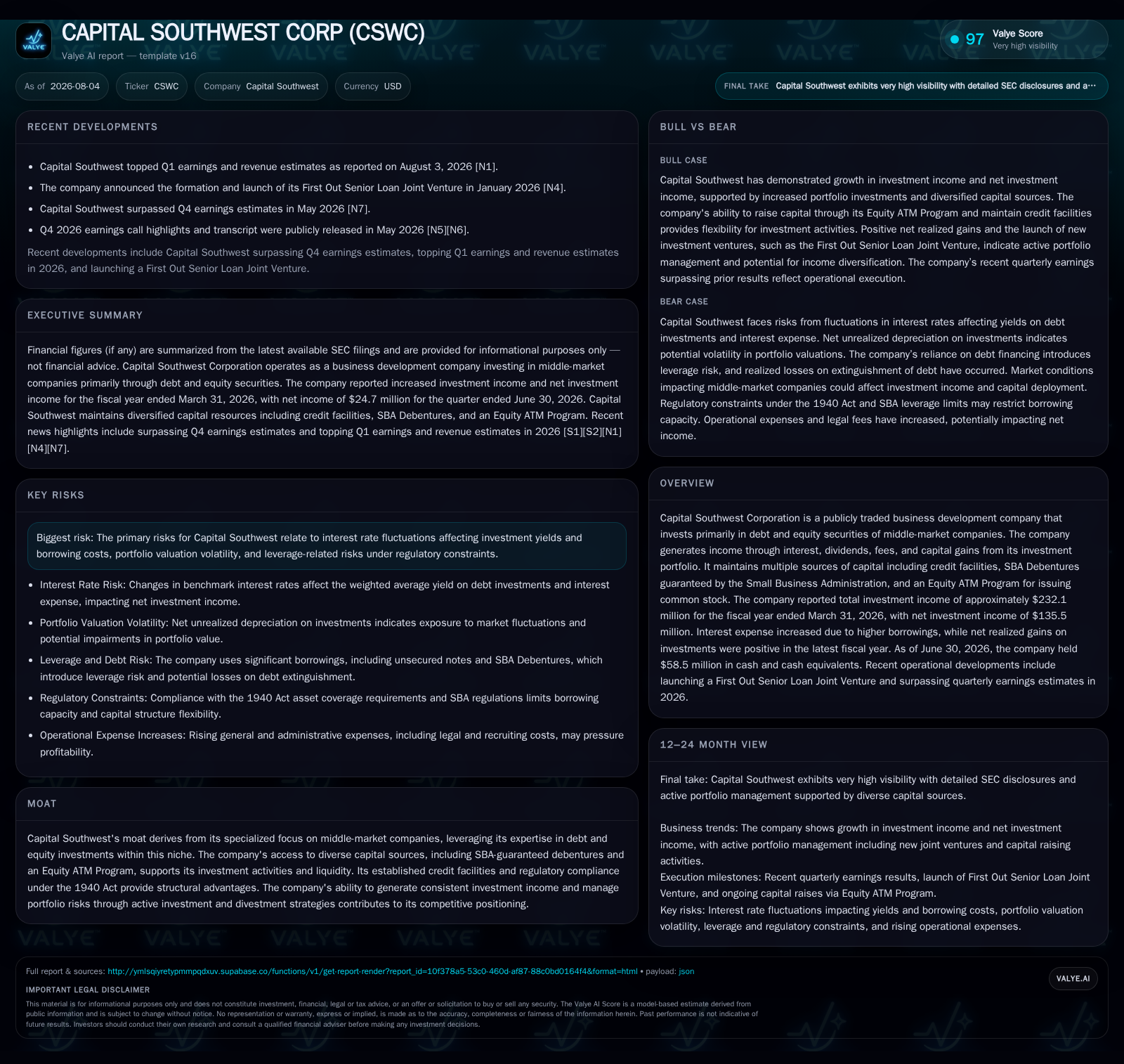
Capital Southwest Corporation reported robust net investment income growth in its latest quarter driven by a larger portfolio and solid income from debt and equity investments in middle-market companies. The company’s business development company (BDC) model relies on deploying capital raised from multiple channels, including credit facilities, SBA-guaranteed debentures, and an Equity ATM program. While leveraging these sources to expand its portfolio, the company maintains regulatory asset coverage well above minimum thresholds. Ongoing investments and disciplined capital management underscore its capacity to generate recurring investment income, though interest rate volatility and portfolio valuation remain watchpoints.
Recent Operating Update
Liquidity is reinforced with $58.5 million in cash and cash equivalents plus approximately $364 million of undrawn credit facility capacity providing significant dry powder for ongoing portfolio deployment or operational flexibility [F1][S1][S4]
Business Model Overview
Capital Southwest operates within the BDC industry framework as a closed-end fund investing primarily in middle-market companies that often face limited access to traditional banks or public capital markets. Through deployments in senior secured debt, subordinated loans, equity securities, and fee-generating arrangements related to financing structuring or servicing, the company generates diversified investment income composed of interest payments, dividends, fee revenue, and capital appreciation opportunities [S1][S10]
Revenue mechanics rely heavily on the spread between yields earned on portfolio assets—mainly debt instruments with floating or fixed rates—and the company's effective cost of debt plus operational expenses. Returns are affected by volume (portfolio size), pricing (yield levels), credit quality (default risk provisioning), and realized gains or losses on investment exits or restructurings.
Strategically, Capital Southwest leverages multiple capital sources including:
- Corporate Credit Facilities providing flexible short- to medium-term borrowings;
- SBA Debentures issued through licensed SBIC subsidiaries that offer advantageous long-dated leverage backed by government guarantees;
- An Equity ATM Program facilitating opportunistic common stock issuance without dilutive large equity offerings.
These diversified funding tools enable measured leverage usage while respecting regulatory asset coverage rules under the Investment Company Act of 1940 limiting senior securities exposure relative to net assets.
Industry Structure and Competitive Position
The BDC sector functions as an intermediary layer bridging capital providers seeking yield with underserved medium-sized enterprises requiring growth capital or restructuring finance solutions. Competitively differentiated firms manage credit risk meticulously while balancing portfolio yield demands against borrowing costs and regulatory leverage compliance.
Capital Southwest's niche focus on middle-market companies aligns with substantial demand growth given limited traditional bank financing availability post-financial crisis regulatory tightening. Its ability to secure SBA-guaranteed debentures enhances cost-effective borrowing options less accessible to pure private funds or regional lending platforms.
Compared with broader BDC peers that may emphasize higher-yield but riskier subordinated loans or private equity styles of investing, Capital Southwest exhibits a balanced allocation integrating senior secured loans complemented by selected equity holdings for incremental return enhancement without disproportionate portfolio volatility.
Growth Drivers
Multiple structural factors underpin growth prospects for Capital Southwest:
- Persistent demand for alternative financing vehicles among middle-market companies unable or unwilling to utilize commercial bank credit lines;
- A sizable pipeline for new originations supported by experienced origination teams familiar with underwriting middle-market risk profiles;
- Regulatory environments maintaining asset coverage ratios keep balance sheet discipline tight but predictable;
- Expanded fee income opportunities derived from structuring arrangements augment core interest/dividend returns;
- Access to SBA Debentures injects long-duration funding stability catalyzing scalable portfolio build-out;
- Opportunistic use of Equity ATM Programs enables timely opportunistic capital raises aligning equity base with funded asset growth.
Monitoring KPIs such as net investment income trajectory relative to changes in portfolio composition, average cost basis expansions, fee income trends, asset coverage compliance ratios comfortably above minimums (noted at 209%), plus utilization metrics under credit facilities will signal ongoing execution effectiveness [S1][S10][F1]
Risks and Watchpoints
Industry inherent risks pose vigilance points including:
- Interest rate fluctuations that compress net interest margins if rising funding costs outpace yields earned on floating or fixed-rate assets;
- Credit risk escalation causing defaults or write-downs within the loan book that could impair dividend coverage;
- Market valuation volatility affecting unrealized gains/losses particularly on equity stakes which can introduce earnings variability;
- Regulatory leverage limits constraining aggressive expansion strategies requiring careful asset-liability matching;
- Liquidity risks regarding ability to exit positions timely potentially heightening exposure during economic downturns;
- Concentration exposure where few industries or portfolio segments generate outsized risk profile shifts.
Capital Southwest’s recent realized gains reversal—from significant realized losses in prior years to modest gains recently—appears encouraging but underscores cyclicality potential demanding active risk management strategy continuity.
What To Watch Next
Investors should monitor:
- Quarterly net investment income progression tied closely to portfolio yield dynamics amid changing interest rate environment;
- Changes in borrowing levels under syndicated credit facilities versus utilization capacity signaling funding appetite or constraints;
- Activity within SBA debenture issuance reflecting reliance on government-backed long-term leverage sources;
- Updates from Equity ATM Program utilization including any dilution effect balanced against reinvestment capacity;
- Portfolio quality indicators such as non-accrual loan levels or concentration metrics disclosed quarterly;
- Announced exits or restructurings influencing realized gain/loss lines impacting overall earnings stability;
- Dividend declarations confirming payout sustainability given underlying NII results.
Next quarterly filings slated around November/December will provide fresh checkpoints aligning financial performance against evolving macroeconomic conditions impacting middle-market borrowers.
Financial Profile Discussion
As of June 30, 2026, Capital Southwest held $58.5 million in cash and cash equivalents against total debt approximating $1.24 billion for net debt near $1.18 billion—a leverage profile commensurate with established BDC norms managed within regulatory asset coverage guidelines mandating minimum levels at or above 150%, while the company targets conservative internal thresholds such as ~166% per board resolutions [F1][S4][S10]
Total interest expense increased over $11 million annually due mainly to incremental drawdowns averaging close to $190 million additional borrowings driving scaling loan portfolios; however pricing remained steady suggesting refinancing efficiency supported by a laddered unsecured note program (including recent issuances maturing out five years hence) plus stable spread SBA debentures benefiting from government guarantees prolonging duration risk management [S1][S6][S20]
The mix of fee income growing marginally alongside dividend income expanding sharply reflects successful selective equity investments providing complementary earnings streams beyond core interest returns typical for BDC peers focusing predominantly on senior secured lending.
Despite modest headwinds from declining benchmark rates compressing yields on newly originated loans relative to older vintages locked at higher coupons, Capital Southwest’s growing scale (average monthly debt base increasing >20%) allows it to produce meaningful absolute increases in net investment income supporting distribution policies aligned with shareholder expectations [S1][S9]
In summary, Capital Southwest sustains a resilient financial foundation combining diversified capital sourcing via credit facilities ($364 million undrawn), SBA-guaranteed debentures offering affordable long-term leverage, convertible notes enhancing flexibility and common equity issuances through an Equity ATM program maintaining liquidity for opportunistic investing needs.
Disclaimer: This analysis is intended solely for informational purposes based on publicly available SEC filings and industry context. It is not a research view regarding any security holdings.
Disclaimer: This is research-only, informational analysis and not investment advice. It may include AI-generated interpretation and general industry context. Always verify important details using primary sources.

Comments