
TKO Group’s Q2 2026 Results: Shifts in Live Event Dynamics and Financial Stance
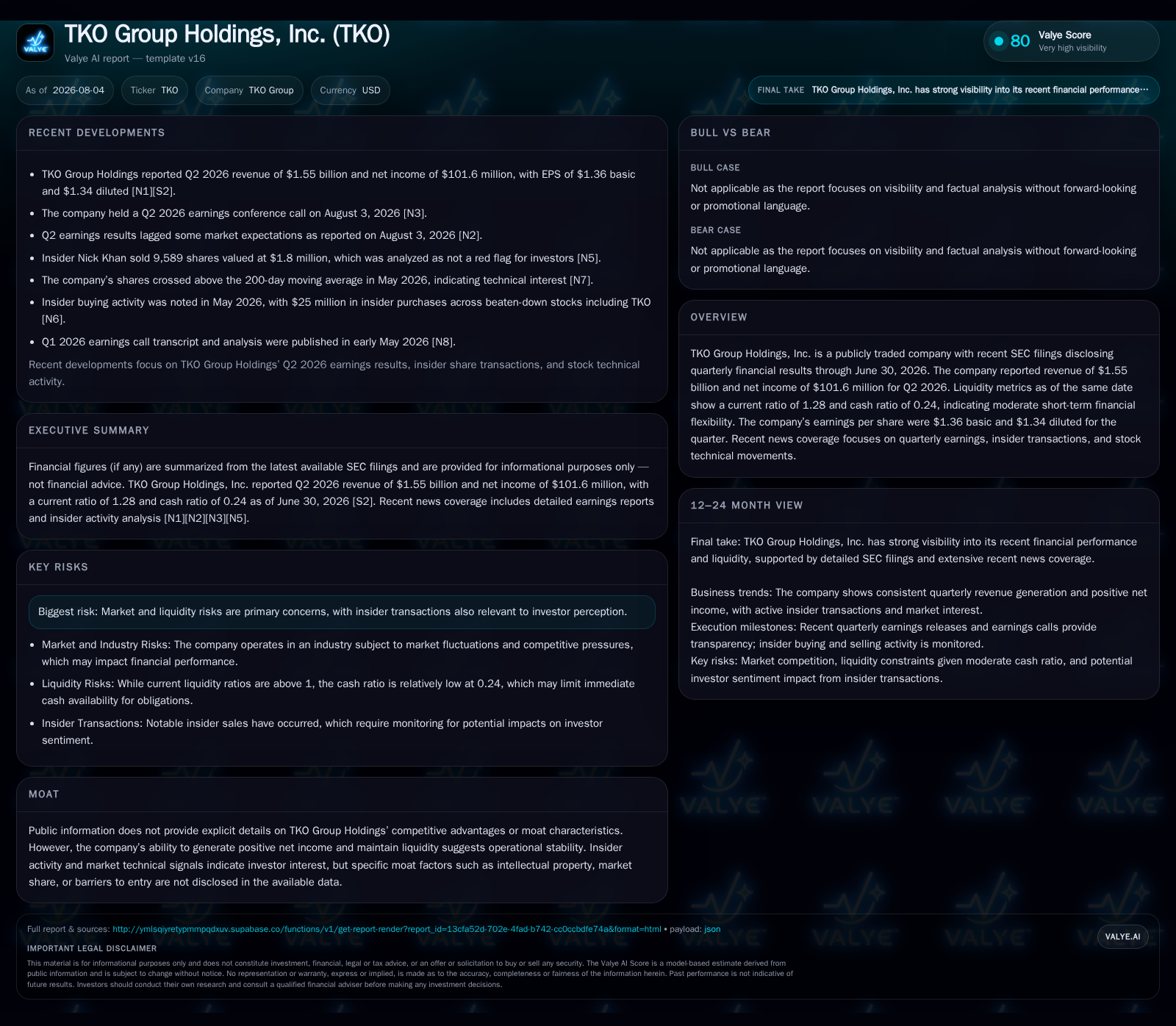
TKO Group Holdings reported solid Q2 2026 revenue of $1.55 billion and net income of $101.6 million, reflecting operational resilience amid a capital-intensive live sports entertainment model.
In Q2 2026, TKO Group Holdings demonstrated sustained operational momentum with $1.55 billion in revenue and $101.6 million in net income, alongside a liquidity profile that supports ongoing investment despite substantial leverage. The company’s diversified revenue streams—encompassing live event promotion, media rights licensing, sponsorships, ticket sales, and ancillary services—mirror industry trends that balance high fixed costs with opportunities from digital expansion and sponsorship growth. Peer comparisons suggest margin pressures persist amid competitive and pricing challenges. Key risks include leverage strain and sensitivity to consumer discretionary spending, while growth hinges on digital platform monetization and international event expansion.
Sustained Operational Momentum Evidenced in Q2 Financials
TKO Group Holdings reported revenue of approximately $1.55 billion for the quarter ended June 30, 2026, accompanied by a net income of $101.6 million and diluted earnings per share of $1.34 [S2], [F1], [N1]. These results highlight the company’s ability to generate positive operating leverage within its capital-intensive live sports and entertainment business model. The current ratio stood at a moderate 1.28 as of quarter-end, supported by cash and equivalents totaling around $592 million against current liabilities near $2.5 billion [F1]. This liquidity profile suggests the firm maintains enough short-term flexibility to meet obligations despite a relatively high absolute debt load.
The firm’s margin profile must be viewed through the lens of seasonality typical to the live event sector where event frequency and execution cadence vary quarter-to-quarter. This deal not only anchors recurring revenue but also signals growing importance of OTT platforms in fan engagement strategies.
Ticket sale volumes combined with pricing dynamics heavily influence operating margins given high fixed production costs. Average revenue per user (ARPU) trends per event serve as critical performance indicators but require disclosure updates for precise assessment.
Competitive Context: Peer Comparisons Highlight Margin Headwinds and Pricing Challenges
Operating margins in this segment are challenged by inflationary cost pressures on event production inputs such as staffing, venue operation expenses, and technology investments for broadcast enhancements. Peers like Live Nation Entertainment exhibit similar cost structures but command scale advantages in ticketing infrastructure which may yield better margin resilience.
Endeavor Group Holdings’ recent earnings highlight tightening sponsorship renewals amid macroeconomic uncertainty impacting advertising budgets—a dynamic also relevant for TKO given their reliance on sponsorship flows for non-ticket revenue generation [N2]. Digital distribution channels impose additional competitive pressures as broadcasters negotiate complex fee structures impacting content licensing fees.
Understanding how TKO’s margins trend relative to these peers will clarify competitive positioning; any margin improvement reversal or peer outperformance would materially affect valuation narratives.
Growth Catalysts Anchored in Digital Expansion and Sponsorship Dynamics
Expansion into digital streaming platforms enhances monetization potential beyond traditional live attendance revenues. The Paramount deal exemplifies participation in OTT ecosystem monetizing viewer subscriptions alongside pay-per-view models—a growing trend across sports content distribution.
Concurrently, rising sponsor interest post-pandemic reflects renewed commercial investment in audience engagement opportunities offered by live events plus targeted digital campaigns leveraging enhanced data analytics capabilities seen within TKO’s portfolio. Enhanced analytics aid customer acquisition efficiency by refining marketing spend allocation.
Sector-wide demand for immersive fan experiences—augmented reality offerings or VIP hospitality—also affords ancillary revenue upside beyond core tickets or licensing fees.
Risk Landscape Including Leverage Strain and Demand Sensitivity to Economic Cycles
TKO carries significant leverage with total debt reported near $4.66 billion as of quarter-end offset partially by cash balances yielding net debt near $4.07 billion [F1]. High fixed costs inherent in live event production constrain operating flexibility during demand downturns.
Consumer discretionary expenditure volatility presents material risk given the reliance on ticket sales volume sensitive to economic cycles influencing attendance rates and pricing power. Event cancellations due to regulatory changes or unforeseen external factors such as weather or health crises pose episodic threats to revenue continuity.
Regulatory complexity surrounding broadcasting rights adds legal risk exposure while competition intensifies for finite sponsorship dollars amidst broader advertising market fluctuations documented in TKO’s risk disclosures [S11]. Robust liquidity management remains imperative to mitigate refinancing risk amid asset-heavy operations.
Key Near-Term Milestones: What Investors Should Monitor Next
Investors should monitor several critical developments including upcoming sequential quarterly earnings releases that provide updated insights into revenue mix shifts or margin trends [N3], [S3].
Renewal status of major media rights agreements beyond UFC-Paramount will indicate revenue visibility duration while evolving sponsorship contracts will signal marketing partner confidence.
Digital platform engagement metrics—subscriber counts, streaming hours watched—will reveal success levels penetrating OTT audiences compared to traditional viewership.
Acquisition activity or divestitures may recalibrate content portfolios influencing future growth trajectories.
Consolidated Financial Discipline Against Capital-Intensity Backdrop
Financially, TKO demonstrates discipline balancing robust liquidity—current ratio of 1.28—and a cash reserve exceeding half a billion dollars against substantial gross debt levels surpassing $4.65 billion [F1]
This posture suggests prudent funding capacity for ongoing investments alongside planned share repurchases historically financed via incremental term loans detailed in prior filings [S28]
Evidence grounding covers Q2 2026 financial results contrasted with sector archetypes emphasizing margin dynamics, risk considerations linked to capital structure constraints, and growth avenues fueled by digital shift trends.[S2],[S26],[F1],[N1],[N2],[N3]
Disclaimer: This report is for informational purposes only; it does not constitute investment advice or an investment research view.
Disclaimer: This is research-only, informational analysis and not investment advice. It may include AI-generated interpretation and general industry context. Always verify important details using primary sources.

Comments