
Ranpak’s Recurring Revenue Model and Automation Investments Bolster Competitive Edge
Q2 highlights demonstrate Ranpak’s resilience in consumable sales amid margin pressures, driven by its proprietary packaging systems and expanding automation offerings.
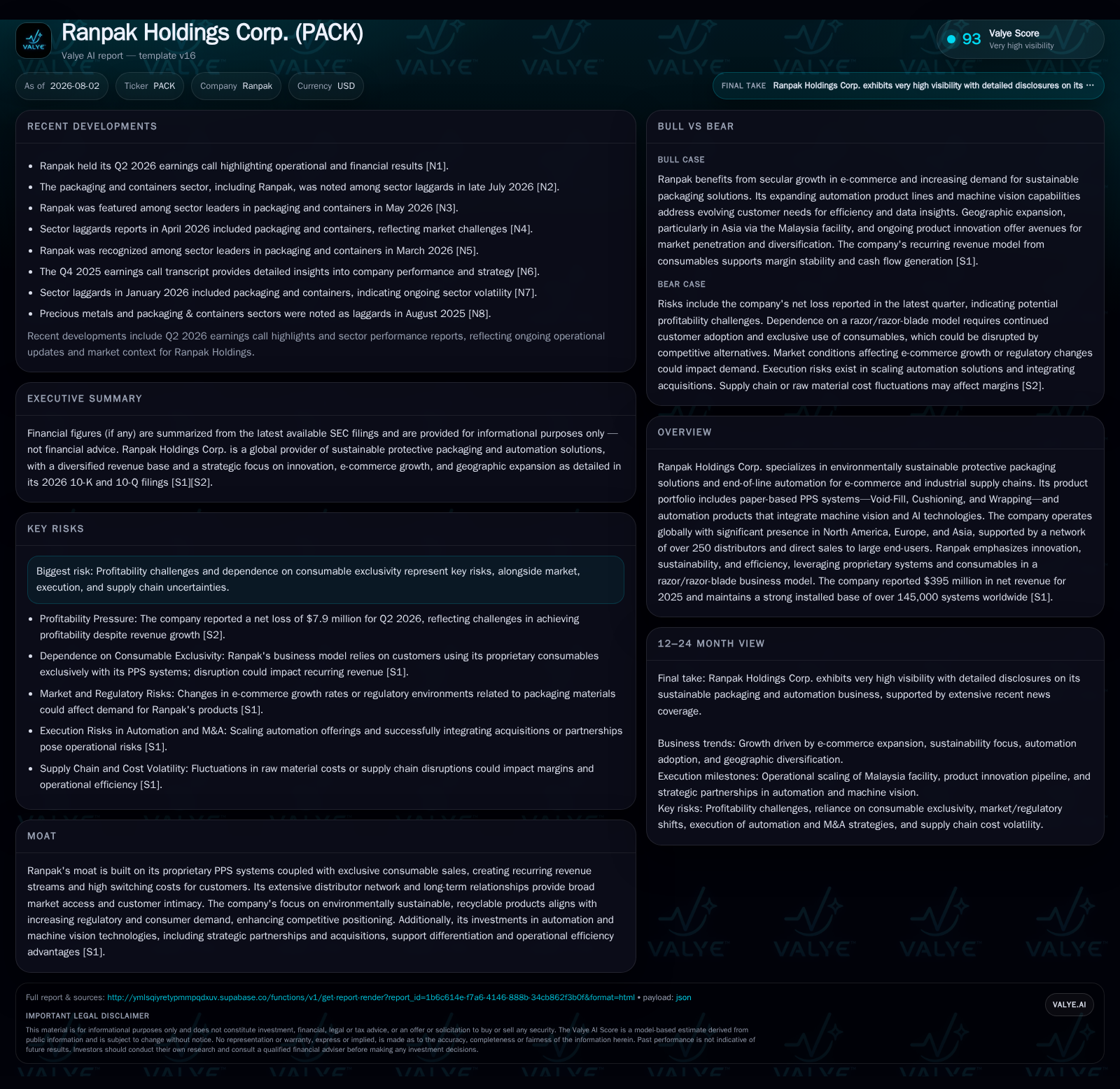
Ranpak Holdings Corp.'s latest quarterly report confirms steady recurring revenue from its exclusive consumable sales, reinforcing the durability of its razor/razor-blade business model. The company continues to grow its installed base and integration of automation and machine vision technology, which now accounts for an increased share of revenue. Strategic expansion into sustainable cold chain packaging aligns with evolving market demands. However, margin compression due to raw material inflation and supply risks present ongoing challenges. Ranpak’s strong distributor network and geographic diversification underpin its competitive positioning, while upcoming operational benchmarks in automation scale-up and market penetration will be critical to watch.
Q2 Results Spotlight Consumption Resilience Amid Cost Pressures
Ranpak Holdings Corp.’s 10-Q filing for the quarter ended June 30, 2026, reveals continued strength in its core consumable sales despite mounting input price inflation that has compressed margins. The company’s razor/razor-blade model—a hallmark of its business—relies heavily on proprietary paper packaging systems (Protective Packaging Solutions or PPS) sold or leased to distributors and end-users coupled with recurring sales of exclusive paper consumables necessary for system operation. In Q2, consumable volume remained resilient, underscoring sticky demand linked to the installed base exceeding 145,000 systems globally as of end-2025 [S2,S3,S1]. This installed base ensures recurring cash flows tied directly to customers’ packaging throughput.
Margin pressure reported in the quarter appears largely attributable to cost inflation in kraft paper and other raw materials rather than volume declines. Durable consumption volumes despite these headwinds illustrate the embedded nature of the systems within end-user operations—usage declines would risk operational disruptions such as machine jams if off-spec materials were substituted. Hence, the company retains pricing power over consumables while facing inflationary impacts on input costs [S2,S3]. Monitoring the trajectory of supply chain costs and corresponding pass-through pricing will be essential to gauge margin sustainability.
Sustaining Growth Through Exclusive Consumable Model and Installed Base Expansion
Ranpak’s business model is strongly differentiated by its proprietary PPS systems paired with a high-margin consumables franchise operating under a razor/razor-blade framework [S1]. This setup creates elevated switching costs: customers must use Ranpak’s exclusive paper consumables to avoid negative operating consequences like system jams or inefficiencies, effectively locking them into usage commitments that provide predictable recurring revenue streams.
The company's revenue structure reflects that approximately 80% stems from distributor sales worldwide who have exclusivity agreements not to promote competing paper-based solutions. Distributors play an essential role in servicing a highly fragmented protective packaging market by offering local presence and customization capacity—enabling Ranpak to reach diverse end users spanning small businesses to multinational corporations [S5]. Direct sales account for roughly 20% of revenue concentrated among larger end-users needing extensive engineering integration support for complex warehousing or fulfillment centers.
This broad installed base paired with disciplined renewal mechanisms via consumption thresholds underpins attractive payback periods per system and high returns on invested capital. The network effect inherent in their long-standing distributor relationships enhances customer intimacy and market coverage while maintaining lean internal sales investment [S1,S5]. The stable nature of this annuity-like revenue contrasts favorably against more commoditized packaging competitors.
Automation Gains: Machine Vision Driving Incremental Efficiency Solutions
A notable strategic shift is the progressive contribution from Ranpak's Automation and Machine Vision product lines which accounted for approximately 10% of net revenue in 2025 compared to 8% in the preceding year [S1,S28]. These solutions integrate advanced robotics and AI-driven machine vision technologies through internal development (e.g., R Squared Robotics) as well as strategic acquisitions like Pickle Robot Co., expanding the company's footprint in intelligent warehouse automation.
Customers deploying these automated packaging systems realize improvements in end-of-line speed, reduced labor intensity, and operational data insights that optimize throughput and reduce waste. This evolution moves Ranpak beyond being purely a provider of disposable packing materials toward becoming a supplier of integrated logistical efficiency platforms. Given rising labor costs globally and growing volume demands in e-commerce fulfillment centers, this technology infusion positions Ranpak competitively against warehouse automation integrators and specialized robotics providers who are increasingly active in this space.
Measuring success will require tracking new installations' adoption rates alongside contributing revenue growth within total top-line figures since automated systems are typically sold outright (not leased) but supported by ongoing maintenance contracts [S1,S28]. Expansion here reflects both product innovation progress and deeper account penetration potential for higher average revenue per installed solution
Strategic Moves in Sustainable Cold Chain Packaging Highlight New Markets
Ranpak is diversifying through emerging applications including environmentally sustainable cold chain packaging catering primarily to food & beverage logistics—a segment representing around 3% of net revenue as of 2025 but with substantial growth opportunity given consumer preferences shifting toward eco-friendly alternatives [S6]
The company has introduced fiber-based liners like the RecyCold® Climaliner Plus™—a fully recyclable paper-based alternative replacing traditional polystyrene foams—to maintain temperature control for up to 72 hours during transit. Complementary plant-based cool packs enhance this offering's appeal for perishable goods shipping aligned with tightening sustainability regulations targeting plastic reduction.
This product line extension leverages Ranpak’s expertise in fiber-based materials while responding to regulatory tailwinds accelerating demand for greener cold chain solutions globally. Capturing share amid expanding e-commerce grocery delivery markets provides incremental growth avenues beyond core protective packaging segments historically focused on parcel shipping or industrial customers [S6].
Heavy Reliance on Distributor Network Balances Scale with Customer Customization Needs
The company's distribution network comprises over 250 established distributors worldwide who contribute roughly four-fifths of net revenues via exclusive agreements prohibiting competing products; this emphasizes scale benefits alongside deep regional penetrations across North America, Europe, and Asia-Pacific regions [S5,S18]. These partners manage inventory locally, provide technical expertise for installation/configuration adjustments, and facilitate customer training—essential functions given variability across end-user sectors from e-commerce fulfillment centers to industrial manufacturing plants.
Conversely, direct sales address sophisticated clients requiring customized solutions integrating PPS equipment alongside automation technologies necessitating engineering services for optimal facility-specific deployment—accounting for about one-fifth of revenues. This hybrid selling strategy balances mass-market reach through distributors with tailored engagements that drive higher ticket offers per system installation.
Furthermore, collaboration with warehouse automation integrators extends penetration into complex logistics environments where Ranpak’s automated solutions fit within broader mechanization schemes enhancing overall acceptance rates among high-volume clients seeking turnkey operations efficiency [S5]
Risks Focus: Raw Material Volatility, Margin Compression, and Supply Chain Dependence
While Ranpak benefits from a durable recurring revenue base, multiple risk vectors could constrain profitability or growth trajectory [S1,S13]. Primary concerns include dependence on specialized kraft paper supplies sourced from a limited approved pool—a bottleneck heightening vulnerability to shortages or price spikes adversely impacting gross margins amid industry-wide inflationary pressure. Maintaining rigorous supplier qualification protocols helps mitigate risk but does not eliminate exposure.
Additionally, customer concentration risk warrants attention; significant portions of revenue derive from a handful of major e-commerce clients whose volume fluctuations can materially influence top-line trends. Changing consumption patterns or sourcing shifts among these large accounts could generate sudden demand shocks.
Technological obsolescence looms as automated packaging evolves rapidly; failure to innovate relative to competitors incorporating advanced machine vision or robotic capabilities might diminish differentiation advantages over time. Lastly, international operations expose Ranpak to currency volatility alongside geopolitical uncertainties affecting supply chains or tariff regimes that could increase operational complexity or costs [S1,S13].
What’s Next: Execution Milestones to Monitor in Automation Scale-Up and Geographic Penetration
Investors should monitor several near-term execution indicators validating growth narratives:
- Acceleration in installation rates and adoption levels of machine vision-enabled automated packaging platforms across existing global accounts.
- Expansion efforts within APAC markets leveraging the Malaysia conversion facility aiming to enhance supply responsiveness and cost efficiencies regionally where the company currently has limited penetration (<10% net revenues).
- Commercial progress metrics for sustainable cold chain packaging including pilot-to-commercial conversion rates among food/beverage logistics operators—the extent adoption scales beyond niche use cases signals broader market traction.
- Further distribution network enrichment via new partnerships or expanded exclusivity terms enhancing access within fragmented industries requiring specialized protective solutions.
- Tracking consumables usage volumes relative to installed systems helps infer system utilization changes that drive long-term recurring revenue sustainability [N1,S3,S6]
Financial Profile Discussion: Liquidity Holding Despite Heavy Debt Load Reflecting Ongoing Investment
At June-end 2026, Ranpak reported cash and equivalents totaling about $43 million against total debt nearing $403 million yielding a net debt position close to $360 million [F1]
Profitability remains challenged as evidenced by operating losses totaling $24.3 million at FY-end 2025 translating into persistent negative net income ($38.3 million), underscoring ongoing margin pressures exacerbated by input cost inflation alongside investment loads tied to commercialization efforts in automation technologies. Cash flow generation appears sufficient presently but will merit scrutiny should adverse volume shifts materialize or capital intensity rise further absent commensurate revenue growth gains.
In summary, Ranpak's financial posture supports an innovation-driven strategy though constrained profitability cushions warrant monitoring liquidity prudence amid heavier indebtedness levels vis-à-vis peer packaging firms typically exhibiting stronger margin profiles.
This analysis integrates recent quarterly developments with comprehensive annual disclosures providing insight into Ranpak Holdings’ evolving competitive stature rooted in exclusive consumable frameworks bolstered by advancing automation technologies amid dynamic sustainability-focused market opportunities. Key operating KPIs such as installed base size, consumable recurrent volumes, automation product share growth, plus channel reach underpin an intricate balance between scale advantages and execution-sensitive risks including raw material supply challenges and competitive innovation demands.
Disclaimer: This report is an analytical assessment based exclusively on public SEC filings (), news reports (), and structured company facts ([F1]). It is not investment advice nor does it reflect non-public information.

Comments