
Sirius XM's Q2 Struggles Highlight Licensing Costs and Competitive Pressures
Sirius XM’s latest quarter exposes escalating royalty costs and intensifying competitive challenges that constrain margin expansion and subscriber growth.
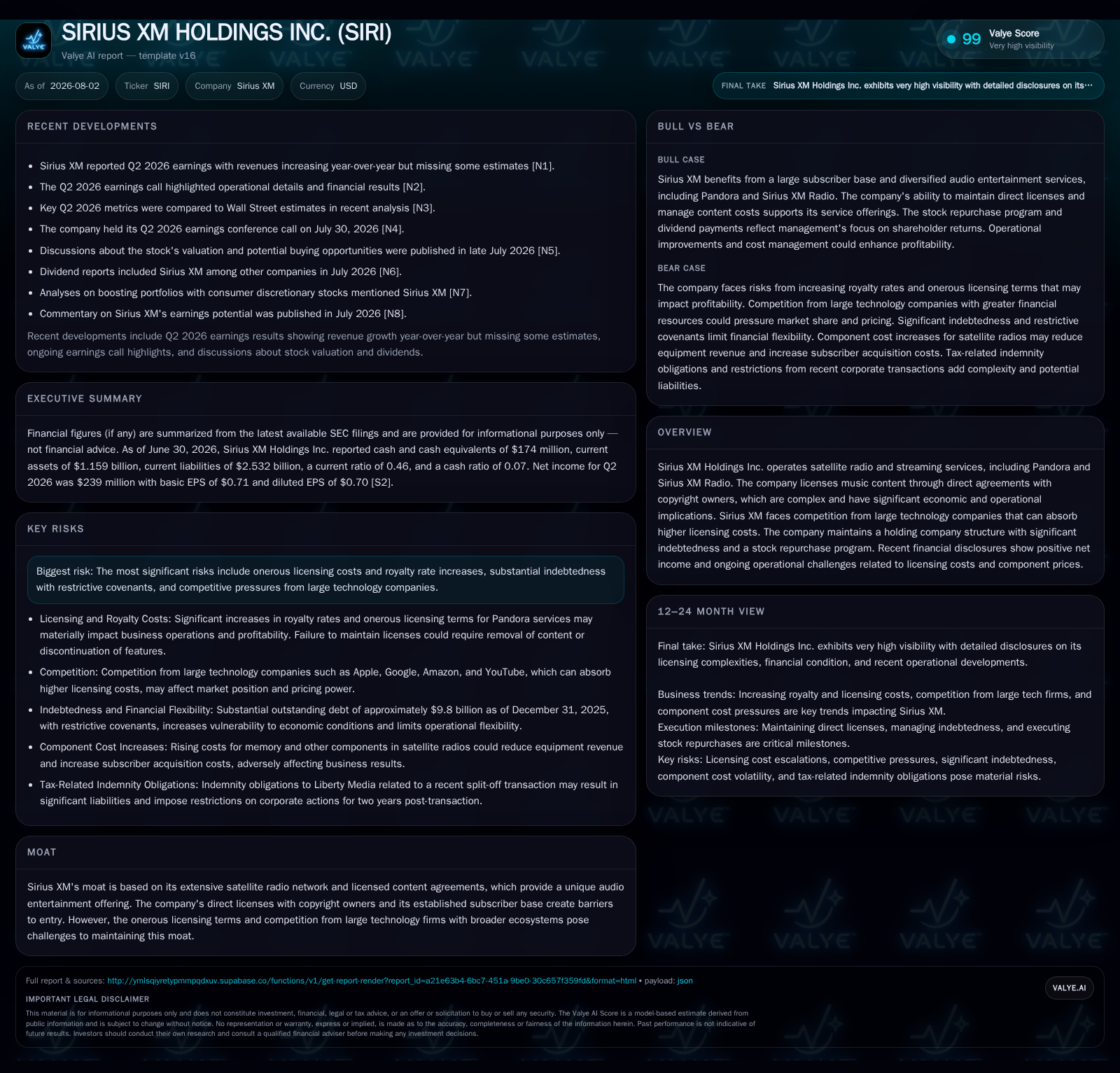
In its Q2 2026 filing, Sirius XM disclosed significant upward pressure on content licensing expenses that are compressing operating margins despite steady subscription revenue trends [S2]. Complex direct licensing agreements with onerous terms limit flexibility in cost management, particularly contrasted with tech giants whose broader ecosystems absorb such costs more easily [S1]. Subscriber growth appears constrained by competition from bundled audio offerings by Apple, Amazon, and Google, which strains Sirius XM’s ability to lower churn and increase average revenue per user (ARPU) [S2][N1]. Additionally, rising component costs for satellite radios are dampening equipment sales revenue and could elevate subscriber acquisition costs [S2]. The company continues managing a heavy debt load with a net debt position near $9.3 billion as of June 30, 2026, while pursuing share repurchases within the limits of restrictive covenants [F1][S2]. Key near-term risks include ongoing royalty audits, tight covenant headroom, and intensified external competition that together challenge sustainable growth [S1].
Q2 Earnings Unpack: Licensing Costs Escalate While Competitive Dynamics Intensify
this unfavorable cost environment underscores structural challenges fundamental to Sirius XM's business model.
Licensing Complexities Limit Margin Expansion Despite Subscription Revenue Strengths
The company’s Pandora streaming service licenses music via direct contracts with copyright owners. These agreements entail complex rights grants including broad licensor controls over interactive features like replays, skips, and offline play. Such provisions impose onerous economic terms on Sirius XM compared to more typical statutory license frameworks. Notably, these licenses contain most favored nation clauses which enforce parity or escalation clauses that lock Sirius XM into royalty rates aligned with or exceeding those negotiated by larger competitors in the streaming space [S1]. Since many tech giants — Apple, Amazon, Google — offer audio content as a supplementary feature within their expansive ecosystems, they effectively tolerate premium licensing costs better than Sirius XM can sustain profitably [S1]. Concurrently, ongoing auditing processes by entities such as SoundExchange exert additional risk exposure through disputed royalties potentially leading to retroactive payments plus interest or penalties [S1]. As a result, while subscription fees generate recurring revenue streams anchored in sizable subscriber bases, the inflexible licensing cost structure significantly curtails operating margin leverage.
Subscriber Dynamics in a Mature Market: Growth Constraints and Churn Management
Though Sirius XM maintains strong brand recognition through its satellite radio network and Pandora platform, subscriber growth contends with industry maturity effects and heightened competition. Operators face challenges expanding the paid base as alternative audio services offered by tech conglomerates bundle music alongside other value-added offerings at competitive price points or even free tiers supported by dominant advertising platforms. This ecosystem advantage reduces overall willingness-to-pay for standalone subscription audio services like Sirius XM’s core offerings [N1][S1]. Key KPIs such as average revenue per user (ARPU) and subscriber churn rate show subtle stress points reflective of this environment; retention requires increasingly targeted interventions balanced against rising subscriber acquisition costs whose inflation partly stems from higher equipment prices discussed below [S2][N1]. The limited pricing power imposed both by customer expectations and contractually mandated royalties restricts the company's ability to offset cost inflation via higher subscription pricing.
Cost Pressures in Equipment Sales Highlight Supply Chain and Pricing Risks
The company also reports ongoing adverse impacts on equipment revenue tied primarily to increased memory chip prices essential for the production of satellite radio modules embedded in vehicles or sold as separate devices. These supply cost escalations stem from global market imbalances amplified by AI-driven demand surges, geopolitical uncertainties affecting key manufacturing hubs, and potential tariff regimes affecting components sourcing [S2][S13]. Higher memory prices translate directly into increased unit costs which squeeze front-end margin profiles on hardware sales. In addition, elevated equipment prices can increase the effective subscriber acquisition cost since many customers require radio activation concurrent with hardware purchase or vehicle integration [S2]. Given equipment sales contribute a non-trivial portion to revenues outside recurring subscriptions or advertising revenue streams, margin pressure here further complicates overall profitability management.
Capital Structure Focus: Balancing High Indebtedness With Active Stock Repurchases
Financial disclosures show Sirius XM had approximately $9.45 billion in total debt and $174 million in cash and equivalents as of June 30, 2026, resulting in net debt near $9.28 billion, with a current ratio of 0.46 indicating limited near-term liquidity coverage [F1]. Management continues an aggressive stock repurchase program authorized at over $1 billion commenced in 2024; during Q2 2026 it repurchased nearly 230 thousand shares costing roughly $28.10 each utilizing a combination of operating cash flow and borrowing capacity while maintaining sufficient authorization availability totaling close to $996 million remaining for future buybacks [S2][F1].
Risks Related to Royalty Audits, Covenant Limitations, And Market Competition
Annual risk disclosures underscore that royalty audits present substantive contingent liabilities stemming from possible underpayment assessments or interpretative disagreements over license compliance [S1]. Such exposures create risk case volatility impacting financial statements unpredictably when settlements or adjudications occur. Furthermore, the company notes restrictive debt covenants may hamper additional borrowings needed for opportunistic maneuvers during market disruptions or technology platform investments necessary to sustain competitive positioning. Competitors’ bundling strategies—enabled by their extensive technology ecosystems—intensify pricing pressure while diluting consumer loyalty toward Sirius XM products. Loss or non-renewal of essential music licenses could force content removals undermining service appeal on Pandora Premium or satellite radio channels—a direct threat to revenue sustainability given content exclusives’ critical role [S1]. These aggregate risks frame an ongoing operational balancing act demanding careful negotiation acumen and robust compliance vigilance.
Near-Term Catalysts: Licensing Negotiations, Subscriber KPI Trends, And Cost Management Targets
Looking ahead into late 2026 and beyond, several catalysts warrant close attention for validating the trajectory outlined herein. Renewals or modifications to key direct licenses may alleviate or exacerbate existing royalty burdens depending on negotiation outcomes potentially influenced by market-competitive pressures or regulatory shifts impacting copyright frameworks [S2][N2]. Quarterly monitoring of ARPU fluctuations combined with subscriber churn adjustments will be critical metrics reflecting whether Sirius XM’s retention initiatives counterbalance competitive erosion effects effectively. Meanwhile, tracking semiconductor supply chain stability influencing memory costs can offer early signals regarding equipment sales margin recovery potential or further deterioration risks requiring adjustments in acquisition strategies [N3][S2]. Lastly, management commentary from upcoming earnings calls will provide qualitative guidance illuminating operational priorities around cost management targets versus strategic investments amid capital constraints.
Financial Profile Discussion
Disclaimer: This is research-only, informational analysis and not investment advice. It may include AI-generated interpretation and general industry context. Always verify important details using primary sources.

Comments