
Agios Pharmaceuticals Advances Rare Disease Portfolio Amid Regulatory Milestones and Pipeline Reshaping
Recent Q2 results show revenue growth driven by dual anemia therapies, offset by net losses and strategic pipeline adjustments including a new autoimmune license.
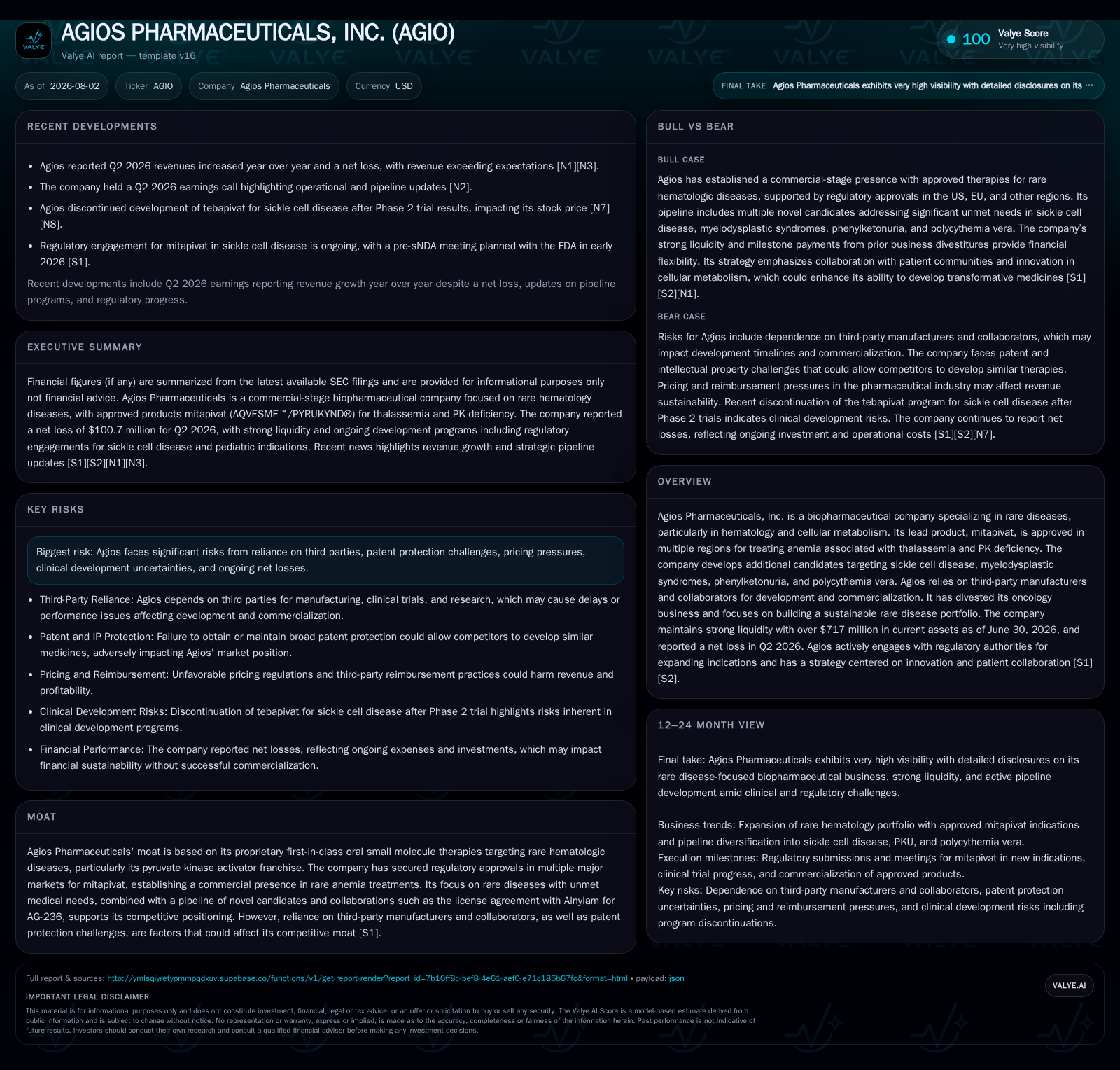
Agios Pharmaceuticals reported solid operational progress in Q2 2026, highlighted by revenue generation from its first-in-class mitapivat franchise—PYRUKYND® and AQVESME™—now approved in the U.S. for hemolytic anemias. The company is refocusing its pipeline after discontinuing the sickle cell disease program of tebapivat following Phase 2 trial results. Concurrently, Agios acquired worldwide rights to cevidoplenib for autoimmune indications, signaling a shift toward expanding beyond hematology. Strong cash reserves of approximately $1 billion provide a runway for ongoing R&D investment, though operating losses persist. The company’s reliance on third-party manufacturing, patent protection challenges, and regulatory hurdles remain key risks as it navigates commercialization in rare diseases with complex reimbursement environments.
Recent Operating Update
Agios Pharmaceuticals' Q2 2026 filing reveals tangible commercial progress following FDA approvals of mitapivat-based therapies [S2]. PYRUKYND® (mitapivat) gained U.S. approval in early 2022 for adults with pyruvate kinase deficiency (PKD), initiating product revenue recognition during the quarter ended June 30, 2026. Soon after, AQVESME™ received FDA clearance in December 2025 for anemia treatment in both non-transfusion-dependent and transfusion-dependent alpha- or beta-thalassemia patients in the U.S., with sales commencing post-approval. This dual-product commercialization represents a shift from prior developmental phase status to sustained revenue generation
Simultaneously, Agios discontinued its sickle cell disease (SCD) program involving tebapivat after Phase 2 trial outcomes did not meet efficacy benchmarks [N10][S2]. This strategic withdrawal refocuses capital towards higher-conviction pipeline assets. The termination triggered stock price pressure but aligns resources with the company's core competence areas
Adding to its therapeutic reach, Agios acquired worldwide rights to cevidoplenib from Oscotec in June 2026 to target immune thrombocytopenic purpura (ITP) and other autoimmune conditions outside South Korea where Oscotec retains co-development rights. The upfront payment was recorded as an asset acquisition involving $25 million recognized as in-process R&D during Q2. The deal includes contingent regulatory and sales milestones totaling up to $140 million plus tiered royalties thereafter [S4][S5]. This move diversifies Agios’ portfolio beyond hematology into autoimmunity.
Business Model
Agios operates as a biopharmaceutical entity specializing in rare diseases characterized by unmet medical needs amenable to targeted therapeutics. Its primary revenue stems from commercial sales of orally administered small molecules that activate pyruvate kinase enzymes—integral to cellular metabolism regulation in red blood cells—addressing hemolytic anemias such as PK deficiency and thalassemia.
Customers predominantly include specialty pharmacies and healthcare providers treating adult patients with these rare hematologic disorders. Revenue arises from product sales captured via direct supply chains post-FDA approval plus royalty income streams from out-licensed compounds acquired previously (e.g., oncology assets sold to Servier) [S1][S2]
Capital intensive R&D remains central to business model economics whereby external third parties conduct manufacturing for clinical supplies and commercial scale production while select clinical trials are outsourced to Contract Research Organizations (CROs). This reliance introduces operational risk but enables asset-light scalability essential for nimble deployment of scientific innovation across geographically diverse regulatory jurisdictions. Success hinges on efficient clinical trial progression, timely regulatory filings, and effective market access strategies given the orphan drug pricing environment.
Industry Structure and Competitive Position
Within biotechnology focused on rare diseases, Agios occupies a niche centering on hematologic metabolic disorders through novel enzyme activation mechanisms. Peers include Vertex Pharmaceuticals with cystic fibrosis therapies and BioMarin Pharmaceutical specializing in genetic disorders; these peers share similar challenges around patient identification, restricted patient populations, and reimbursement complexities.
Agios' competitive moat is underpinned by first-in-class oral small molecules offering differentiated therapeutic options for underserved anemic conditions that historically lacked targeted treatments. However, competitive pressures arise from emerging gene therapies or potentially disruptive biologics entering hematology niches.
Strategic collaborations—such as licensing agreements exemplified by Oscotec cevidoplenib acquisition—represent industry-standard risk-sharing tactics allowing access to novel modalities without front-loading full internal development costs [S1][S4]. These alliances also prepare Agios against patent cliff scenarios common within biotech innovation cycles.
Growth Drivers
Key growth enablers include:
- Expansion of approved indications: Regulatory approvals like AQVESME™ broaden commercial addressable markets beyond PKD into thalassemia subtypes.
- Pipeline advancements: Although tebapivat SCD program was terminated, other candidates targeting myelodysplastic syndromes (MDS), phenylketonuria (PKU), and polycythemia vera offer medium-term clinical milestones.
- Strategic licensing deals: The Oscotec agreement is both a diversification step and potential revenue stream contingent upon successful development path.
- Increased diagnosis rates: Heightened awareness of rare anemias fuels patient enrollment potential.
- Favorable reimbursement landscape: Securing health technology assessments supporting premium orphan drug pricing drives sustainable margins.
For biotech companies at Agios’ value chain stage—early commercialization coupled with heavy pipeline investment—the balance between advancing clinical programs simultaneously while executing commercial launches is crucial to ramping revenue trajectories alongside managing burn rate.
Risks / Watchpoints / Growth Constraints
Areas warranting vigilance include:
- Clinical development uncertainty: Rare disease trials carry enrollment challenges and elevated failure risk impacting timelines and capital consumption.
- Regulatory hurdles: Extensions into new indications require successful submissions; delays or rejections could postpone sales ramp-ups.
- Intellectual property exposure: Patent protection breadth on mitapivat compounds must withstand potential generic competition especially as market exclusivity periods evolve.
- Manufacturing dependency: Reliance on third-party partners may cause bottlenecks impacting drug supply or quality control.
- Pricing pressures: Reimbursement authorities globally scrutinize orphan drug pricing; shifts in policy could compress margins.
- Net loss continuation: Despite nascent revenue streams from commercial products, operating losses persist reflecting ongoing R&D investments required to mature pipeline [S1][S2]
What to Watch Next
Investors should monitor:
- Upcoming quarterly earnings releases detailing sales trajectory of PYRUKYND® and AQVESME™, including indication-specific uptake metrics.
- Clinical trial updates or regulatory submissions related to pipeline candidates particularly those addressing MDS or autoimmune applications via cevidoplenib.
- Milestone achievements tied to Oscotec licensing arrangement which may catalyze near-term valuation inflection points if met timely.
- Cash burn trends against liquidity runway given expectations of funding research until profitable scale achieved.
- Any shifts in competitive landscape involving emerging therapies targeting similar patient populations or modes of action.
Financial Profile Discussion
As of June 30, 2026, Agios reported strong liquidity with approximately $1 billion in combined cash, cash equivalents, and marketable securities providing ample runway beyond twelve months to fund operations despite persistent net losses [S2][F1]. Current assets totaled about $717 million versus current liabilities near $70 million yielding a robust current ratio exceeding 10x—a favorable short-term solvency indicator uncommon among biotech peers at similar developmental stages [F1].
The company continues expending heavily on research and development reflecting its commitment to sustaining innovation pipelines even while managing product launches. Net loss recorded over the first half of 2026 approximated $200 million consistent with historical operating deficits tied closely to R&D intensity [S2][S24]. Expense capitalization policies remain conservative aligning with typical industry accounting wherein most R&D costs flow through P&L impacting profitability metrics but represent essential long-term value creation investments.
Overall, Agios' financial status underpins capacity for clinical advancement and commercialization efforts though depends on multiple clinical/regulatory achievements for transition toward profitability akin to biotechnology peers focusing on rare disease niches.
This analysis synthesizes publicly available SEC filings through July 30, 2026 ([S1],[S2],[S3],[S4],[S5]) combined with recent market commentary ([N10],[N1]) adhering strictly to disclosed data without conjecture beyond supported evidence. It aims to provide rigorous industry context framing AGIO’s strategic position within the rare diseases-biotech value chain without investment research view.
Disclaimer: This is research-only, informational analysis and not investment advice. It may include AI-generated interpretation and general industry context. Always verify important details using primary sources.

Comments