
Reservoir Media's Emerging Recorded Music Segment Shapes Revenue Mix Amid Steady Publishing Growth
Q1 2026 results highlight recorded music as a growing but still nascent revenue contributor alongside steady music publishing streams.
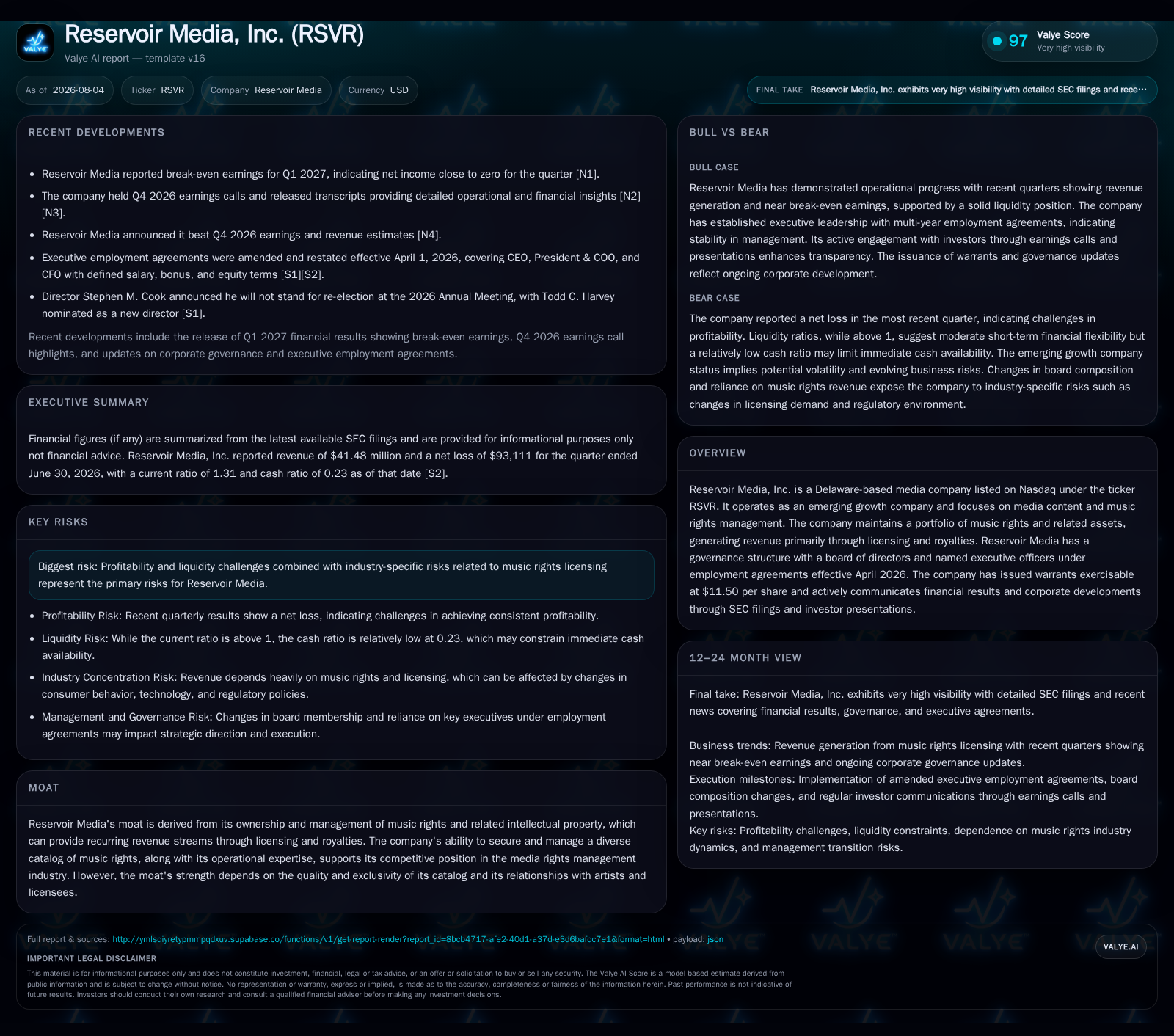
Reservoir Media's latest quarterly filing reveals increased revenue diversification driven by its emerging recorded music segment, which contributed materially for the first time alongside its core publishing business. The company’s business model leverages dual licensing streams from both music publishing and sound recording rights, with catalog acquisitions playing a strategic role in expanding recurring royalties. While publishing revenues remain stable, recorded music brings potential for higher operating leverage and margin expansion, though its commercial impact is still developing. Financially, Reservoir maintains adequate liquidity and compliance with credit covenants despite significant leverage from catalog financing.
Q1 Operational Update Illuminates Shift in Revenue Mix Toward Recorded Sound Assets
In its latest quarterly filing dated August 4, 2026, Reservoir Media reported distinct revenue contributions from its two main business segments: Music Publishing and Recorded Music. Publishing delivered $26.5 million in revenues over the three-month period ending June 30, 2026. More notably, the Recorded Music segment reported $14.1 million during the same timeframe—a first material contribution that represents about 35% of total segment revenues ($40.6 million) combining both segments [S2]. This pivot reflects Reservoir's strategic intent to broaden beyond traditional publishing into ownership and monetization of sound recording rights.
The Recorded Music operations cover two core activities: active marketing and licensing of frontline sound recordings from current artists under Reservoir’s control, and promotion plus licensing of acquired catalogs of previously recorded sound rights [S2]. While revenues from newly created frontline recordings remain immature commercially today, acquired catalogs already provide recurring licensing income streams. The emergence of this segment indicates an important inflection point that could enhance future cash flow stability through diversified royalty channels with potentially higher operating leverage relative to publishing.
Business Model Nuances: Dual-Leveraged Licenses from Publishing and Recorded Music Rights
Reservoir Media’s business model monetizes intellectual property assets via licensing royalties across distinct rights categories embedded in both publishing copyrights and sound recordings [S1,S2]. Licensing revenue streams encompass public performance rights collected from broadcasters and digital platforms; mechanical royalties derived from physical or downloaded reproductions; synchronization licenses allowing music use in film or advertisements; and neighboring rights associated with international usage of sound recordings
The company’s music publishing arm primarily manages song copyrights—encompassing songwriter relationships, licensing negotiations, and administrative royalty collections—providing steady performance-based income. Meanwhile, the growing recorded music segment strategically complements by controlling master sound recordings which command additional streams through distribution deals and digital streaming royalties with platforms such as Spotify or Apple Music.
The moat manifests through reservoir’s portfolio quality across both catalog types—high-profile songwriters or sought-after master recordings enhance bargaining power to secure synchronization deals or favorable licensing terms. Rights administration expertise further improves collection efficiency ensuring royalties are maximized and accurately reported to artists and stakeholders.
Competitive Dynamics Shaping Catalog Acquisition Strategies and Licensing Power
Within the broader music rights management industry context, competition centers heavily on acquiring high-value catalogs that offer reliable recurring revenues while maintaining exclusivity against peer bidders. Companies like Concord Music Publishing emphasize selective acquisitions enriched with proven hit songs; Kobalt Music Group differentiates itself via technology-enabled rights administration reducing leakage risk.
Reservoir operates similarly by balancing scale acquisition efforts with active catalog management to optimize monetization potential [S1]. However, catalog finance considerations impose constraints; acquiring premium assets typically requires leveraging debt facilities due to high upfront costs balanced against projected royalty cash flows [S2]. This dynamic necessitates discipline in portfolio curation to avoid dilution of returns or overextension on balance sheet leverage.
Licensing power derives not just from size but the ability to execute synchronization licenses—growing particularly valuable given rising demand for tailored music content in film and advertising globally—a competitive edge Reservoir is cultivating alongside expanded catalog breadth.
Growth Catalysts Underpinning Recurring Royalties and New Recorded Content Initiatives
Digital streaming platform proliferation serves as a structural growth driver affecting nearly all players in music rights management including Reservoir. As global consumer listening volumes expand across markets—from mature US/Europe to emerging Asia—the value of recorded sound rights rises commensurately due to subscription fees funneling into royalty pools.
Additionally, synchronization license demand continues robust growth fueled by increased content production in film, TV series, advertising campaigns, gaming platforms, and branded social media content creation [S2]. Reservoir’s investment in conjunction with artist relationships aims to capitalize on these expanding addressable markets by offering flexible rights packages anchored in its catalogs.
Further growth enablers include geographic diversification supported by office locations across North America, Europe, Middle East, South Asia critical for capturing regional usage patterns [S1]; plus operational enhancements via improved royalty tracking technology boosting collection rates while lowering administrative cost drag.
The company's senior credit facility includes covenants enforcing a fixed charge coverage ratio minimum (≥1.10:1) alongside a consolidated senior debt-to-library value cap (≤0.45:1) providing some protection yet necessitating diligent asset performance monitoring [S2]. Any downturn in licensing fees or delays in synchronization deals could pressure cash flows creating refinancing or liquidity risks.
Moreover legal/regulatory uncertainties inherent to copyright law enforcement worldwide pose ongoing operational hazards. Ensuring clarity over ownership rights amid industry litigations or disputes is critical lest adverse judgments impair revenue continuity or trigger costly settlements [S1]. Finally dependency on exclusive artist relationships and catalog quality means erosion or increased competition could weaken margins or renewal terms negatively impacting revenue durability.
What to Watch: Milestones Signaling Execution Success or Margin Expansion Potential
Key near-term indicators include sequential licensing revenue growth within the recorded segment reflecting successful monetization of newly acquired catalogs or signed artists under “Current Artist” initiatives described by management [S2]. Synchronization deal volume evidencing traction across media outlets will serve as an important signal validating market appetite for Reservoir’s expanding offering.
Operational KPIs such as improvements in royalty collection rates or reductions in catalog churn would underscore superior rights administration efficiency supporting margin enhancement efforts. Watch also for announcements regarding further catalog acquisitions which demonstrate ongoing commitment to scaling recurring income base.
Monitoring warrant exercise activity provides insight into capital structure evolution affecting potential dilution while signaling market confidence among stakeholders given existing exercise price set at $11.50 per share [S4]. Lastly compliance status against financial covenants under credit facilities will remain relevant to assess balance sheet flexibility for continued investment execution.
Financial Profile Discussion: Liquidity, Debt Covenants, and Capital Structure Supports Strategic Ambitions
Reservoir finished Q1 fiscal 2026 with a current ratio approximating 1.31 (current assets $77.3 million vs current liabilities $59.1 million), indicating reasonable short-term liquidity buffering operational needs [F1]. Total debt stands near $465 million predominately attributed to secured line-of-credit borrowings intended for catalog financing purposes.
The company adheres to its credit agreement covenants requiring maintenance of a fixed charge coverage ratio no less than 1.10:1 as well as a senior debt-to-library value ratio capped at 0.45:1 [S2], suggesting manageable leverage aligned with underlying asset valuations.
Warrants outstanding exercisable at $11.50 impose potential equity dilution risk dependent on stock price movements but concurrently represent an alternative capital source enabling funding flexibility for further content acquisition or general corporate purposes [S4].
In sum, Reservoir’s financial profile reflects typical characteristics of an emerging growth music rights management firm balancing asset-heavy investments with measured liquidity preservation aiming for organic profitability expansion driven by increasing licensed royalties from steadily diversifying sources.
Disclaimer: This is research-only, informational analysis and not investment advice. It may include AI-generated interpretation and general industry context. Always verify important details using primary sources.

Comments