
Ernexa Therapeutics Progresses ERNA-101 Clinical Plans While Addressing Nasdaq Compliance and Manufacturing Scale-Up
Ernexa advances synthetic iMSC therapies for ovarian cancer and autoimmune diseases, balancing IND filings, manufacturing risks, and financial pressures typical of early-stage biotech development.
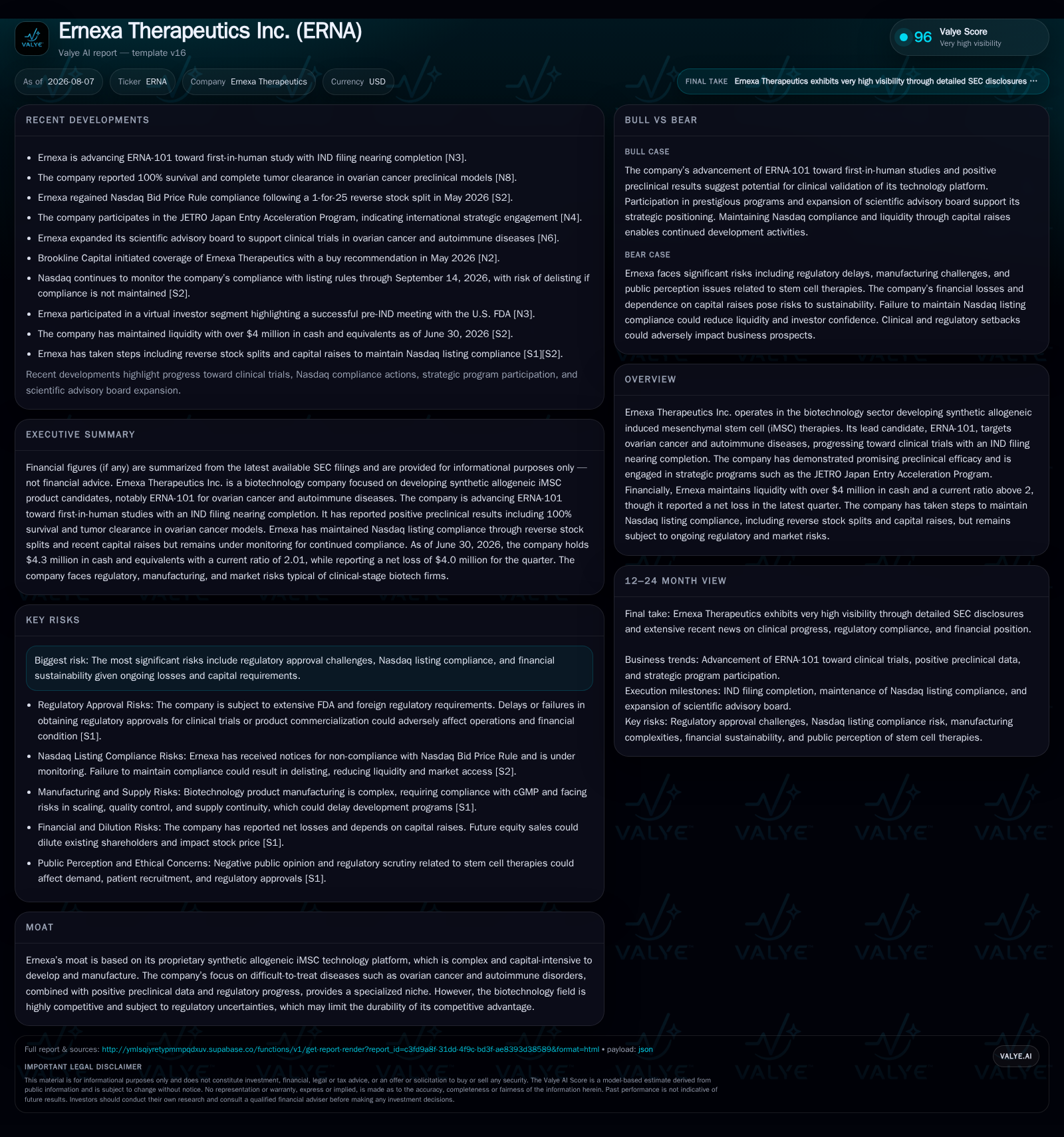
Ernexa Therapeutics Inc. is progressing its lead synthetic induced mesenchymal stem cell (iMSC) candidate ERNA-101 towards clinical trials, leveraging promising preclinical data and strategic acceleration programs. The company remains in the costly biotech early-development phase, relying on equity raises and maintaining Nasdaq listing compliance through reverse splits. Critical near-term drivers include completing Investigational New Drug (IND) filings and managing manufacturing scale-up risks inherent to synthetic cell therapies. Financially, Ernexa reports a cash cushion supporting ongoing research but faces continued net losses typical of preclinical biotechs.
Recent Operating Update
Ernexa Therapeutics’ latest Quarterly Report filed August 6, 2026 details continued advancement of its lead therapeutic candidate ERNA-101 developed via a synthetic allogeneic induced mesenchymal stem cell (iMSC) platform aimed at treating ovarian cancer and autoimmune diseases. The company has made material progress toward completing Investigational New Drug (IND) applications required before initiating human clinical trials — a critical inflection point signaling transition from preclinical R&D to clinical validation [S2]. In parallel, Ernexa has raised approximately $10.5 million via an equity offering combined with milestone-linked warrants in early 2026 to finance these costly development activities as well as general administrative costs [S1].
However, the firm continues to grapple with stringent Nasdaq listing requirements. After receiving notice in March 2026 of non-compliance with the Bid Price Rule due to depressed share prices and being ineligible for standard cure periods (following a prior reverse stock split), Ernexa effected a further 1-for-25 reverse stock split in May. This capital action promptly restored minimum bid price compliance by month-end but subjects Ernexa to monitoring through September 2026 by a Nasdaq panel tasked with ensuring sustained compliance — failure could lead to delisting without remediation opportunities [S2]. This episode encapsulates ongoing market risk pressures common among smaller biotech firms reliant on speculative investor sentiment.
Business Model Detail
Ernexa operates as a preclinical-stage biotechnology company primarily engaged in developing novel synthetic allogeneic iMSC therapies. These iMSCs are pluripotent stem-cell-derived mesenchymal cells engineered ex vivo to serve as off-the-shelf therapeutics differentiated from traditional autologous or donor primary cell treatments. The core value proposition lies in scalable manufacturing processes intended to produce standardized cell therapy products compatible across multiple patients without extensive immunosuppression — theoretically enabling broader accessibility in complex disease contexts like oncology and autoimmunity.
The company's revenue at this stage is nearly nonexistent from product sales given its early development lifecycle; anticipated future monetization drivers involve milestone payments linked to regulatory achievements or partnerships/license agreements post-clinical validation and eventual commercialization. Currently, revenue mechanics depend largely on periodic capital raises through equity or warrant issuances designed explicitly to fund iterative R&D phases including preclinical testing, cGMP process scale-up, IND submissions, and initial clinical trials [S1], [F1]. As such, operating losses are substantial reflecting high fixed costs in laboratory personnel, materials for biologics production, regulatory support functions, and associated administrative overhead.
Industry Structure and Competitive Position
Ernexa sits within the highly specialized subsegment of synthetic allogeneic cell therapy developers — a group characterized by technical complexity in both biological design and precision manufacturing. Peers include Fate Therapeutics and Mesoblast which are also innovating allogeneic cell platforms targeted at diverse immune-oncology indications but have generally progressed further clinically with established partnerships that underpin capital stability.
Unlike traditional small-molecule or monoclonal antibody drug developers reliant directly on large pharmaceutical commercial networks post-approval, companies like Ernexa must demonstrate robust proof-of-concept biomarker-driven efficacy while simultaneously solving manufacturing scale-up challenges for reproducible clinical-grade cellular products under cGMP conditions. The competitive moat is predicated on proprietary technology protecting optimized reprogramming methods for iMSCs alongside securing patent estates that cover manufacturing processes as well as therapeutic applications. However, the industry is marked by rapid innovation cycles and evolving regulatory landscapes that can erode technical advantages if competitors achieve faster clinical milestones or establish more attractive partnership syndicates.
Growth Drivers
The foremost growth catalyst remains successful completion of IND submissions enabling authorization to commence Phase 1 human clinical trials for ERNA-101 — progression here materially de-risks development programs by validating safety profiles, manufacturing comparability data, and preliminary efficacy signals crucial for later-phase investment decisions.
Advances in synthetic biology techniques underpinning iMSC engineering offer a technological edge that may allow Ernexa’s candidates to outpace conventional donor-derived therapies regarding potency consistency and immunomodulatory functionality. Positive preclinical study outcomes demonstrating efficacy in disease models bolster confidence among potential pharmaceutical collaborators or biotechnological licensors seeking innovative platforms in oncology/autoimmune therapy niches.
Furthermore, engagement with the JETRO Japan Entry Acceleration Program indicates strategic intent to expand geographic reach into Asia-Pacific markets where regulatory frameworks are increasingly supportive of regenerative medicine innovations — such international pathways could accelerate time-to-market relative to solely US/EU-centric approaches.
Finally, access to public capital markets as evidenced by recent financings provides runway extension necessary for sustained R&D investment until clinical milestones trigger valuation inflection points or partnering discussions.
Risks and Watchpoints
Regulatory uncertainty poses significant risk—FDA requirements may evolve during trial designs or enforce additional non-clinical/clinical study mandates delaying timelines while inflating costs [S1]. Manufacturing complexities specific to cellular therapies remain challenging: scale-up risks include batch variability affecting quality control measures plus vulnerabilities linked to raw material sourcing disruptions or contamination events that would impede trial progress.
Continued Nasdaq listing compliance presents operational risk affecting investor sentiment; failure here could dramatically reduce liquidity impairing capital raise prospects when funds are critically needed. Financings invariably introduce dilution concerns impacting shareholder value, especially given thin revenues absent clinical proof points so far.
Public perception challenges pertaining to stem cell-based interventions could dampen patient recruitment or provoke restrictive labeling regulations possibly limiting market potential even if approved. Intellectual property enforcement uncertainty compounds competitive pressure where patent litigation might divert resources away from core development activities.
Additionally, reimbursement dynamics remain unknown pending payer evaluations post-commercialization; new biologic pricing scrutiny could constrain achievable margins threatening profitability outlooks over long term horizons.
What to Watch Next
Key milestones include finalizing IND approvals for ERNA-101 followed by successful initiation of Phase 1 trials which will validate both safety endpoints and initial clinical feasibility driving subsequent funding rounds or partnership negotiations.
Monitoring quarterly cash burn rates against capital raise timing will signal financial runway adequacy given large upfront fixed costs typical at this stage of biotech evolution.
Observing compliance outcomes related to Nasdaq rules post-monitoring period ending September 2026 is essential for maintaining listing status critical for investor accessibility.
Further updates on manufacturing process refinements addressing cGMP scale-up efficiency will indicate practical readiness for broader clinical testing phases beyond IND enabling steps.
Strategic moves tapping licensing or collaboration opportunities leveraging pipeline assets—especially participation in international accelerator programs—may unlock alternative backlog avenues accelerating commercial viability timelines.
Financial Profile Discussion
As of June 30, 2026, Ernexa held about $4.3 million in cash and equivalents against current liabilities approximating $2.9 million resulting in a healthy current ratio slightly above 2.0 signifying short-term liquidity adequacy amidst ongoing spending commitments [F1]
Net losses remain substantial exceeding $9 million annually reflective of sustained R&D intensity inherent within preclinical biotech business models coupled with fixed operational costs including personnel salaries tied principally to discovery research efforts rather than revenue-generating operations [F1], [S2]. Revenue streams remain negligible given absence of commercial product sales; scale-up toward monetizable milestones depends principally on successful advancement into clinical stages or material partner licensing deals yet unseen.
Capital raises conducted via sale of shares combined with milestone-linked warrants provide necessary funding corridors bridging research phases though introduce dilution elements impacting existing shareholders whose effects require continuous monitoring against valuation progress gaps sustained until positive therapeutic data emerge reliably.
Ernexa Therapeutics exemplifies an early-stage biotech undertaking advanced synthetic allogeneic iMSC therapy development competing within a capital-intensive innovation ecosystem dominated by complex technical hurdles and regulatory navigation challenges. Progress toward IND filing completion for ERNA-101 coupled with strategic financing activities demonstrates operational momentum albeit within a framework constrained by listing rule compliance pressures and intrinsic developmental risks familiar across similar peer ventures. The company’s ability to translate promising preclinical science into tangible clinical evidence alongside sustaining sufficient liquidity will be determinative factors shaping its path forward within the competitive regenerative medicine landscape.
This analysis is based exclusively on publicly filed SEC documents as referenced herein and does not constitute investment advice or research views.
Disclaimer: This is research-only, informational analysis and not investment advice. It may include AI-generated interpretation and general industry context. Always verify important details using primary sources.

Comments