
Optimum Communications Struggles with Heavy Debt Amid Ongoing Restructuring Efforts
Q2 2026 results reveal operational losses and liquidity stresses despite capital raising and credit amendments.
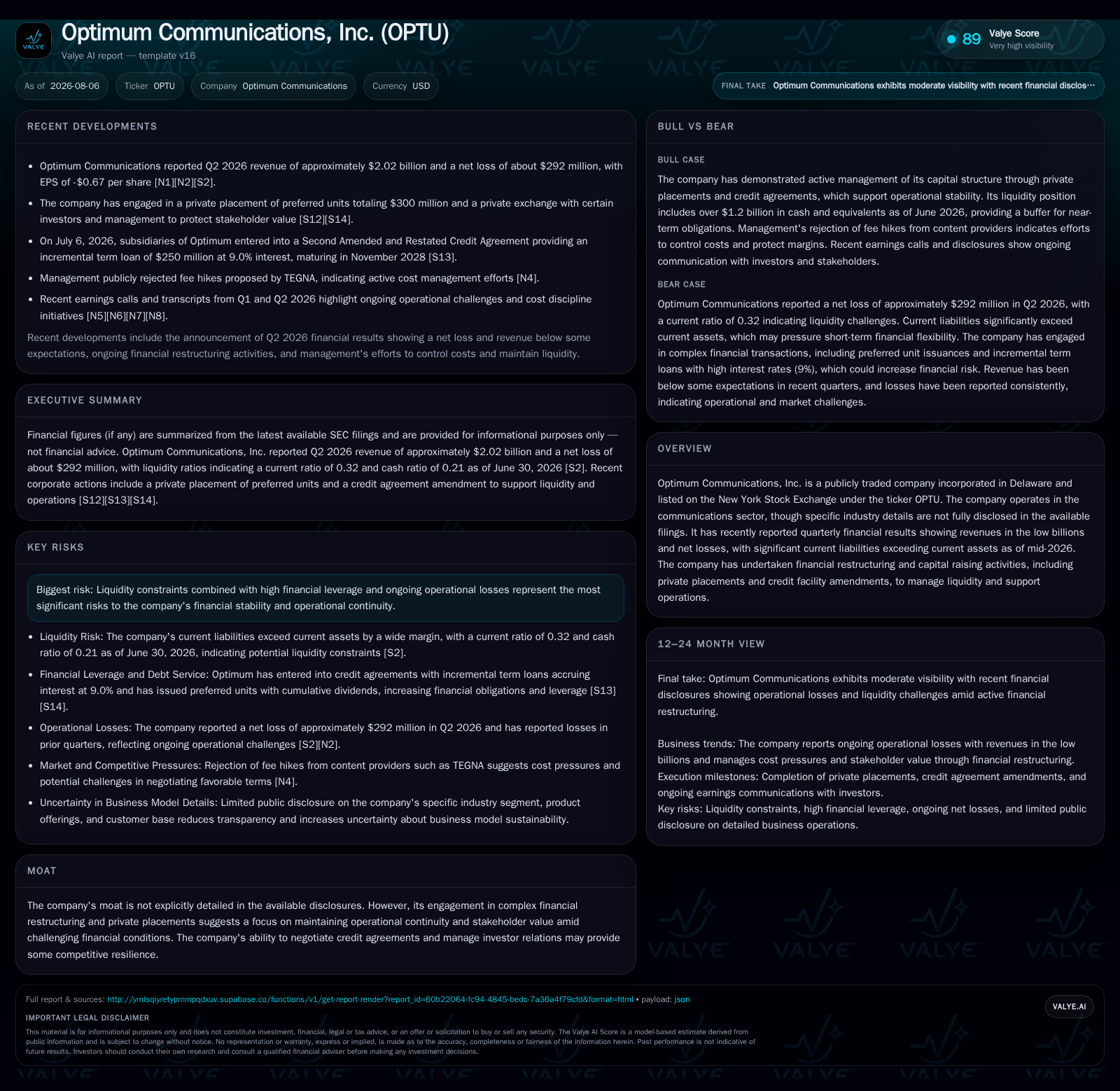
Optimum Communications, Inc. reported second-quarter 2026 financial results marked by continued net losses and a constrained liquidity profile underscored by a low current ratio of 0.32. The company is engaged in comprehensive financial restructuring, including a sizeable private placement of preferred units and amendments to its credit facilities aimed at shoring up operations. While operating in the capital-intensive communications sector with recurring subscription-based revenue, Optimum faces significant risks from its elevated leverage and ongoing operational challenges. The firm’s restructuring transactions are pivotal to managing creditor relations and sustaining service provision amid demanding debt servicing requirements.
Recent Operating Update
Optimum Communications’ Q2 2026 filing confirms ongoing operational challenges with net losses continuing despite efforts to stabilize the business. The quarter ended June 30 showed revenue shortfalls relative to estimates alongside continued negative operating income, consistent with recent trend patterns noted in earlier quarterly disclosures [S2], [N1], [N2]. These results highlight that the company is still struggling to achieve profitable scale or margin improvement in a sector known for intense competition and capital demands.
The liquidity snapshot as of mid-2026 reveals a precarious situation: current assets totaled approximately $1.94 billion while current liabilities were $6.07 billion—producing a constrained current ratio of only about 0.32 [F1]. This indicates significant near-term obligations far exceeding readily available liquid resources. The mismatch underlines the urgency behind Optimum’s financing maneuvers.
Business Model
Operating primarily as a communications service provider, Optimum delivers broadband and related voice/data solutions to both residential customers and enterprise segments. Revenue typically derives from monthly subscription fees supplemented by usage charges, with long-term contracts stabilizing cash flow streams when customer churn is controlled—a vital KPI for sustainability.
However, the company faces margin compression attributable largely to substantial capital expenditures required to maintain and upgrade network infrastructure—a norm in the telecom industry—and elevated interest expenses driven by its heavy debt burden. Operating margins continue negative territory [S1], reflecting these structural cost pressures alongside competitive pricing forces in broadband markets.
Industry Structure and Competitive Position
The communications services sector is characterized by high fixed costs, dense regulation, and evolving technology demands such as fiber optic deployment and wireless spectrum investments (including 5G). Large integrated players like AT&T, Verizon Communications, Comcast Corporation, and T-Mobile US benefit from diversified revenue pools spanning wireless, broadband, pay TV, and enterprise solutions; their scale enables more favorable capital access.
Optimum operates at a comparatively smaller scale with visibility into revenue around several billion dollars annually but carries disproportionately higher financial leverage relative to peer benchmarks. Its dependence on network maintenance spending amid weak operating income constrains financial flexibility versus these peers who enjoy better EBITDA margins and free cash flow coverage of interest costs.
Customer acquisition cost (CAC), average revenue per user (ARPU), churn rate, contract renewal rates, network uptime/reliability metrics remain critical KPIs; however, Optimum’s filings do not disclose detailed trends on these indicators. Still, sustaining subscriber base traction while controlling churn would be necessary to bend profitability upward.
Growth Drivers
Macro trends favoring Optimum include strong consumer demand for high-speed internet driven by streaming video growth, telecommuting expansion post-pandemic era norms, increasing IoT adoption requiring robust connectivity, and shifts towards enterprise digital transformation fostering increased data service requirements.
Additionally, service bundling strategies—combining internet access with voice or video services—can elevate customer lifetime value if executed effectively. Infrastructure investment toward enhanced fiber rollouts or wireless upgrades could drive future ARPU gains if capacity permits.
Yet such initiatives require significant upfront capital spend at a time when Optimum is under financial restructuring stress—a delicate balance between investing for growth versus conserving cash.
Risks / Watchpoints / Growth Constraints
The pivotal risk factor inhabiting all analysis layers is the company's elevated debt profile—total liabilities nearing $26.55 billion as of June 2026—with net debt after cash approximating $25.25 billion [F1]. This leverage level exacerbates refinancing risk amid volatile credit markets or shifts in interest rates.
Moreover, the ongoing operational losses amplify cash burn rates restricting internal funding capacity for growth or innovation initiatives essential in this sector.
Potential non-consensual restructuring events involving CSC Holdings’ funded debt raise concerns about corporate structure complexity; consequential tax liabilities may exceed $4 billion jointly across entities should deconsolidation occur [S20]. Such contingencies threaten shareholder value preservation efforts.
Competitive pressures on pricing from national providers combined with regulatory compliance demands add further headwinds potentially suppressing margin recoveries.
What to Watch Next
Key milestones include monitoring the effectiveness of recently completed financial transactions such as:
- The $300 million private placement of Series A preferred units through Unsub Topco intended to bolster capital reserves while offering dividends at high rates subject to compounding clauses [S21],
- Amendments yielding incremental term loans totaling $250 million executed July 2026 providing some alleviation of near-term liquidity bottlenecks [S26],
- Progress toward any consensual CSC Holdings debt restructuring minimizing tax liabilities,
- Operational metrics like subscriber trends or ARPU shifts announced externally or within subsequent filings,
- Potential public exchange offers or tender offer uptake signaling shareholder confidence or dilution effects.
Watching management commentary on customer retention strategies and capex prioritization will be equally important for interpreting trajectory toward stabilization or recovery.
Financial Profile Discussion
At June 30, 2026, Optimum held approximately $1.3 billion in cash equivalents against total debt exceeding $26.5 billion—resulting in very tight net liquidity capacity to service obligations given high current liabilities at over $6 billion compared with just under $2 billion in current assets (current ratio 0.32) [F1]. This stark imbalance reflects ongoing funding strain despite active credit facility amendments designed for incremental term loans at elevated fixed rates (9%) maturing November 2028 without amortization [S26].
These incremental financings reflect attempts by management to enhance operational runway but come at heightened interest costs limiting free cash flow conversion potential critical in capital-intensive telecom businesses where asset maintenance spending runs high.
The private placement of preferred units delivering immediate cash infusion supports short-term stability but introduces cumulative dividend obligations tied up to 15% per annum compounding if not paid in cash—an expensive form of financing reflective of underlying risk perceptions by institutional investors [S21]
Disclaimer: This analysis synthesizes publicly filed data through August 2026 without proprietary forecasts or investment advice. It aims solely to provide an informed perspective on Optimum Communications’ operational dynamics within its industry context based on disclosed evidence.
Disclaimer: This is research-only, informational analysis and not investment advice. It may include AI-generated interpretation and general industry context. Always verify important details using primary sources.

Comments