
Pacific Biosciences’ Strategic Shift Focuses on HiFi Long-Read Sequencing and Commercial Challenges
PacBio’s latest quarter exposes ongoing revenue pressure despite tightening losses, underscoring the strategic pivot to proprietary long-read technology amid commercialization hurdles.
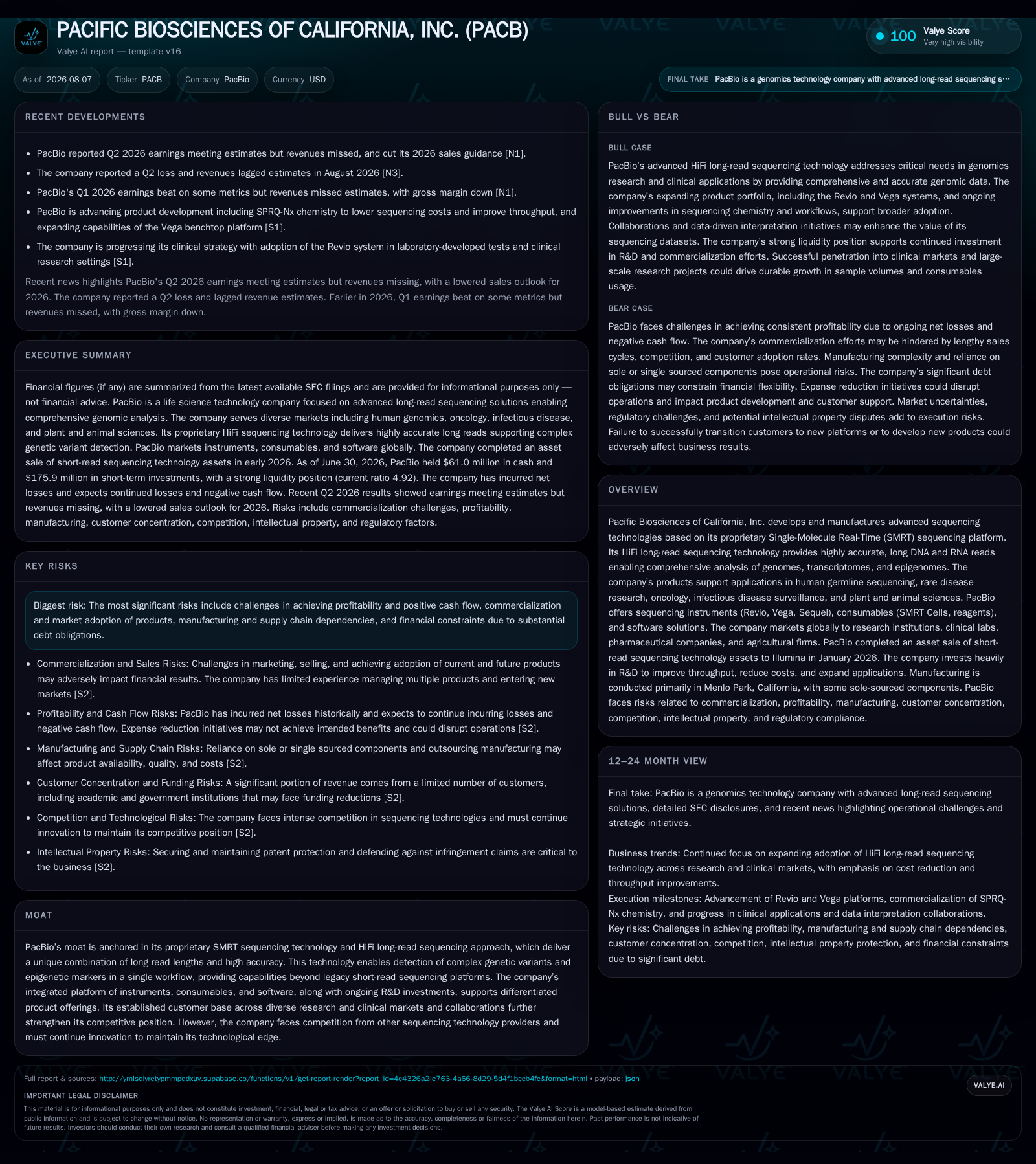
Pacific Biosciences reported second-quarter results showing narrowed operating losses but missed revenue estimates, leading to a tempered full-year sales outlook [S2],[N2],[N3]. The company has sharpened its focus on its HiFi long-read SMRT sequencing platform following its January 2026 divestiture of short-read technology assets to Illumina, narrowing product breadth but strengthening technology moat [S1],[S13]. Recurring revenue from consumables such as SMRT Cells remains critical for margin expansion, although demand adoption challenges and supply chain dependencies pose risks [S2],[S12]. PacBio faces stiff competition from dominant short-read players and alternative long-read technology providers, necessitating ongoing R&D investment to maintain differentiation [S1],[S13]. Financially, the company holds approximately $61 million in cash with a strong current ratio but remains burdened by substantial debt obligations and restrictive covenants [F1],[S4].
Q2 Operational Snapshot Reveals Revenue Pressures Despite Narrowed Losses
Refined Business Model Centered on HiFi Long-Read SMRT Platform Drives Product Strategy
After the significant early-2026 divestiture of its short-read DNA sequencing assets to Illumina—a dominant incumbent in that segment—PacBio’s strategy crystallizes around its Single-Molecule Real-Time (SMRT) sequencing technology emphasizing HiFi long-read accuracy [S1]. This transition trims product breadth but doubles down on differentiated offerings: the Revio system that runs four SMRT Cells simultaneously for higher throughput, complemented by the Vega and Sequel systems with single SMRT Cell capacity each [S1]. The integrated platform includes proprietary consumables (SMRT Cells and reagents) and bioinformatics software enabling precise base calling, genome assembly, transcriptome analysis, and epigenomic detection. This suite targets research institutions, clinical labs, pharmaceutical firms, and agricultural biotechnology companies globally. The recurring consumable sales model anchored to instrument installed bases is critical since instruments represent sizable capital equipment investments with extended sales cycles [S13].
Competitive Dynamics: Battling Illumina’s Short-Read Strength While Facing Long-Read Rivals
Illumina remains a formidable force post-asset acquisition in dominating short-read sequencing market segments. PacBio no longer competes in this domain directly but must defend its position as a leader in accurate long-read sequencing essential for complex variant detection inaccessible to short reads [S1]. Oxford Nanopore Technologies is another key competitor offering an alternative long-read technology based on nanopore sensing rather than SMRT biochemistry. PacBio's moat derives from the unique combination of length and high fidelity of HiFi reads—advantageous for clinical applications requiring ultra-accurate variant calls. Nonetheless, pricing power varies: customers appreciative of accuracy may tolerate premium pricing but elongated sales cycles typical of capital-intensive genomics tools impose pressure on rapid scaling [S1].
Critical Growth Levers: Consumable Demand, R&D Intensity and Market Adoption
The sustainability of PacBio’s growth hinges on increasing installed instrument counts which drive up recurring consumable volume consumption measured chiefly through SMRT Cell usage—a key proxy for platform adoption. Alongside this metric, R&D expenditure maintained at substantial percentages of revenue underscores PacBio’s commitment to enhance read accuracy and throughput features that differentiate it from competitors and facilitate entry into lucrative clinical diagnostics markets such as rare diseases and oncology [S1],[S2]. Read accuracy improvements are pivotal given stringent regulatory requirements for diagnostic-grade sequencing. The company's innovation pipeline includes simplifying workflows, reducing per-genome costs through increased throughput per run (e.g., Revio’s quad-cell capability), and integrating advanced bioinformatics solutions—elements vital for deepening market penetration beyond early adopters into mainstream genomics research.
Navigating Key Risks: Manufacturing Dependencies, Profitability Challenges, Concentrated Customer Base
Despite technological strengths, PacBio faces notable risks which could impair business trajectories. Outsourcing certain manufacturing components introduces supply chain risk exacerbated by sole-source dependencies [S1],[S12]. The capital equipment nature imposes inherently lengthy sales cycles delaying revenue recognition stability; combined with a concentrated customer base predominantly comprising academic institutions subject to variable federal funding cycles adds revenue volatility risks [S11],[S19]. Challenges translating innovation into consistent profitability compound financial constraints driven by significant outstanding convertible notes obligations totaling roughly $640 million principal outstanding at recent reporting dates plus unknown subsequent paydowns or refinancing activity [F1],[S7]. Intellectual property litigation also remains salient given ongoing patent disputes which can divert resources or constrain product offerings if unresolved favorably [S10],[S12].
What Investors Should Watch Next: Sales Trajectory, Product Pipeline Milestones, Cash Flow Signals
Key near-term indicators signaling trajectory turnaround include quarterly sequential increases in new instrument purchases since they underpin sustainable consumable revenues with higher gross margins. Progress against planned launches or upgrades enhancing throughput or cost-efficiency would evidence tangible returns on large R&D investments and bolster competitive positioning [S2],[S3]. Monitoring improvements in cash flow from operations beyond expense reductions will demonstrate operating leverage potential amid heavy debt service obligations. Additionally, shortening sales cycle duration reflecting quicker customer adoption can validate evolving go-to-market effectiveness.
Financial Profile Discussion: Balance Sheet Health Amid Capital Intensity
At June 30, 2026, Pacific Biosciences held approximately $61 million in cash and equivalents complemented by current assets of $338.6 million against current liabilities near $68.8 million yielding a robust current ratio near 4.92—a strong near-term liquidity indicator supporting operational runway despite challenging cash flow profiles [F1]
This analysis synthesizes Pacific Biosciences’ latest quarterly disclosures and historical context emphasizing the complex interplay between proprietary sequencing technology leadership centered on HiFi long-read capabilities versus persistent commercialization headwinds characterized by extended sales cycles and financial leverage constraints. Stakeholders should prioritize commercial execution improvements reflected through instrument placement acceleration and consumable volume gains while monitoring ongoing innovation outcomes sustaining competitive differentiation within the rapidly evolving genomics industry landscape.
Disclaimer: This report is intended solely for informational purposes reflecting public regulatory filings and company announcements without providing investment advice or research views.
Disclaimer: This is research-only, informational analysis and not investment advice. It may include AI-generated interpretation and general industry context. Always verify important details using primary sources.

Comments