
Alps Group Advances Personalized Cancer Care While Expanding Commercial Healthcare Services
Alps Group demonstrates robust revenue growth driven by its integrated biotechnology and healthcare platform, with ongoing challenges in profitability and liquidity management.
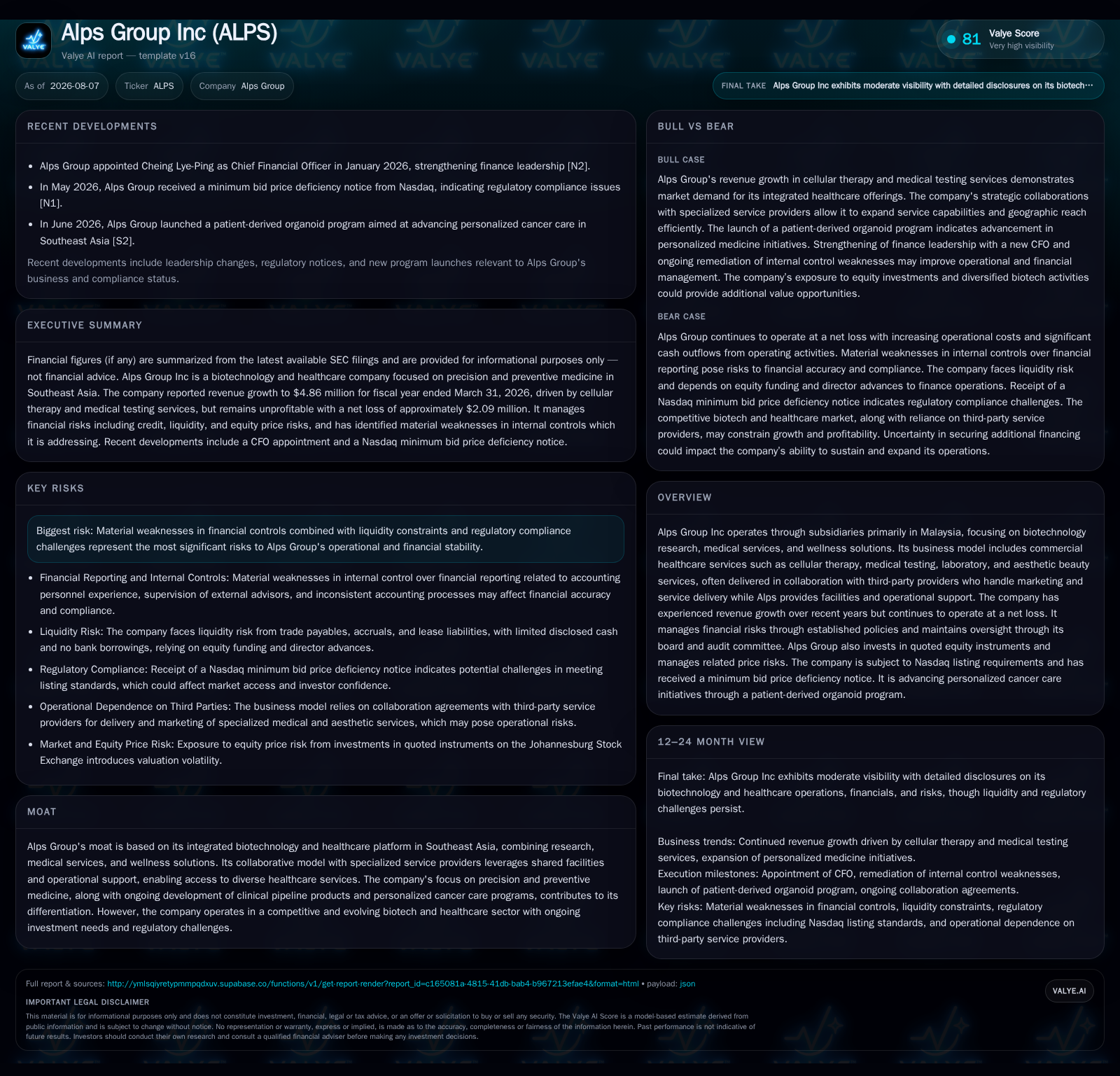
Alps Group Inc reported a 44% year-over-year revenue increase to $4.86 million for fiscal 2026, fueled by strong expansion in cellular therapy sales and medical testing, laboratory, and aesthetic services in Southeast Asia. The company launched a patient-derived organoid program advancing personalized cancer care and achieved Whole Genome Sequencing accreditation, signaling clinical capability enhancement. Despite improving gross profit, the growing contribution of lower-margin aesthetic services has compressed overall gross margin to 32.1%, with net losses narrowing but continuing amid elevated operating costs and investment in pipeline development. Alps balances its commercial operations with early-stage biotechnology research, while liquidity constraints and material weaknesses in financial controls represent ongoing risks.
Recent Operating Update
Alps Group Inc's latest quarterly filings refresh the near-term operating narrative with two critical developments: the launch of a patient-derived organoid program targeted at enhancing personalized cancer care across Southeast Asia [S2] and accreditation of whole genome sequencing capabilities under MS ISO 15189:2022 through its subsidiary MyGenome Sdn. Bhd. [S3]. These events mark tangible progress toward building clinical differentiation within precision medicine—a focal point aligning with the company's strategic vision of integrating biotechnology research with commercial healthcare delivery.
Revenue momentum remains robust for fiscal year ended March 31, 2026 (FY2026), rising approximately 44% year-over-year to $4.86 million from $3.37 million in FY2025 [S1][S15]. This growth is principally driven by cellular therapy sales which expanded 51% to nearly $883k [S15], complemented by a 20% increase in revenue from medical testing, laboratory services, and aesthetic beauty offerings totaling $3.15 million or roughly 65% of total revenue [S1][S15]. Notably, sales of medicine and healthcare products surged materially to $731k from just over $10k the prior year as the company broadened its product portfolio adjacent to aesthetic services [S15].
Business Model Analysis
Alps Group operates an integrated bench-to-bedside platform that combines revenue-generating commercial healthcare operations with an early-stage biotechnology pipeline focused on precision and preventive medicine principles [S1]. Its subsidiaries provide cellular therapies alongside diagnostic laboratory testing and aesthetic wellness services largely within Malaysia and regional ASEAN markets.
A key characteristic is Alps' collaborative operating model where third-party providers manage marketing and direct service delivery while Alps supplies physical facilities and operational support infrastructure—a setup common among regional biotech-healthcare integrators aiming to optimize capital efficiency via profit-sharing agreements embedded within cost structures [S1][S15]. This structure enables access to specialized treatment modalities such as cellular therapies without requiring full vertical integration upfront but also contributes to observable gross margin variability linked to shifting service mixes.
Gross profit rose steadily from $598k in FY2024 to over $1.55 million in FY2026; however, gross margin compressed from 38.6% in FY2025 to approximately 32.1% in FY2026 mainly due to the increased proportion of lower-margin aesthetic services subject to profit-sharing recorded within cost of sales and expansion into medicine product sales which carry higher direct costs [S1][S15][S18]. This dynamic signals Alps’ commercial revenue base broadening but also underlines margin pressure characteristic of multi-service biotech-healthcare operators balancing higher-margin clinical pipeline investments with near-term service revenues.
Research and development expenditures dropped sharply from $277k in FY2024 to just $61k in FY2026 as the company discontinued its COVID-19 mRNA vaccine candidate program during the year and concentrated resources on priority pipeline projects [S1][S17]. R&D spend reductions reflect disciplined capital allocation amid cash constraints but pose tradeoffs on potential medium-term innovation output.
Industry Structure and Competitive Position
Alps Group competes within the intersection of biotechnology research firms developing novel therapeutic modalities (notably personalized oncology) and clinical healthcare providers offering diagnostics, cellular therapies, aesthetic medical services, and wellness solutions in emerging Southeast Asian markets. This dual role demands navigating distinct competitive dimensions: regulatory compliance rigor for clinical operations versus innovation cadence imperative for biotech pipeline advancement.
Peer categories encompass specialized molecular diagnostics companies focusing on genomic sequencing (e.g., similar accredited laboratories), cellular therapy developers advancing innovative biologics pipelines, medical aesthetics operators leveraging patient retention models through bundled wellness packages, and integrators managing outsourced service delivery models while retaining asset-light operational control.
The company’s operational emphasis on Malaysian/Asean markets positions it advantageously given increasing demand for precision medicine frameworks yet subjects it to intense regional competition from both local clinics scaling aesthetic portfolios and multinational biotech firms advancing oncology therapeutics.
Growth Drivers
Key avenues for future value creation stem from leveraging clinical accreditations like the newly secured whole genome sequencing certification to strengthen diagnostic credibility critical for personalized treatment protocols [S3]. The launch of patient-derived organoid initiatives represents a technology-driven growth vector enabling ex vivo tumor modeling that may improve therapeutic selection accuracy—a potential differentiator supporting personalized cancer care programs tailored to Southeast Asian genetic profiles [S2].
Simultaneously, sustained momentum in core commercial healthcare lines—particularly cellular therapy sales expanding at over 50% annual pace—and growing medicine product offerings are poised by management intent to stabilize revenue streams during pipeline maturation phases [S15][S18]. Planned expansion into post-treatment survivorship care using existing clinic networks reflects emerging industry trends emphasizing comprehensive continuum-of-care programs addressing chronic condition monitoring post-primary intervention—a significant untapped market opportunity although currently nascent within Alps' roadmap [S1].
Additionally, increasing patient volumes spurred by rising awareness of preventive medicine interventions across ASEAN economics favor incremental utilization growth within laboratory testing and wellness segments consonant with regional healthcare infrastructure development patterns.
Risks and Watchpoints
Material risks include ongoing net losses reflecting delayed profitability typical among early-stage biotech-healthcare platform operators prioritizing R&D alongside commercial scale-up efforts [S10]. Compressed gross margins related to profit-sharing expense structures necessitate close monitoring as shifts towards more labor or capital-intensive service lines could further constrain profitability.
Dependence on third-party partners for marketing/delivery introduces operational integration risks that may affect customer experience consistency or referral retention if not well coordinated.
Finally, biotechnology pipeline success inherently faces scientific uncertainty around clinical trial progression timelines, approval risk hurdles, or commercialization viability; any setbacks could affect long-term value realization.
What To Watch Next
Upcoming milestones include early results or validation data emanating from the organoid program targeting localized applications of personalized oncology—monitoring efficacy signals here would gauge the practical advancement of Alps’ promise beyond infrastructure buildout [S2].
Tracking patient volume trends across high-growth commercial units such as cellular therapy sales will be critical KPIs reflecting underlying market demand strength against competitive pressure [S15]
Development progress updates regarding prioritized R&D candidates—specifically whether new projects offset discontinued programs—and evidence of progressing regulatory filings will serve as forward indicators influencing investment horizon risk assessments.
Financially, observing cash flow statements for operational cash burn trajectories together with asset liquidation execution will clarify mid-term liquidity sustainability absent additional external financing rounds noted as intentions but not guaranteed [S12]
Lastly, advancing accreditation scope beyond whole genome sequencing could signal broader laboratory service validations critical for scaling molecular diagnostics penetration especially amidst regional competitors working toward similar certifications.
Financial Profile Discussion
Alps continues operating at a net loss stage consistent with companies transitioning from pure research entities into combined commercial biotech-healthcare platforms [S1][S10]. Operating cash outflows increased commensurately given these structural cost bases augmented by one-off transactional professional fees.
Liquidity management relies principally on equity funding complemented by advances from directors; absence of traditional bank financing mitigates interest-rate risks though highlights persistent capital reliance on equity markets or strategic partnerships yet to be fully realized externally [S12][S16]. Working capital improvement plans hinge on timely monetization of strategic investments plus flexible creditor negotiations underscoring fragile balance-sheet dynamics typical for emerging biotech-healthcare providers amid ongoing investment phases.
Disclaimer: This analysis is based solely on publicly available information filed with securities regulators as cited ([F1],, ) as of mid-2026. It does not constitute investment advice or research views but aims to provide an informed industry-focused perspective grounded in verified data.
Disclaimer: This is research-only, informational analysis and not investment advice. It may include AI-generated interpretation and general industry context. Always verify important details using primary sources.

Comments