
XPEL’s Vertical Integration Bet: Assessing the Margin and Risk Implications of In-House Manufacturing
XPEL's August 2026 quarter marks a strategic shift to direct production of paint protection films, introducing new operational risks and margin opportunities amid global expansion.
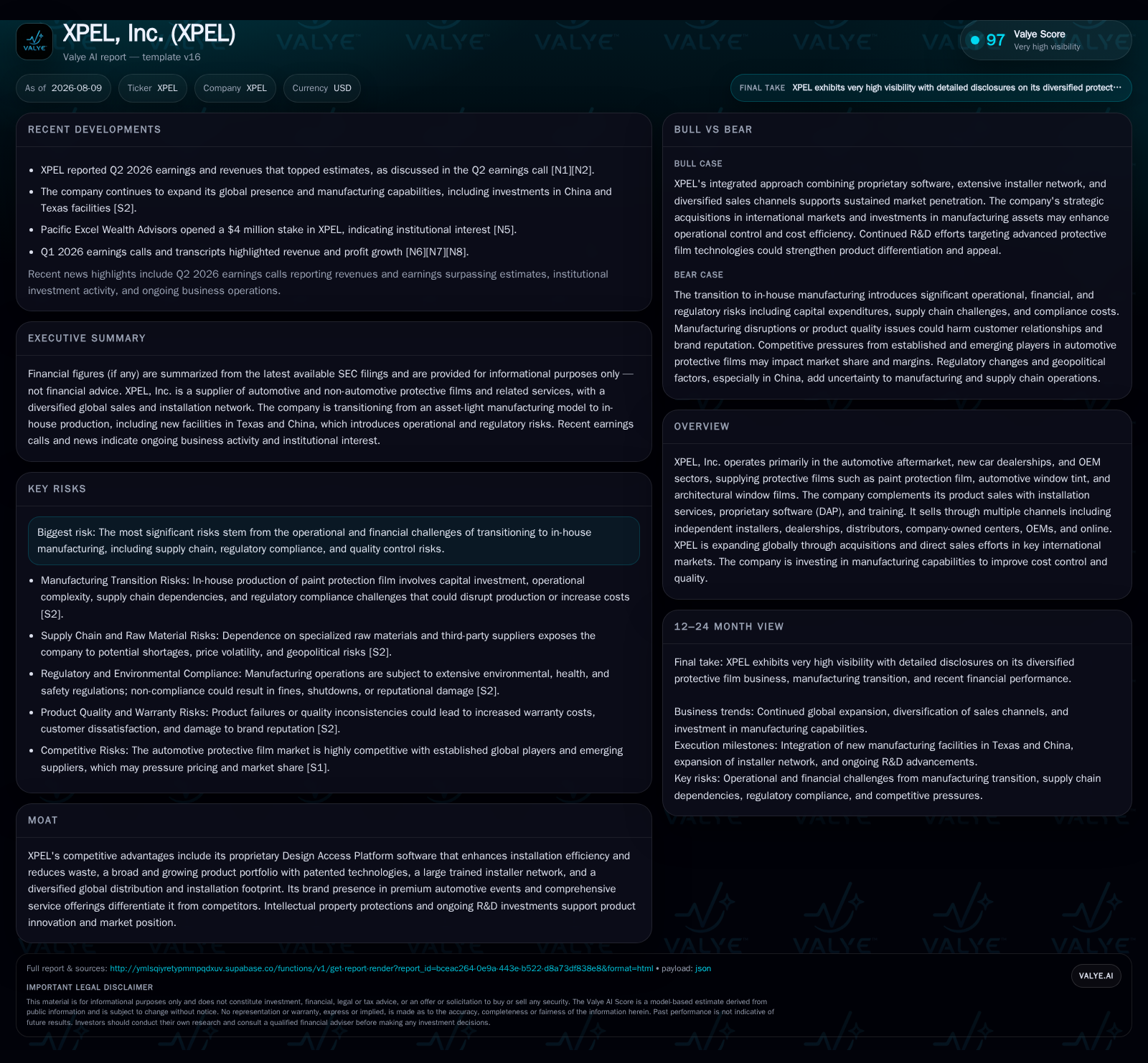
In its latest quarterly filing, XPEL disclosed advancing vertical integration with the acquisition of manufacturing assets in China and Texas, transitioning from a contract manufacturing model to in-house production of paint protection film (PPF). This move aims to improve gross margins by reducing third-party costs and enhancing quality control but introduces significant capital expenditures, supply chain responsibilities, and regulatory compliance challenges. The company's proprietary Design Access Platform (DAP) software continues to solidify installer loyalty through recurring licensing fees and training services. Diverse revenue channels—including independent installers, dealerships, OEMs, distributors, and company-owned centers—support steady growth and geographic diversification. Key near-term metrics to watch include production ramp in new facilities, margin evolution, and software subscription growth.
Vertical Integration Reconfigures Cost Structure and Operational Risk
XPEL’s latest quarterly disclosure highlights a fundamental shift from an asset-light manufacturing model towards direct ownership of production capabilities [S2][S3]. The company acquired a majority stake in a Chinese paint protection film facility and purchased multiple adjoining properties near its San Antonio headquarters for developing domestic manufacturing capacity
This strategic pivot is designed to improve gross margins by eliminating intermediary costs inherent in contract manufacturing. However, it significantly increases fixed costs due to capital investments in specialized coating, lamination, curing, cutting equipment, raw material inventories, and personnel required for PPF production [S2]. Managing raw material sourcing—particularly adhesives and chemical compounds critical for multilayer polyurethane films—now involves direct supplier relationships subject to geopolitical tensions and logistics risks
Environmental health and safety regulations impose strict compliance requirements across U.S. federal/state jurisdictions as well as China’s regulatory framework. These include permits for chemical handling, emissions control, workplace safety protocols, waste management procedures, and facility operations. Failure to comply could result in fines or forced production shutdowns that would impair XPEL’s ability to fulfill customer demand promptly [S2][S14]
Given the capital-intensive nature of chemical film manufacturing, achieving high capacity utilization is essential to spread fixed costs over volume [S2]. Early gross margin trends in upcoming quarters will reveal whether vertical integration yields expected cost efficiencies or if execution challenges such as quality control issues dampen profitability
Proprietary Software Platform Enhances Installer Efficiency and Loyalty
Central to XPEL’s competitive differentiation is its Design Access Platform (DAP), a proprietary SAAS solution providing access to an extensive database with over 90,000 vehicle-specific patterns for precise cutting of paint protection films and window tints [S1][S4]. This system enhances installer productivity by reducing installation time and material waste—a significant cost driver.
DAP generates steady recurring subscription revenues less exposed to commoditization pressures than product sales alone [S1][N1]. Complemented by comprehensive training programs delivered through company-owned centers and certified dealer networks worldwide—currently supporting over 640 trained technicians—this ecosystem creates high switching costs for independent installers reliant on proprietary patterns and certification credentials tied to XPEL’s brand reputation
This integrated software-plus-training model distinguishes XPEL from niche competitors lacking broad proprietary pattern libraries or extensive installer support infrastructure.
Multi-Channel Distribution Supports Diversified Revenue Streams
XPEL operates across multiple sales channels including independent aftermarket installers (approximately 51% of revenue), new car dealerships, OEMs, distributors (notably in India, Thailand, Japan, China), company-owned installation centers (34 globally), and online retailing of accessory products [S1][S12]. This diversified approach mitigates concentration risk while capturing incremental demand from distinct customer bases.
Independent installers benefit from full-service solutions combining proprietary films with DAP access, training services, marketing support, and lead generation through XPEL’s dealer locator platforms—reinforcing dealer loyalty. New car dealerships either outsource installations via aftermarket partners or develop internal teams supported by XPEL training. OEM relationships involve direct product sales augmented by pre-delivery inspection installations conducted onsite or nearby under contract terms.
International expansion is underscored by recent acquisitions of distributors across Asia-Pacific markets coupled with local manufacturing investments in China—reflecting a strategic move toward localized control over supply chains and go-to-market execution beyond North America [S1][S2].
Growing Service Revenues Reflect Enhanced Value Capture
Installation labor revenues now represent roughly 18% of consolidated sales—a growing share indicative of successful service-led growth tied directly to the size and expertise of XPEL’s trained installer network [S1][N1]. These service revenues provide operating leverage relative to competitors focused primarily on product sales without integrated installation support.
Maintaining high installation quality through continuous training is crucial to warranty adherence and customer retention across both enthusiast-driven aftermarket segments and dealership service departments incorporating PPF as standard upsell offerings.
Risks: Supply Chain Volatility and Regulatory Compliance Challenges
Despite potential margin benefits from vertical integration, XPEL faces increased exposure to supply chain disruptions involving specialty adhesives susceptible to global shortages or price fluctuations exacerbated by geopolitical factors [S2]
Manufacturing scale-up phases are inherently risky due to possible quality control variability impacting yield rates—a factor that could delay order fulfillment timelines threatening brand reputation built over years.
Regulatory compliance requires sustained capital investment maintaining ISO certifications while managing exposure to fines or shutdowns associated with complex chemical processes intrinsic to PPF manufacture [S14]. These operational risks elevate execution complexity compared with previous contract manufacturer reliance.
What Investors Should Monitor Going Forward
Key performance indicators include quarterly gross margin trajectories reflecting progress offsetting upfront capital expenses relative to legacy outsourcing models.
Production ramp metrics at the Chinese joint venture plant alongside San Antonio facilities will provide tangible evidence of scalable manufacturing economics.
Growth in DAP subscription fees offers insight into recurring SaaS revenue momentum driven by expanding installer network engagement measurable via certification counts or active dealer participation rates.
Competitors lacking vertically integrated production or proprietary software ecosystems may struggle sustaining similar margin profiles amid pricing pressures; thus XPEL’s ability to harmonize these elements determines its competitive durability.
Financial Profile Discussion: Strong Liquidity Supports Capital Investment Phase
At June 30, 2026 quarter-end, XPEL reported cash & equivalents totaling approximately $40.7 million against minimal debt levels—historically around $0.46 million—and maintained a strong current ratio above 2.6 indicating healthy liquidity coverage supporting ongoing capital expenditures for facility development [F1]
This financial position provides balance sheet flexibility critical during this phase of elevated fixed costs associated with vertical integration initiatives without placing undue stress on credit facilities.
While increased operating leverage introduces earnings volatility risk if production volumes lag targets, prudent liquidity management mitigates refinancing concerns during this transition period.
Disclaimer: This analysis synthesizes information from XPEL's SEC filings through August 2026 combined with recent earnings call disclosures without speculative forecasts or investment advice. Readers should consider inherent execution risks related to manufacturing scale-up alongside evolving market dynamics.
Disclaimer: This is research-only, informational analysis and not investment advice. It may include AI-generated interpretation and general industry context. Always verify important details using primary sources.

Comments